Posted on 04/01/2026 9:47:18 PM PDT by SeekAndFind
After announcing a 2029 target for migration to post-quantum cryptography (PQC), Google issues a new warning that a quantum system could attack a Bitcoin (BTC) transaction in about nine minutes.
The tech giant warned it won't happen today but it's a possibility one should be prepared for sooner than later.
Though the most powerful supercomputers active today will take thousands of years to decrypt cryptography, the cryptocurrency community fears quantum computers will be able to crack cryptocurrencies like Bitcoin within minutes or even seconds.
While the computers active today use binary electrical signals or bits to represent ones or zeros, quantum computers use quantum bits (qubits), which are subatomic particles.
Optimized qubits can simultaneously represent combinations of both ones and zeros. More qubits mean large-scale computing power for problem-solving.
It was in the 1990s that the Massachusetts Institute of Technology (MIT) mathematician Peter Shor developed the first well-known quantum algorithm to crack encryption. Over decades, quantum computing has seen enormous progress.
The paper found that it could take fewer than 500,000 qubits—far less than millions of qubits cited earlier—to crack the cryptography used by cryptocurrencies like Bitcoin or Ethereum (ETH).
"This is an approximately 20-fold reduction in the number of physical qubits required to solve ECDLP-256."
Here is how grave Google estimated the threat to be.
Instead of going after old wallets, a quantum hacker could target real-time Bitcoin transactions. When a Bitcoin transaction is made, the public key is revealed for a brief period. A powerful and fast quantum computer can use the public key to arrive at the private key and steal the money.
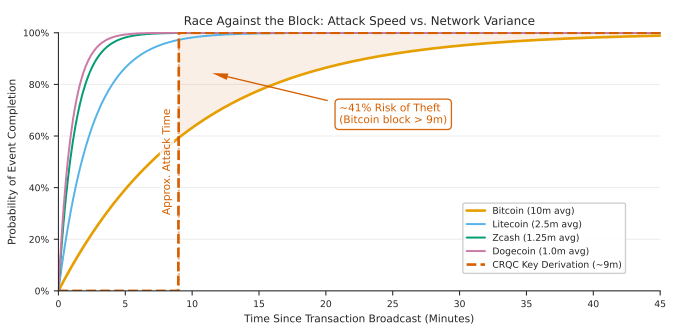
Such a quantum computer could be prepared to launch the attack in advance by making necessary calculations and then crack a Bitcoin transaction in about nine minutes, the paper warned.
It takes approximately 10 minutes for a Bitcoin transaction to confirm; the probability of success is slightly less than 41%, the paper estimated.
In fact, around 6.9 million Bitcoin are already vulnerable, including around 1.7 million coins from the Satoshi era, the paper highlighted.
Though the Taproot upgrade in 2021 claimed to make Bitcoin private and efficient, it exposed public keys by default. That choice could expand the number of vulnerable Bitcoin wallets, the paper concluded.
Cryptocurrencies like Ether take far less time than Bitcoin to confirm transactions, so they are less vulnerable to such attacks, it concluded.
Google used the zero-knowledge proof method to conduct the research so that the methodologies used to crack cryptography aren't used by bad actors.
The tech giant said it has been working since 2016 to migrate to PQC and urged all vulnerable cryptocurrency communities to join the migration without delay.
Chris Tam, president of the quantum technology company BTQ Technologies, told TheStreet Roundtable that the estimates for quantum computing breaking cryptography have only lowered over the years. The Google whitepaper also mentions a 20-fold reduction in the number of physical qubits required to solve ECDLP-256, he reminded.
We are seeing rapid progress in the field and this won't be the last breakthrough for a while, he added.
Though a transition to post-quantum (PQ) algorithms can save cryptocurrencies from future quantum threats, it's not going to be easy, Tam underlined.
Crypto networks, decentralized by definition, don't update with the "flip of a switch" and networkwide backward compatible upgrades require months, if not years, to be properly implemented, he warned.
"Networks can and should put plans in place to address not only the risk, but the entire migration effort that will be required."
Decentralized networks have a path to follow: discourses, proposals, and testnets. If the social consensus is slow to adopt or fails, even forks are in the cards, he predicted.
Tam gave the example of Bitcoin Quantum, a quantum-safe fork of Bitcoin that BTQ Technologies is testing with quantum-safe features.
TheStreet Roundtable asked Tam whether the market estimates for PQ crypto are incentive-driven as large amounts of funds pour into research. He disagreed.
Experts aren't hyping PQ crypto, Tam underlined but added, "Anyways, the thing with crypto is that there will always be perverse incentives."
But the threat is real and the crypto industry needs to be prepared.
"If we look at this scientifically, there's no doubt that quantum threatens the entire industry and progress is moving faster than ever."
Bitcoin was trading at $68,073.72 at press time.
Do they flood a target computer with millions of random pass words per second - until one works?
What do I not understand about this process?
As if anyone gives a rat about a bitcoin.
When quantum can break ‘unbreakable’ crypto, national security is consigned to history.
Not sure 9 minutes but in my opinion: Yes quantum computing will wreck Bitcoin and pretty much all cryptocurrencies.
For those interested: The short version is cryptocurrencies at some level are all based on public key cryptography, which is based on the difficulty of factoring large composite numbers (this is a simplification). Classic computers cannot crack that problem in any reasonable period of time. Technically it's called an NP complete problem. Quantum computing will be able to do so soon if they cannot already. Crack that problem and cryptocurrencies go poof overnight.
Also has sever implications for data security, although progress has been made on creating quantum immune security. Problem with cryptocurrencies is the underlying tech is "baked in." Security can be updated.
Rollback blockchains? How? They’re distributed all over the place. Good luck with that.
Actually yes it does. A lot of the garbage people call quantum computing isn’t. But real quantum computing does exist and it’s advancing at a terrifying rate.
“release quantum-resistant algorithms”
I’ve seen some of these alleged ones. Anything running on a classic computer simply cannot be quantum-resistant. Only quantum computing can be used to implement truly quantum-resistant algorithms, and true quantum computing mostly only exists in advance labs. Us little people cannot buy real quantum computing. Simulations and fluff? Sure. That’s the junk people get fooled into thinking is quantum computing. Also why some people (one Freeper above is an example) think quantum computing isn’t real. But it is. Access to the real deal though? It’s rare and not possible for normal people, businesses, etc.
Disclaimer: Opinions posted on Free Republic are those of the individual posters and do not necessarily represent the opinion of Free Republic or its management. All materials posted herein are protected by copyright law and the exemption for fair use of copyrighted works.