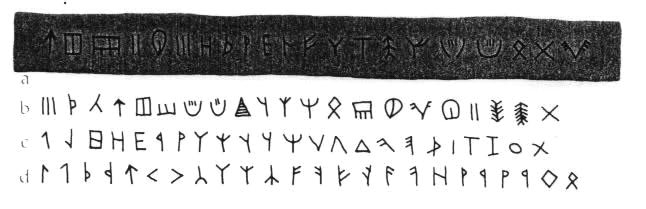
In her Plato Prehistorian: 10,000 to 5,000 B.C. Myth, Religion, Archaeology, Mary Settegast reproduces a table (above) which shows four runic character sets; a is Upper Palaeolithic (found among the cave paintings), b is Indus Valley script, c is Greek (western branch), and d is the Scandinavian runic alphabet.The Ancient Wisdom: Origin of Writing [this kinda poor scan is one *I* did 20 or so years ago, and my online version of it died with tinypic; but of course, I feel famous. Even the caption was what I'd typed in, btw. Dunno who "ancient wisdom" is, maybe a FReeper? :^)]
(The graphic is one I scanned in the late 1990s at what was higher res back then, and it's floated around the internet and wound up on that website. Non-secure, so you'll have to visit the link to see it.)
2 posted on
03/11/2026 10:30:37 AM PDT by
SunkenCiv
(TDS -- it's not just for DNC shills anymore -- oh, wait, yeah it is.)
11 posted on
03/11/2026 7:44:34 PM PDT by
SunkenCiv
(TDS -- it's not just for DNC shills anymore -- oh, wait, yeah it is.)
Upper Paleolithic writing recovered from Magdalenian cave sites (top) compared to characters in three early written languages: (b) Indus valley signs, (c) Greek and (d) Runic. Settegast (p. 28) after Forbes and Crowder, 1979.~ p 28

12 posted on
03/11/2026 8:09:24 PM PDT by
SunkenCiv
(TDS -- it's not just for DNC shills anymore -- oh, wait, yeah it is.)
FreeRepublic.com is powered by software copyright 2000-2008 John Robinson
