
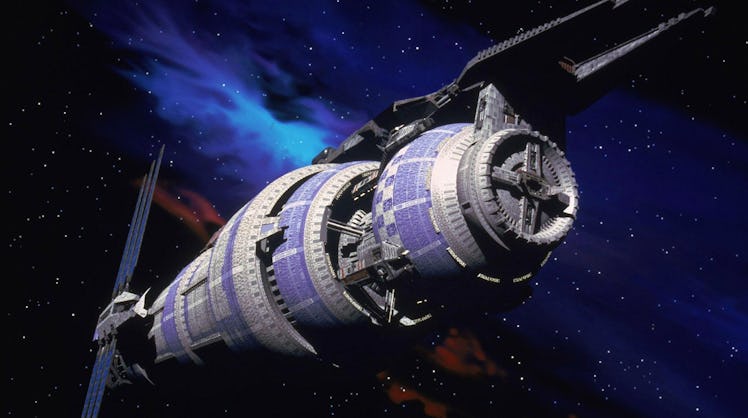
Musk wants to go to Mars. O’Neill wanted to build an orbiting space cylinder. Why not do both?
https://en.m.wikipedia.org/wiki/O%27Neill_cylinder
An O’Neill cylinder (also called an O’Neill colony, or Island Three) is a space settlement concept proposed by American physicist Gerard K. O’Neill in his 1976 book The High Frontier: Human Colonies in Space.
O’Neill proposed the colonization of space for the 21st century, using materials extracted from the Moon and later from asteroids.
Artist’s depiction of a pair of O’Neill cylinders
https://en.m.wikipedia.org/wiki/File:Spacecolony1.jpg
Interior view, showing alternating land and window segments
An O’Neill cylinder would consist of two counter-rotating cylinders. The cylinders would rotate in opposite directions to cancel any gyroscopic effects that would otherwise make it difficult to keep them aimed toward the Sun.
Each would be 6.4 kilometers (4 mi) or 8.0 kilometers (5 mi) in diameter and 32 kilometers (20 mi) long, connected at each end by a rod via a bearing system. Their rotation would provide artificial gravity.
Mars is easier. At least until the day comes when we can order the materials for O’Neill cylinders from Space Depot, for delivery by Amazon Planetary, and assembly by illegal Mexican work crews.
“Musk wants to go to Mars. O’Neill wanted to build an orbiting space cylinder. Why not do both?... An O’Neill cylinder (also called an O’Neill colony, or Island Three) is a space settlement concept proposed by American physicist Gerard K. O’Neill... [that] would consist of two counter-rotating cylinders... [and] provide artificial gravity.”
I like the idea of pursuing both, but both will have enormous challenges. And permanent off-earth colonies will probably require new energy sources and forms of propulsion.
The artificial gravity created by rotating a ship or other manmade dwelling is not the same as gravity because the acceleration is not linear which causes the Coriolis effect. It is impossible to say how this may affect living things in the long run. People, animals, and plants may not be able to adapt to it long-term any more than the rough conditions of Mars.