Free Republic
Browse · Search
General/Chat
Topics · Post Article

To: Jan_Sobieski
Gematria is the ancient practice of coding numbers into letters - to reveal deeper meanings and connections or associations which are not outwardly apparent. The four base (simplest and most common) Gematria ciphers are: English Ordinal, Reverse Ordinal, Reduction/Pythagorean and Reverse Reduction.

James Webb was a pivotal figure in the early history of NASA.

Webb led NASA from the beginning of the Kennedy administration through the end of the Johnson administration, thus overseeing each of the critical first crewed missions throughout the Mercury and Gemini programs until days before the launch of the first Apollo mission. He also dealt with the Apollo 1 fire.

In 2002, the Next Generation Space Telescope was renamed the James Webb Space Telescope as a tribute to Webb.

On February 14, 1961, Webb accepted President John F. Kennedy's appointment as administrator of NASA, taking the reins from interim director, Deputy Administrator Hugh L. Dryden. Webb directed NASA's undertaking of the goal set by Kennedy of landing an American on the Moon before the end of the 1960s through the Apollo program. For seven years after Kennedy's announcement on May 25, 1961, of the goal of a crewed lunar landing, Webb lobbied for support for NASA in Congress, until he left NASA in October 1968. As a longtime Washington insider and with the backing of President Lyndon B. Johnson, he was able to produce continued support and resources for Apollo.

During Webb's administration, NASA developed from a loose collection of research centers to a coordinated organization. He had a key role in creating the Manned Spacecraft Center, later the Johnson Space Center, in Houston. Despite the pressures to focus on the Apollo program, Webb ensured that NASA carried out a program of planetary exploration with the Mariner and Pioneer space programs. Webb was an early champion of space telescopes, like the one that would later bear his name.

-----------------------------------

It is believed by some that IF the moon landing project was faked, Hollywood director Stanley Kubrick had a hand in it.

An acrostic is a poem or other word composition in which the first letter (or syllable, or word) of each new line (or paragraph, or other recurring feature in the text) spells out a word, message or the alphabet.

Kubrick’s movie, The Shining - is believed to contain clues from the director that he was in fact, involved in the Apollo project. There are numerous elements which could indicate this, and a most curious one is a type of acrostic message embedded in a recurring phrase in the movie.

Jack Nicholson’s character is both an alcoholic author with a writer’s block, and a deeply disturbed man. At one point in the movie he repeatedly types the phrase, “All work and no play makes Jack a dull boy.”

Using an acrostic method for the sentence, “All work and no play makes Jack a dull boy” - we take the first letters of each word - A w a n p m J a d b. Using the four base (the simplest and most common) Gematria ciphers - these letters match exactly to James E Webb:
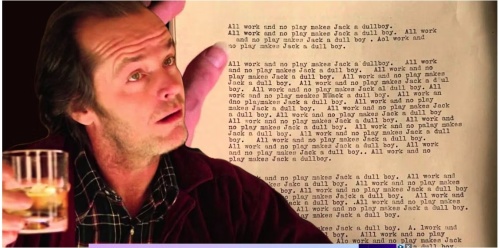
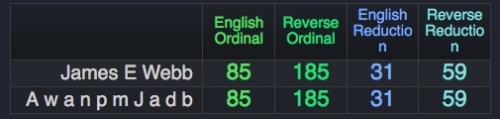
image host

image host

63 posted on 08/03/2023 9:04:35 AM PDT by yelostar (Spook codes 33 and 13. See them often in headlines and news stories. )
[ Post Reply | Private Reply | To 1 | View Replies ]


To: yelostar
It is believed by some that IF the moon landing project was faked, Hollywood director Stanley Kubrick had a hand in it. Part of the reason for this “conspiracy” theory - might be that Kubrick was familiar to - and had dealings, with NASA.

His movie, 2001 - A Space Odyssey - premiered in Washington, D.C. on April 2, 1968 - less than a year before the moon landing, and was released in the U.S. on April 3. The UK release was May 1. Most of the filming took place in England, at Shepperton Studios.

Kubrick had previous contact with NASA - and on more than one occasion.

The Carl Zeiss Planar 50mm f/0.7 is one of the largest relative aperture (fastest) lenses in the history of photography. The lens was designed and made specifically for the NASA Apollo lunar program to capture the far side of the Moon in 1966. Stanley Kubrick used these lenses when shooting his film Barry Lyndon, which allowed him to shoot scenes lit only by candlelight. In total there were only 10 lenses made. One was kept by Carl Zeiss, six were sold to NASA, and three were sold to Kubrick.

For 2001:

According to biographer Vincent LoBrutto, Universe was a visual inspiration to Kubrick. The 29-minute film, which had also proved popular at NASA for its realistic portrayal of outer space, met "the standard of dynamic visionary realism that he was looking for."

Kubrick hired the company that produced it, Graphic Films Corporation—which had been making films for NASA, the US Air Force, and various aerospace clients—as a design consultant. Graphic Films' Con Pederson, Lester Novros, and background artist Douglas Trumbull airmailed research-based concept sketches and notes covering the mechanics and physics of space travel, and created storyboards for the space flight sequences in 2001. Trumbull became a special effects supervisor on 2001.

--------------------------------

JFK was a pivotal figure in the moon project, since it was his call to action.

JFK's birthday was May 29. He would have turned 52 years old. The moon landing occurred 52 days later on July 20.

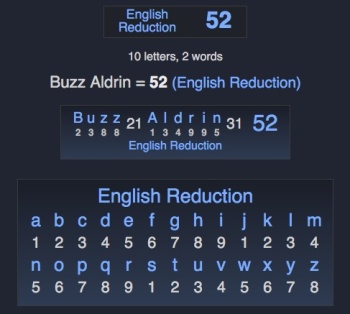
BUZZ ALDRIN - reduces to 52 - in the Reduction cipher.

Both JFK and Arthur C. Clarke - the co-author of the screenplay for the film, and an accomplished science fiction author - were born in 1917. Clarke would also turn 52 years old in 1969, in December.

The Reduction cipher - uses single digits only, 1-9.

image host

75 posted on 08/03/2023 10:59:31 AM PDT by yelostar (Spook codes 33 and 13. See them often in headlines and news stories. )
[ Post Reply | Private Reply | To 63 | View Replies ]

Free Republic
Browse · Search
General/Chat
Topics · Post Article


FreeRepublic, LLC, PO BOX 9771, FRESNO, CA 93794
FreeRepublic.com is powered by software copyright 2000-2008 John Robinson