Skip to comments.
Studies Reveal Negative Attitudes Toward the Unvaccinated— Polarizing views on COVID vaccination status poses risk to pandemic management, researchers say
MedPageToday ^
| December 21, 2022
| Ingrid Hein
Posted on 12/21/2022 3:55:07 PM PST by nickcarraway
The magnitude of prejudice and aversion against individuals refusing COVID-19 vaccination was detailed in three studies spanning 21 countries.
In data from the U.S., vaccinated people were 16 percentage points (95% CI 14-19) more likely to have antipathy toward those who remain unvaccinated than toward the vaccinated.
"Incompetence" was endorsed 14 percentage points more often and "untrustworthy" 13 percentage points more often by the vaccinated about the unvaccinated, Michael Bang Petersen, PhD, of Aarhus University in Denmark, and colleagues reported in Natureopens in a new tab or window.
"The conflict between those who are vaccinated against COVID-19 and those who are not threatens societal cohesion as a new socio-political cleavage," co-author Alexander Bor, PhD, of Aarhus University, said in a press release. "The vaccinated clearly seem to be the ones deepening this rift."
Unlike the attitudes expressed by vaccinated persons, the study authors did not find that unvaccinated people expressed discriminatory attitudes toward vaccinated people (with the exception of some negativity among unvaccinated respondents in Germany and the U.S.). "But we do not find statistical evidence in favor of negative stereotyping or exclusionary attitudes," the study authors noted.
A 'Natural' Reaction?
In these situations when people feel they have made a sacrifice to get vaccinated in part to protect others, they may have a strong reaction to those who are not willing to do the same -- "what they perceive as free-riding on a public good," Petersen warned in a press release. But this could have "severe consequences for society."
"In the short run, prejudice toward the unvaccinated may complicate pandemic management because it leads to mistrust, and we know that mistrust hinders vaccination uptake," he said. "In the long run, it may mean that societies leave the pandemic more divided and polarized than when they entered it."
Punitive public policy is not necessarily effective, the researchers argued, and can create a "cleavage" between members of society with different attitudes. They cited the example of French President Emmanuel Macron, who said he wanted to "piss off" the unvaccinated population to a degree that will make them get vaccinated.
"While moralistic communication of collective responsibilities may be an effective strategy to increase vaccination uptake, such strategies may have unintended negative consequences in the form of eliciting prejudice, especially in cultures with strong cooperative norms," Petersen and co-authors wrote, which "may have negative long-term effects ... hurting well-being, eroding identification with majority society, and breeding mistrust of the state, including health authorities."
However, the language used in the study, including the word "prejudice" and "discrimination" may evoke the wrong public reactions to the information, commented Maxwell Smith, PhD, a public health ethicist at the University of Western Ontario in London, Ontario.
"You can be exclusionary for the right reasons, or bad reasons," he told MedPage Today in an interview.
"Consider whether we'd say women who refuse to have sex with men who are unwilling to wear a condom have 'exclusionary attitudes' or that they're being 'punitive.' No, we wouldn't," Smith said. "It's fine to want to protect your health, and there are scientific reasons to believe ... condom-wearing will protect your health."
He expressed concern that people might take certain findings from the study out of context to suggest this form of discrimination is "just as bad" as other discrimination, whereas "there is no suggestion that it's morally bad" to discriminate.
Peterson told MedPage Today that the reaction to the study on social media has perhaps added fuel to the divisiveness. Although the study "does not speak at all to the vaccination decision itself," he said that "we are seeing very strong endorsement from people who are skeptical of vaccination and so on."
Rather than using the results to debate vaccine attitudes, Smith said, the findings should help develop better public policy.
Peterson agreed that it's important to communicate to both groups in a way that decreases tension as much as possible and called on authorities to mitigate punitive attitudes.
Study Results
Combining data from three studies involving 15,233 people from 21 countries, the researchers found that, around the world, vaccinated people were prejudiced against unvaccinated people.
In the U.S. specifically, the vaccinated were 10 percentage points (95% CI 8-12) less likely to respect an unvaccinated person's "right to residence," such as to live in their neighborhood, and 8 percentage points (95% CI 6-10) less likely to support an unvaccinated person's application for citizenship. They were 28 percentage points (95% CI 25-31) more likely to agree that the unvaccinated should have limited freedom of movement (for example, not being allowed to sit beside them on a bus).
Further, vaccinated persons were more likely to not respect unvaccinated people's freedom of speech (e.g., on social media) or support social assistance benefits for them (difference 7 percentage points for both, 95% CI 5-9).
All those response differences were statistically significant (P<0.001).
The studies were conducted through experimental methods, including the use of the "Dictator Game," in which participants reported emotions and allocated resources accordingly. Questions were asked in different ways, such that participants were both asked to rate their agreement with statements like "I would be unhappy if this person married one of my close relatives" and were forced to respond to a decision scenario on the same issue.
The researchers noted that the experimental nature of the studies was a limitation. Also, since the studies were performed online, it's not clear to what degree their responses would carry through to real-world attitudes and actions.
Notably, the studies were conducted "while the vaccine-evading Omicron variant was dominant, and vaccine-induced immunity against infection spread was waning," the researchers noted.
Ingrid Hein is a staff writer for MedPage Today covering infectious disease. She has been a medical reporter for more than a decade. Follow
TOPICS:
KEYWORDS:
Navigation: use the links below to view more comments.
first previous 1-20, 21-40, 41-48 last
To: DSH
Frightened seems about right. Does anyone else notice how the vaxxers don’t talk about the vax even among themselves? I’ve noticed around a lot of my acquaintances (not my friends, they are all purebloods) that if I mention anything about the covid shots, all they want to do is change the subject as quickly as possible. They’re scared, and don’t want to be reminded of it.
To: monkeyshine
Worst case, well, the unvaccinated may have a lot of anger on behalf of and sympathy towards the vaccinated.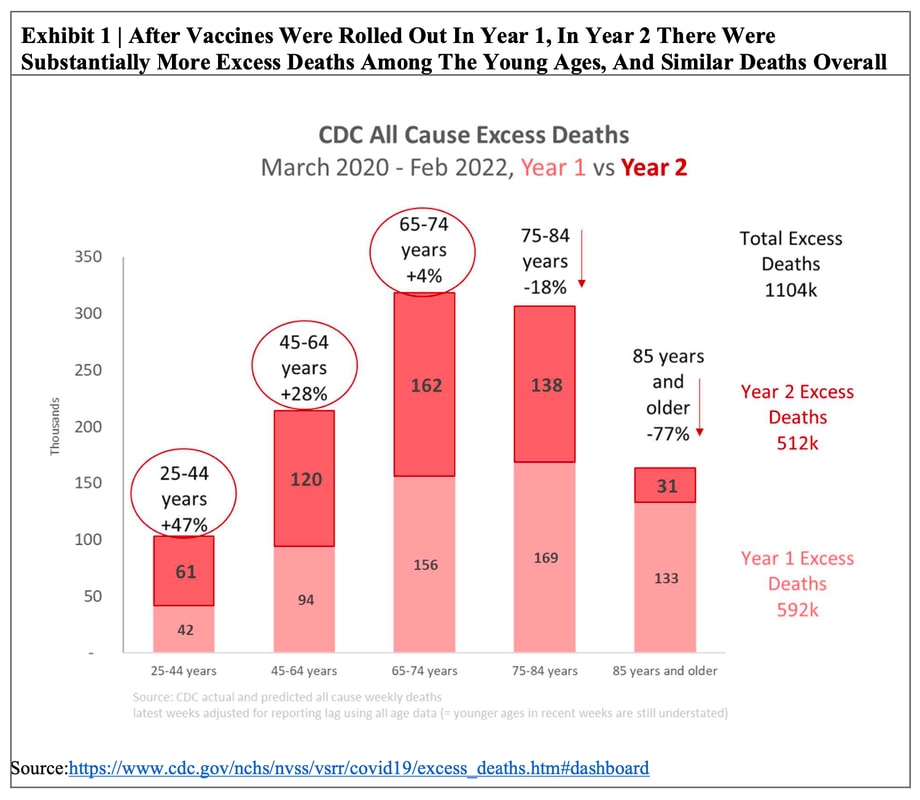
With over one million EXCESS DEATHS in the US since the SAFE and EFFECTIVE became available, it's NOT hard to pin the vaxxxxxxines as the cause.
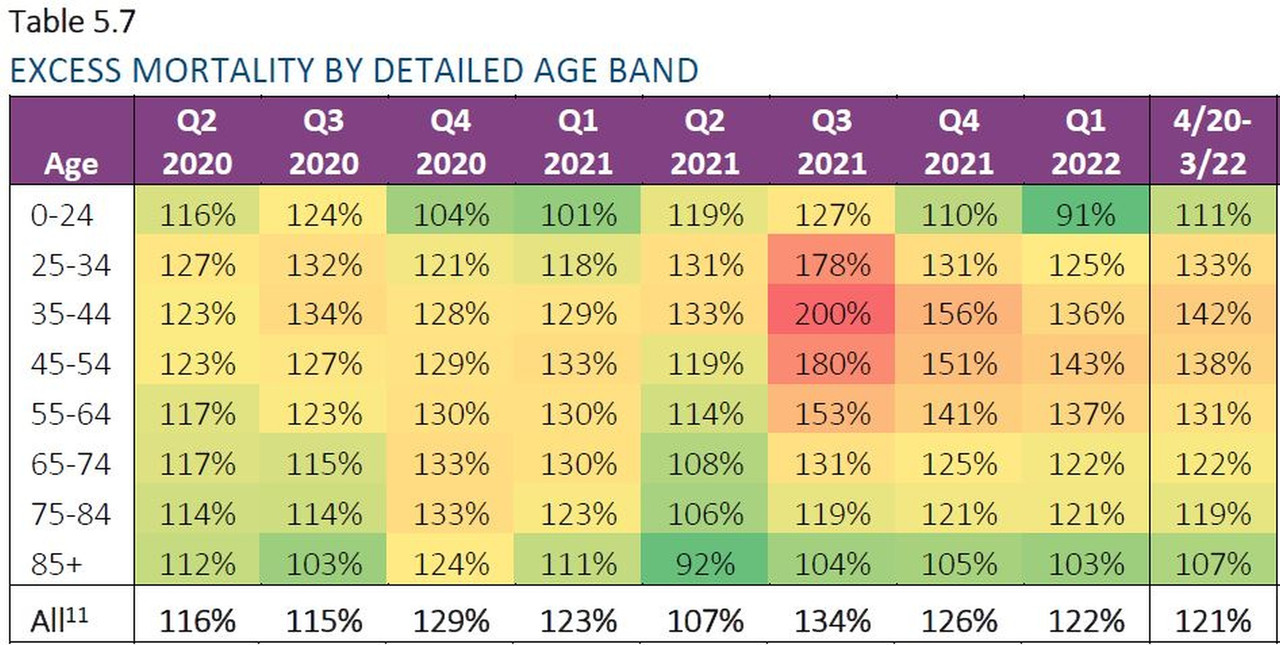
Notice the highest EXCESS DEATH rates in the fall of 2021 correspond to the vaxxxxxxine mandate insanity. Excess death rates now correspond to approximately ONE of every 250 people vaxxxxed are dead.
Life expectancy in the US has decreased THREE YEARS since Biden became Resident. With present death rates continuing, life expectancy will be down to 52 years old by 2025. Most people know a vaxxxxed person who has died. By 2025, most people will know several vaxxxxxxed people who are dead. At that point, even the DimWIT voters will begin to figure out the vaxxxxxxed who are still alive in 2025 are dead people walking.
Why post this? Because those still on the fence about flu shots or boosters need to realize, the more shots you've taken, the sooner you drop dead.
42
posted on
12/21/2022 8:39:20 PM PST
by
politicianslie
(Genocide with vaxxxxxxines is EASY. The fools get in line and then their relatives bury them. Easy!)
To: nickcarraway
As a Christian I consider it good practice for when we will be vilified for our faith. COVID has helped build up spiritual muscle to resist the mark of the beast.
To: monkeyshine
“In a year or two, best case, this won’t matter at all.”
I think it demonstrated that much of the public would have no problem throwing lots of people they disagree with into camps.
Could have been an experiment for some future operation for all we know.
Can you imagine the reaction if the “disease” was made to look like it had a 30% death rate? Neighbors would have been shooting each other.
There would have been camps. And I’m sure the “disease” would periodically sweep through and wipe out their populations.
44
posted on
12/22/2022 4:36:39 AM PST
by
Sarcazmo
("Sarcasm is the highest form of wit" ~ O. Wilde)
To: Clarancebeaks
I have noticed this as well. At work we have been asked not to talk about the “vax”.
45
posted on
12/22/2022 4:50:10 AM PST
by
Sarcazmo
("Sarcasm is the highest form of wit" ~ O. Wilde)
To: nickcarraway
I have gotten the vaccine in previous years,now they have these mRNA vaccine I won’t take those,no thanks
To: patriot torch
Many of the vaxxed have Stockholm Syndrome—identifying with the prison guards that torment the inmates.
47
posted on
12/22/2022 5:57:40 AM PST
by
cgbg
(Claiming that laws and regs that limit “hate speech” stop freedom of speech is “hate speech”.)
To: Neverlift
"What do the unvaccinated think about the vaccinated?"
I would say that for the most part, we feel pity, maybe some level of disdain, but few feel antipathy towards the vaxxed. To the extent that the unvaxxed do feel any animosity toward the vaxxed, it is most likely due to the badgering/hectoring/shaming/Karen-ing that they have been subjected to by the vaxxed from the start.
48
posted on
12/22/2022 6:06:59 AM PST
by
Sicon
("All animals are equal, but some animals are more equal than others." - G. Orwell)
Navigation: use the links below to view more comments.
first previous 1-20, 21-40, 41-48 last
Disclaimer:
Opinions posted on Free Republic are those of the individual
posters and do not necessarily represent the opinion of Free Republic or its
management. All materials posted herein are protected by copyright law and the
exemption for fair use of copyrighted works.
FreeRepublic.com is powered by software copyright 2000-2008 John Robinson