Iran Update, January 13, 2024
The Iranian-backed Badr Organization announced the submission of a draft law that requires the removal of US forces from Iraq. This law is part of Iran's decades-old effort to expel US forces from Iraq and the region. Conquest Alliance MP Faleh al Khazali said that the law is the result of “the Americans’ continued violations of Iraqi sovereignty.”[1] The United States has not violated Iraqi sovereignty because it is conducting self-defense strikes against militias firing at US servicemembers. Khazali announced a draft law on January 13 that requires the removal of US forces from Iraq.[2] Conquest Alliance is the Badr Organization's political arm in parliament. Eighty-eight parliamentarians signed the draft law, which is 77 signatures short of a majority. The law calls for the removal of US forces and the formation of a committee led by the prime minister to implement the law. The committee will present a report to the Iraqi parliament that will describe the “requirements for ending” the US force presence in Iraq.
This law aims to increase pressure on Iraqi Prime Minister Mohammed Shia al Sudani and to force him to expel US forces from Iraq. Politico reported on January 9 that senior Iraqi advisors to Sudani told the US State Department that Sudani does not seek the expulsion of US forces.[3] The draft law's inclusion of a prime minister-led committee increases the pressure on Sudani by forcing him to author a report detailing how Iraq would end the US presence in Iraq. The inclusion of this requirement is a key difference between the draft law and the 2020 nonbinding resolution that called for the expulsion of US forces.[4] Iranian-backed Iraqi proxy militias like the Badr Organization have been increasing political and military pressure on the United States in Iraq since late November 2023 as part of their effort to expel US forces from Iraq.[5]
The expulsion of US forces from Iraq will likely allow ISIS to resurge in Syria and then threaten Iraq within 12 to 24 months. The expulsion of US forces from Iraq would benefit ISIS by preventing US support to the Iraqi Security Forces (ISF). The ISF still faces deficiencies in intelligence, logistics, and fire support.[6] The expulsion of US forces from Iraq would also require the US to end operations in Syria because US forces in Syria rely on Iraqi bases for their logistics and other support. CTP-ISW continues to assess that ISIS would likely resurge within 12-24 months in Syria without a US force presence and then threaten Iraq.[7]
full report: https://www.understandingwar.org/backgrounder/iran-update-january-13-2024
https://en.wikipedia.org/wiki/Badr_Organization
Iran Update, January 14, 2024
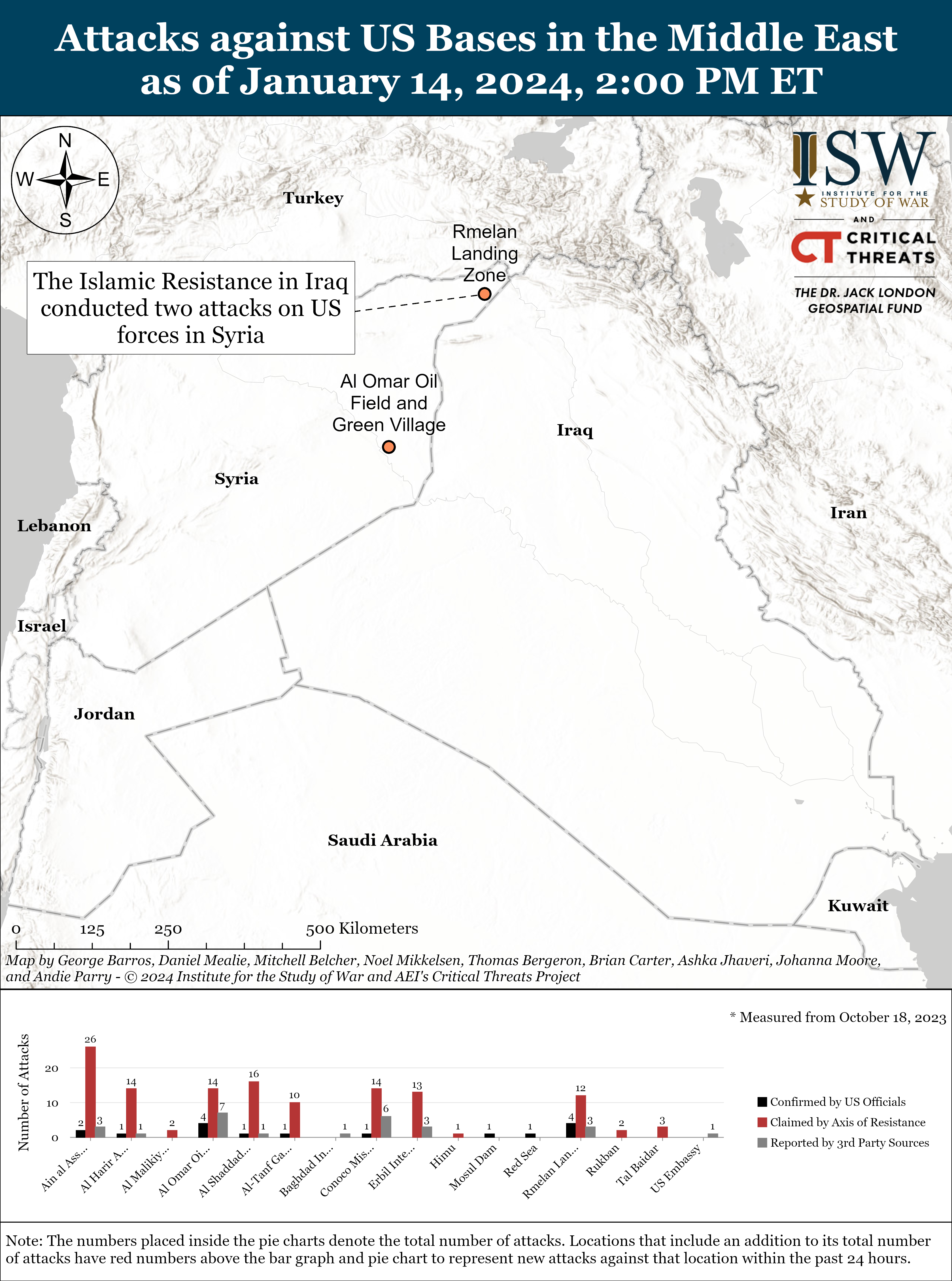
The Islamic Resistance in Iraq—a coalition of Iranian-backed Iraqi militias—claimed two attacks on US forces in northwestern Syria on January 13.[13] The group fired rockets at Rumaylan Landing Zone in Hasakah Province and launched drones at al Omar oil field in Deir ez Zor Province.
full report: https://www.understandingwar.org/backgrounder/iran-update-january-14-2024