Iran Update Special Report, May 26, 2026
Iran and the United States have not bridged key differences on all the major demands in the US-Iran talks. Iranian officials said that they are unwilling to discuss their nuclear program on May 25, and Iranian regime media on May 25 insisted that the United States observe Iran's right to enrich uranium on Iranian territory.[1] Mediators and US officials added that the United States will not provide economic relief to Iran without serious commitments from Iran on its nuclear program.[2] This represents a major impasse in talks because Iran refuses to discuss its nuclear program without economic relief. US President Donald Trump stated on Truth Social on May 26 that Iran's highly enriched uranium (HEU) must be “immediately turned over” to the United States or else destroyed where it is within Iran or at another “acceptable location” with verification.[3] The two sides remain far apart on the Strait of Hormuz, as well, which is discussed in greater detail below.
Granting Iran economic relief by unfreezing funds or removing sanctions would likely decrease Iranian military reconstitution timelines. Iran reportedly demanded that the US immediately release the first half of frozen Iranian assets upon signing the agreement and the second half of the assets within 60 days, according to Islamic Revolutionary Guards Corps (IRGC) media on May 26.[4] The exact amount of these assets is unclear.[5] The Iranian Foreign Affairs Ministry spokesperson explicitly said that Iran would use its unfrozen assets to reconstitute and improve the ballistic missile and drone programs.[6] Iranian officials have also called for the United States to lift the US Navy blockade and sanctions on oil as part of the deal for at least 30 to 60 days.[7] Detailed reconstitution timelines do not exist in the open-source, and intelligence leaks about these timelines are impossible to judge on their own merits due to the lack of context provided in leaks.[8] ISW-CTP has previously assessed that Iran would likely need a longer period of time to reconstitute its missile program than it did after the June 2025 strikes because the combined force struck many more production targets than Israel did in June 2025.[9] This relative assessment — as well as any more detailed assessment — relies on various assumptions about the amount of funds Iran can put towards reconstitution and rebuilding of its military forces, among other factors. Unfreezing funds or dropping sanctions gives Iran relatively more funds to put towards reconstitution.
Iran is also refusing to reopen the Strait of Hormuz and using force to ensure the recognized traffic separation scheme remains closed. Iranian officials continue to state Iran will only re-open the strait to civilian ships under “Iranian arrangements,” and Supreme Leader Mojtaba Khamenei’s guidance to the Iranian government on May 25 said Iran must leverage the strait for economic gain.[10] This position directly contradicts the US position on freedom of navigation, because freedom of navigation through an international waterway has no ”arrangements” imposed by another state. Iran has forced vessels to proceed through the strait using its territorial waters and an illegitimate (but unmined) traffic separation scheme by mining the recognized traffic separation scheme (which is in an international waterway) and threatening to fire at any vessel that uses it.
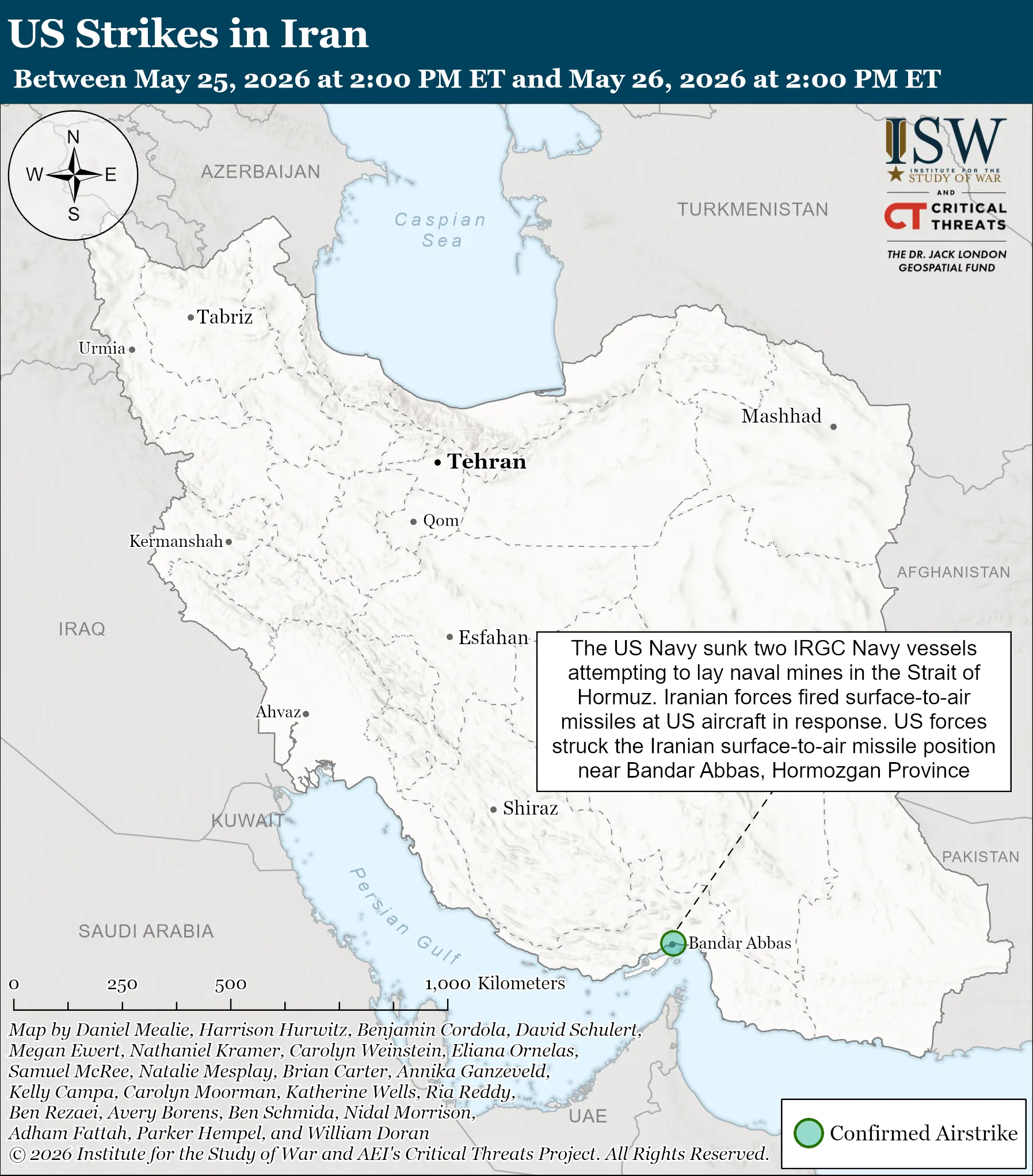
Iran used force again on May 25 to maintain its illegitimate traffic separation scheme when it attempted to deploy mines in the Strait of Hormuz.[11] US Navy aircraft sank the two IRGC Navy vessels responsible for the mine-laying effort. Iran fired at the US Navy aircraft with surface-to-air missiles, but the surface-to-air missile batteries were subsequently struck as well.[12] Iran then separately likely fired an unspecified projectile at and struck the water line of a vessel 60 nautical miles east of Muscat in the Sea of Oman on May 26.[13]
US Central Command (CENTCOM) denied reports that it had resumed Project Freedom and that US forces were escorting vessels through the strait.[14] US President Donald Trump halted the project on May 5 to pursue US-Iran negotiations after announcing the start of it on May 4.[15]
Iranian Supreme Leader Mojtaba Khamenei released a statement on May 26 reaffirming the regime's commitment to the principles of the Islamic Revolution and his father's grand strategy – namely, a commitment to the destruction of Israel, the expulsion of US forces from the region, and the formation of a “new Islamic civilization” united against the United States.[16] Khamenei emphasized that “Death to America [and Israel]” will again be the slogan of Iran and the Islamic world.[17] Khamenei stated that Iran defeated US and Israeli forces in the recent war and highlighted the “martyrs” of Iran's partners and proxies in the region, particularly Hezbollah in Lebanon.[18] Khamenei emphasized the need to unite the Islamic world to “solve the problems” of the region, including preventing the presence of US forces.[19]
The Iranian regime has restored some international internet access to Iran, amid growing public discontent with the regime's economic mismanagement. Iranian President Masoud Pezeshkian ordered the Communications Ministry on May 25 to end the internet shutdown that Iran began in response to the January 2026 protest movement.[20] Internet monitor NetBlocks reported on May 26 that Iran has “partially” restored international internet access and that citizens have gradually increased their internet connectivity.[21] The internet shutdown has exacerbated problems with Iran's already struggling economy, which has been one of Pezeshkian’s main domestic policy concerns.[22] Pezeshkian has previously emphasized the importance of financial gains from negotiations as necessary for Iran to pay for the estimated $300 billion USD in losses from the war with the United States and Israel, for example.[23] There are still restrictions on internet access, however. NetBlocks reported that the popular messaging platform WhatsApp is restricted, Iran's heavily monitored domestic intranet remains active, and that some users are still offline.[24] The Iranian Supreme National Security Council (SNSC) has not yet publicly approved Pezeshkian’s order. Anti-regime media previously reported that the SNSC, led by hardliner Secretary Mohammad Bagher Zolghadr, expressed concern about the potential for renewed protests due to worsening economic conditions.[25] Internet monitor Filter Watch reported during the internet shutdown in the most recent protest wave that the regime would whitelist select individuals to permit them internet access, rather than allow internet access for all Iranians.[26]
The IDF has increased its airstrikes and expanded its ground operations against Hezbollah targets in Southern Lebanon and the Bekaa Valley in response to continued Hezbollah attacks against the IDF in southern Lebanon and northern Israel in recent days. Israeli Prime Minister Benjamin Netanyahu said on May 25 that he has told the IDF to increase its operations against Hezbollah.[27] Netanyahu separately stated on May 26 that the IDF is “seizing dominant terrain” and “fortifying” the IDF buffer zone in southern Lebanon to protect northern Israeli communities from Hezbollah attacks.[28] The IDF has conducted over 270 strikes in Lebanon between May 24 and 26.[29] The IDF struck over 100 Hezbollah weapons depots, headquarters, and observation posts in southern Lebanon and the Bekaa Valley overnight between May 25 and May 26, and around 10 command centers and weapons depots in Tyre on May 25.[30] Lebanese media reported at least 100 IDF strikes in Lebanon on May 24, marking the first time the IDF has conducted at least 100 strikes in a 24-hour period since the start of the temporary ceasefire on April 16.[31] The IDF’s strikes have remained geographically limited to southern Lebanon and the Bekaa Valley.[32] ISW-CTP has not observed any reports of strikes in the vicinity of Beirut since the IDF’s targeted strike in Beirut's southern suburbs on May 6 that killed Hezbollah Radwan Force Commander Ahmad Ghaleb “Malik” Balout.[33]
https://understandingwar.org/research/middle-east/iran-update-special-report-may-25-2026-2/
2,091 posted on
05/26/2026 8:58:28 PM PDT by
AdmSmith
(GCTGATATGTCTATGATTACTCAT)
To: nuconvert
The Achilles’ heel of the GCC during any war with Iran was never oil. It was, and will always be water. The Gulf runs on desalination. Millions of people, critical industries, military bases, hospitals, and entire cities depend on a fragile network of desalination plants concentrated along the coastline. The IRGC knows this. And because they know it, they see it, and use it, as leverage. So if Trump genuinely wants to reassure Saudi Arabia and the GCC during any future military confrontation with Iran, then the United States must establish a very clear strategic deterrence doctrine specifically around water infrastructure.
Two principles should be established publicly and unequivocally:
1) Any Iranian military or IRGC attack against desalination facilities in the GCC - even if limited and without major physical damage - must trigger immediate retaliation against Iranian critical infrastructure, specifically water, electricity, and telecommunications infrastructure inside the Islamic Republic. Immediate, painful, proportional retaliation that creates real deterrence.
2) If Iran succeeds in causing major damage to desalination capacity, disrupting the production of water for civilian populations in any GCC country, then this should be treated as the equivalent of a strategic WMD attack.
Why? Because in the Gulf, water is life. Disabling desalination at scale is not merely an infrastructure strike; it is an attack on the survival of entire urban populations. And once you frame it that way, deterrence changes entirely. The objective here is not escalation. The objective is prevention.
Right now, the IRGC believes the water vulnerability of the Gulf countries gives it strategic leverage. Trump's job should be to remove that belief completely.
https://x.com/AimenDean/status/2059516272652738803
2,092 posted on
05/27/2026 11:18:30 AM PDT by
AdmSmith
(GCTGATATGTCTATGATTACTCAT)
Iran Update Special Report, May 27, 2026
Senior Iranian officials continue to frame Iranian control over the Strait of Hormuz as a strategic necessity and core element of Iranian deterrence against the United States and Israel. Supreme Leader Adviser Ali Akbar Velayati described the strait on May 27 as Iran's “ultimate leverage” and the “real guarantee” of a US-Iran agreement's “survival.”[1] Velayati’s remarks may reflect the Iranian regime's belief that Iran's ability to threaten international shipping and energy markets would make the United States less willing to withdraw from any potential agreement or conduct further military operations against Iran. Velayati’s comments reflect the degree to which senior Iranian leaders are coalescing around the notion of Iranian control over the strait as a key pillar of leverage. His comments are also consistent with ISW-CTP’s assessment that Iran views control of the strait as essential to rebuilding deterrence against the United States and Israel after the degradation of Iran's other deterrent capabilities, particularly Iran's ballistic missile capabilities.[2]
Iranian officials continue to insist that Iran will “reopen” the strait to civilian shipping under “Iranian arrangements,” which reflects the broader Iranian effort to institutionalize control over traffic through the waterway and directly contradicts the US demand for freedom of navigation.[3] Iranian media circulated a reported draft US-Iran agreement in which Iran would “restore” shipping through the strait while continuing to manage maritime traffic jointly with Oman.[4] The reported draft proposal also stipulates that military vessels would be barred from transiting through the strait. Iran has not explicitly barred military vessels from passing through the strait in past draft proposals, but Iranian officials and media have repeatedly publicly stated this restriction.[5] The United States rejected the draft proposal in Iranian media as a “complete fabrication,” but the circulation of the proposal in Iranian media nevertheless reflects Iran's continued effort to secure recognition of its sovereignty over the strait in any agreement with the United States.[6] Iran has used naval mines and attacks on commercial vessels to force vessels to transit through Iran's illegal and unrecognized traffic separation scheme in Iranian territorial waters, effectively forcing vessels to recognize Iran's control of the strait.[7] Iranian officials have cited the UN Convention on the Law of the Sea to attempt to justify charging vessels a fee for transiting through Iranian territorial waters.[8] These vessels are not only coerced into using Iran's traffic separation scheme, but the fees that they pay to Iran are part of an Iranian protection racket in which vessels pay to avoid Iranian attacks.[9] Any arrangement in which maritime traffic can only pass through Iran's traffic separation scheme with Iranian approval contradicts the US demand for freedom of navigation, and such an arrangement would significantly undermine US interests and establish a dangerous precedent for the freedom of navigation in international waterways. US President Donald Trump emphasized on May 27 the importance of freedom of navigation through the strait and stated that “nobody is going to control” the strait.[10]
Conflicting reports about the draft US-Iran agreement, as well as public statements from both sides, highlight continued disagreements on other key issues between the United States and Iran. The Iranian media readout of the reported draft proposal stated that Iran would continue to manage traffic through the Strait of Hormuz in exchange for the United States lifting its naval blockade and withdrawing military forces from Iran's vicinity.[11] The readout omitted any reference to Iran's nuclear program, sanctions relief, or frozen assets. Iranian officials have repeatedly demanded that the United States release half of Iran's frozen assets immediately upon signing an agreement and release the remainder within 60 days, however.[12] The Associated Press, citing two regional officials, contrastingly reported that Iran agreed to “give up” its highly enriched uranium (HEU) stockpile.[13] The officials added that negotiators would discuss how Iran would “give up” its HEU stockpile in a 60-day negotiation period following the signing of an initial agreement.[14] A US official reiterated to the Associated Press that the United States will not provide sanctions relief to Iran unless Iran relinquishes its stockpile.[15] Iranian officials, however, continue to demand economic concessions in an initial agreement while postponing nuclear negotiations until a later phase.[16] Supreme National Security Council Deputy Secretary Ali Bagheri Kani reiterated Iran's right to enrich uranium on May 27 and stated that negotiators are not currently discussing Iran's HEU stockpile.[17] Bagheri Kani suggested that the United States and Iran would not be able to reach a preliminary agreement if both sides tried to reach an understanding on nuclear issues because “differences of opinion [are so big].”[18] Iran's proposed sequencing of concessions would require the United States to surrender key sources of leverage before negotiations over Iran's nuclear program begin, which would significantly reduce US leverage in any future nuclear negotiations.
Iranian media outlet Nour News published an op-ed that emphasized the need for Iran to convert its recent “military victory” into broader political success, which reflects a belief within the regime that Iran emerged from the recent conflict in a position of strength.[19] Iran's maximalist and uncompromising negotiating positions reflect the Iranian regime's effort to translate its perceived success in the war into long-term strategic and political gains. The article argued that Iran must pursue “rapid diplomatic exploitation of military gains,” which supports ISW-CTP’s assessment that Iranian leaders believe they won the conflict and are therefore negotiating from a perceived position of strength.[20] The op-ed called for clear and tangible objectives, including war compensation and guarantees against future attacks, both of which Iranian officials have previously raised as “preconditions” in negotiations.[21] The article also warned that renewed conflict will remain inevitable unless Iran transforms its perceived military success into “sustainable mechanisms.”[22] Iran likely views recognition of its control over the Strait of Hormuz as one such mechanism. It is unclear who currently controls Nour News or what the outlet's current affiliation is. Nour News was previously affiliated with former Supreme National Security Council Secretary Ali Shamkhani, but the combined force killed Shamkhani during the recent war.
An Israeli open-source intelligence analyst posted satellite imagery that shows Iranian reconstitution efforts at the Yazd Missile Base in Yazd Province since the start of the US-Iran ceasefire in April 2026.[23] These reconstitution efforts corroborate ISW-CTP’s assessment that Iran is exploiting the ceasefire period to reconstitute its military capabilities at the tactical and operational levels.[24] The satellite imagery between April 5 and May 22 reveals Iranian efforts to reopen the base's tunnel entrances, clear rubble and debris, build new roadways, and replace missiles and missile launchers.[25] The combined force struck the Yazd Missile Base at least five times during the conflict, including a strike on March 27 directly after Iranian forces launched missiles from the base.[26] The Iranian Foreign Affairs Ministry spokesperson stated on May 26 that Iran would use any unfrozen assets that Iran secures in a potential US-Iran agreement to further reconstitute and improve Iran's ballistic missile and drone programs.[27] ISW-CTP previously assessed that granting Iran economic relief by unfreezing funds or removing sanctions would likely decrease Iranian military reconstitution timelines.[28]
The Iranian regime appears to be setting conditions to further securitize Iranian society, likely in response to the regime's concerns about US-Israeli “hybrid warfare” tactics and potential internal unrest. The regime defines hybrid warfare as “the use of all domains of power, including information, electronic, cultural, social, and military operations, by hostile actors to destabilize Iran.”[29] The Iranian Intelligence Ministry released a statement on May 27 outlining perceived US-Israeli hybrid warfare efforts, including economic pressure, attempts to incite ethnic and religious conflict, border incursions by alleged Israeli-affiliated armed groups, sabotage, and weapons smuggling.[30] The statement accused Farsi-language anti-regime media outlets of inciting political, social, labor, ethnic, and religious unrest.[31] The ministry warned that it will confront any actors who attempt to provoke unrest.[32] The ministry claimed that the United States and Israel's current priority is to incite social unrest around economic grievances.[33] Iranian President Masoud Pezeshkian similarly claimed during a meeting with Tehran’s Chamber of Commerce on May 27 that Iran's adversaries have shifted their focus to undermining Iran's economy.[34] Pezeshkian described the economy as the “main battlefield” of the current conflict.[35] These statements are notable given recent anti-media reporting that the Iranian Supreme National Security Council (SNSC) convened an emergency session in late April during which SNSC members discussed the potential for renewed protests triggered by worsening economic conditions.[36]
Shia National Movement leader Moqtada al Sadr announced on May 27 the dissolution of his Saraya al Salam militia and the “full integration” of the militia's members into the Iraqi state.[37] Sadr added that civilian entities affiliated with Saraya al Salam will be “transformed” into a non-militia “structure” without bases, weapons, or uniforms.[38] It is unclear whether Saraya al Salam will also cede control of the Popular Mobilization Forces (PMF) brigades it controls, including the 313th, 314th, and 315th brigades.[39] The PMF is an Iraqi state security service that includes many Iranian-backed Iraqi militias that answer to Iran instead of the Iraqi prime minister.[40] This announcement comes after a senior Iraqi political official told regional media on May 9 that an Iraqi committee comprised of Badr Organization head Hadi al Ameri, Prime Minister-designate Ali al Zaydi, and caretaker Prime Minister Mohammad Shia al Sudani was close to finalizing a plan to disarm Iraqi militias.[41] The United States has pressured the Iraqi federal government to curb Iranian influence in Iraq, including via militia disarmament, since early 2025, but has intensified its efforts in recent months due to repeated militia attacks against US and foreign targets in Iraq and the region during the war.[42]
https://understandingwar.org/research/middle-east/iran-update-special-report-may-27-2026/
2,093 posted on
05/27/2026 10:52:05 PM PDT by
AdmSmith
(GCTGATATGTCTATGATTACTCAT)
FreeRepublic.com is powered by software copyright 2000-2008 John Robinson