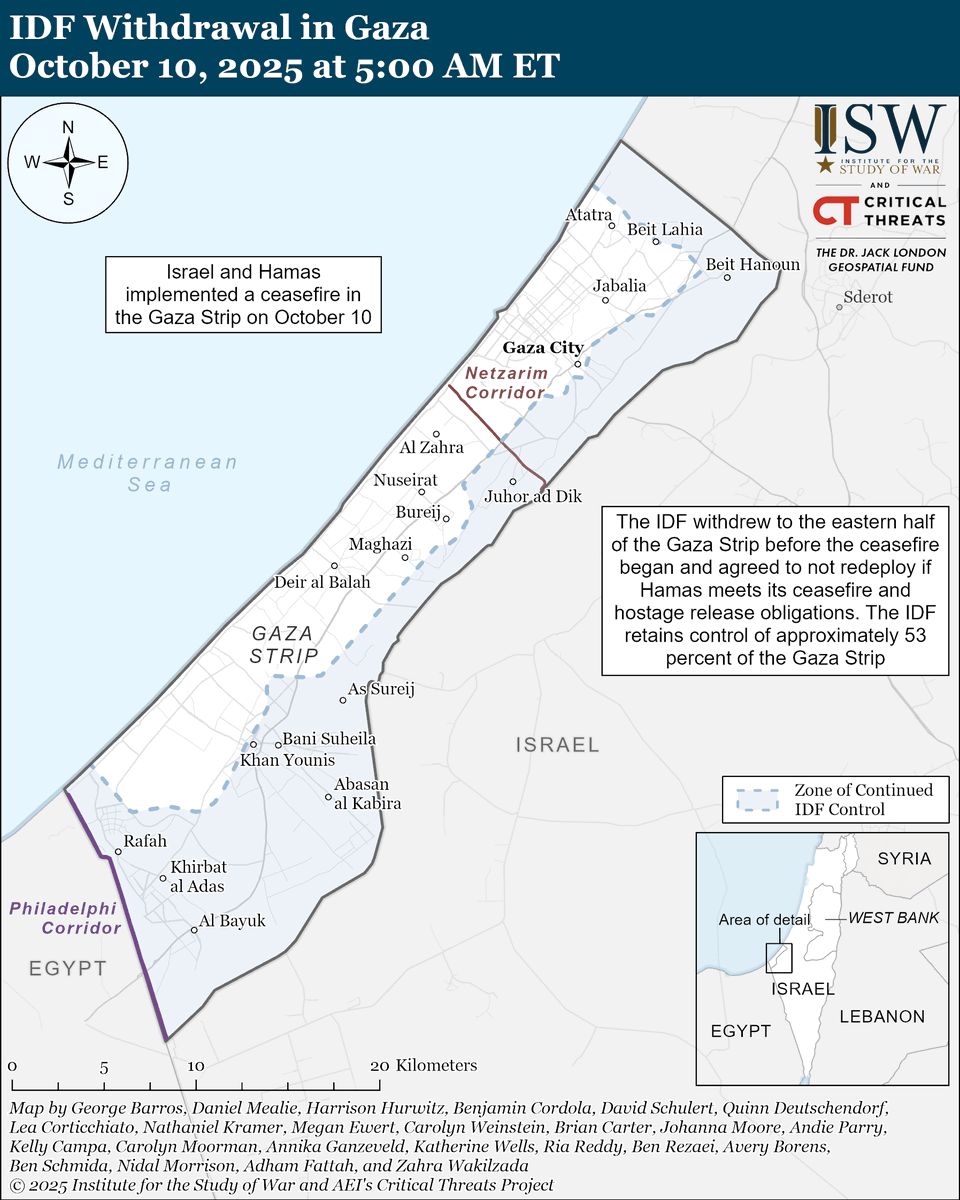
Israel and Hamas implemented a ceasefire in the Gaza Strip at 5:00 AM ET on October 10.[1] The ceasefire agreement does not address outstanding issues that were initially included in US President Donald Trump's plan for peace in the Gaza Strip, such as Hamas’ disarmament, a full Israeli withdrawal, or Gaza's future governance.[2] The Israeli government approved the ceasefire and hostage release resolution during a cabinet meeting on October 9 after two weeks of negotiations.[3] Trump said that he would not permit Israel to abandon the deal.[4] Axios reported that Trump's assurances were a “key factor” in convincing Hamas to accept the ceasefire agreement, citing two US officials.[5]
The Israel Defense Forces (IDF) withdrew to the eastern half of the Gaza Strip before the ceasefire began and has assured Hamas it will not reenter the western areas of the Strip if Hamas meets its ceasefire and hostage release obligations.[6] Israeli forces retain control of approximately 53 percent of the Gaza Strip.[7] The IDF also halted all aerial surveillance over Palestinian-controlled areas of the Gaza Strip.[8] Hamas agreed to release all 20 living Israeli hostages within three days of the ceasefire's implementation.[9] Hamas will also return the remains of all deceased hostages the group has in its possession in the first three days.[10] The agreement stipulates that 600 truckloads of humanitarian aid will enter the Gaza Strip each day.[11] US, Qatari, Egyptian, and Turkish officials will coordinate the ceasefire implementation between Israel and Hamas.[12] Two hundred US military personnel will be in Israel to assist with the ceasefire implementation, but they will not enter the Gaza Strip.[13]
Hamas’ partners in the Axis of Resistance welcomed the ceasefire but expressed skepticism that Israel would adhere to its terms. Iraqi militia leaders welcomed the ceasefire as a “victory.”[14] Iraqi militias launched a support campaign in November 2023 for Palestinians by attacking Israel and US bases with drones and rockets.[15] The Iranian supreme leader warned on October 10 that Israel is not trustworthy and that there is no guarantee that Israel will not resume the war against Hamas.[16] An Iranian government spokesperson said on October 10 that Iran will support every step toward a ceasefire in the Gaza Strip, however.[17] Houthi Supreme Leader Abdulmalik al Houthi threatened on October 9 that the Houthis would continue to provide “backup” for Gazans if Israel does not fulfill its obligations under the ceasefire.[18] The Houthis have launched hundreds of drones and ballistic missiles targeting Israel since October 2023.[19] The Houthis would retain the ability to resume attacks against Israel or international shipping at any time and for any reason in the future, even if they suspended attacks due to a ceasefire in the Gaza Strip.
The United States sanctioned two Popular Mobilization Forces (PMF)-owned commercial entities, three Iraqi bank executives, and three Kataib Hezbollah officials on October 9.[20] Iran has long used partners in Iraq to circumvent US and international sanctions. The PMF is an Iraqi state security service that is primarily comprised of Iranian-backed Iraqi militias, some of which report to Iran instead of the Iraqi prime minister.[21] The US Treasury Department sanctioned the PMF-owned Muhandis General Company and Baladna Agricultural Investments on October 9.[22] Iranian-backed Iraqi militias such asKataib Hezbollah use the Muhandis General Company to generate revenue by diverting funds from Iraqi government contracts.[23] US-designated Popular Mobilization Commission Chief of Staff and Kataib Hezbollah leader Abd al Aziz (Abu Fadak) al Muhammadawi controls the Muhandis General Company.[24] Baladna Agricultural Investments is a commercial front for the Muhandis Company.[25]
The United States sanctioned Iraqi bank executives Ali Ghulam, Ali Meften, and Aqeel Meften for using their positions within Iraq's banking sector to generate revenue and launder money for the Islamic Revolutionary Guards Corps (IRGC) Quds Force and Iranian-backed militias, including US-designated foreign terrorist organizations Kataib Hezbollah and Asaib Ahl al Haq.[26] Ghulam owns three Iraqi banks and has given the IRGC Quds Force “some degree of control” over his banks, which allows the IRGC Quds Force to generate millions of dollars in revenue for itself and Iranian-backed Iraqi militias.[27] The US Treasury Department and Federal Reserve reportedly blocked all three of Ghulam’s banks from engaging in dollar transactions in 2022 due to “suspicious transactions,” presumably with the IRGC or other Iranian institutions.[28] Ali Meften chairs the Board of Directors for the Union Bank of Iraq, which Iraq's Central Bank banned from engaging in dollar transactions in 2024.[29] The US Treasury Department also sanctioned Kataib Hezbollah leader Hassan Qahtan al Saidi and two members of his “source network” for gathering intelligence—including on US forces in Iraq—on behalf of the IRGC.[30]
These US sanctions are part of an effort to isolate Iran from the international financial system and hinder transnational Iranian smuggling efforts. The United States recently sanctioned two Iraqi businessmen and their companies on July 3 and September 2 for smuggling Iranian oil as part of a broader effort to curb Iraq's role in helping Iran evade international sanctions, for example.[31] Iran and its Iraqi partners have historically tried to evade international sanctions on Iranian banks and oil exports through the exploitation of Iraq's financial system and smuggling Iranian oil in Iraqi territorial waters.[32] Sanctioning Iraqi bank officials could further isolate Iran from the international banking system and hinder its ability to evade sanctions. These new US sanctions on Iraqi entities follow the recent reimposition of European Union (EU) and United Nations Security Council (UNSC) sanctions on Iran in September 2025 that the EU and UNSC had lifted under the 2015 nuclear deal.[33]
Iran increased its oil exports in September 2025 by 37 percent, according to Iran-focused advocacy group United Against Nuclear Iran (UANI), which UANI assessed was likely in response to the reimposition of United Nations (UN) sanctions on Iran on September 27.[34] Iran's oil exports in September 2025 totaled 63.2 billion barrels in total (worth $4.26 billion USD), according to UANI. UANI also reported that Iran increased its exports from an average of 1.45 million barrels per day (bpd) to 2.1 million bpd in September, which is Iran's highest daily average export in 2025.[35] The UN and the United States recently imposed sanctions on October 9 targeting UAE-based shipping firms and Chinese port terminals, and refineries for facilitating Iran's illicit oil trade.[36] UN and US sanctions would presumably make some actors less likely to support Iran's ability to transport and sell Iranian oil and generate export revenue.
https://understandingwar.org/research/middle-east/iran-update-october-10-2025/