Iran Update, April 17, 2025
Senior Iranian political and military officials, including Supreme Leader Ali Khamenei, met with Saudi Defense Minister Khalid bin Salman in Tehran on April 17. Saudi Arabia may seek to reassure Iran about its positions on a potential strike on Iran and a potential ground offensive against the Houthis in Yemen.[1] Salman’s visit to Iran follows recent statements by senior Iranian officials threatening to attack any base “used by Americans” in a potential strike on Iran.[2] These threats likely seek to discourage US partners in the Middle East, including Saudi Arabia, from supporting an attack on Iran. Iran previously threatened in October 2024 that it would attack Saudi energy infrastructure if Saudi Arabia supported an Israeli attack on Iran.[3] Salman may have sought to reassure Iranian officials that Saudi Arabia would not support an attack on Iran.
Salman, accompanied by Saudi Ambassador to Yemen Mohammed al Jaber, may have also sought to reassure Iran that Saudi Arabia would not support a ground offensive against the Houthis in Yemen.[4] Salman’s visit to Iran follows recent reports that some Gulf countries and anti-Houthi factions in Yemen are exploring the possibility of a Yemeni government ground offensive against the Houthis.[5] Unspecified Saudi officials told Western media on April 14 that Saudi Arabia would not participate in a ground offensive.[6] Iran views the Houthis as an integral part of the Axis of Resistance, particularly since Israel has significantly degraded other key members of the Axis of Resistance, including Hezbollah and Hamas.[7]
A Chinese government-linked satellite company provided intelligence to the Houthis, according to US officials speaking to the Financial Times on April 17.[8] This intelligence could support Houthi attacks against US vessels and commercial shipping, which demonstrates how the Houthis are continuing to cooperate with US adversaries to disrupt global trade. The US government raised concerns to the Chinese government about Chang Guang Satellite Technology Co., Ltd. (CGSTL) providing satellite intelligence to the Houthis.[9] The Chinese government reportedly ignored these concerns. CGSTL has ties to the Chinese military through China’s military-civilian “fusion” program, which aims to integrate private sector work with military research and development, according to research done by a Washington-based security consulting firm.[10] CGSTL’s provision of satellite intelligence to the Houthis is part of ongoing Chinese, Russian, and Iranian support to the Houthis. Houthi-owned military communications and domestic surveillance companies have reportedly imported Chinese-made communications equipment.[11] Iran and Russia have provided targeting intelligence to the Houthis, which aids Houthi attacks on international shipping.[12] The Yemeni coast guard and Omani customs have previously seized shipments of Chinese-made military equipment to the Houthis, such as hydrogen fuel cells for powering missiles and drone propellers.[13] The Houthis reportedly told China and Russia in March 2024 that the Houthis would not target Chinese and Russian-flagged vessels transiting the Red Sea, according to several sources with knowledge on Houthi leadership discussions.
International Atomic Energy Agency (IAEA) Director General Rafael Grossi met with senior Iranian officials in Tehran on April 16 and 17 to discuss the Iranian nuclear program and the US-Iran nuclear talks.[77] Grossi stated that the IAEA is in contact with US negotiators to discuss how the agency can serve as a bridge between Iran and the United States and help achieve a positive outcome in the talks.[78] Iranian Foreign Affairs Minister Abbas Araghchi stated that the IAEA can play an important role in peacefully resolving the Iranian nuclear issue.[79] Araghchi called on the IAEA “to take a clear stance” against recent threats to the Iranian nuclear program.[80] Grossi told French media before traveling to Iran on April 16 that Iran is “not far” from possessing nuclear weapons.[81]
Iranian Foreign Affairs Minister Abbas Araghchi met with Russian President Vladimir Putin in Moscow on April 17 and delivered a message from Supreme Leader Ali Khamenei to Putin.[82] Araghchi stated that Khamenei’s message addressed important regional and international developments as well as bilateral issues.[83] Araghchi emphasized that Russo-Iranian relations are stronger and more respectful than ever before and noted that the recently-signed Comprehensive Strategic Partnership Agreement elevated the relationship between Iran and Russia to a strategic level.[84] Araghchi emphasized the importance of close coordination with Russia and China on the Iranian nuclear issue.[85] Iran, China, and Russia issued a joint statement on March 14 that condemned US sanctions on Iran and defended the Iranian nuclear program “as peaceful.”[86]
https://www.understandingwar.org/backgrounder/iran-update-april-17-2025
Iran Update, April 18, 2025
An unspecified senior Iranian official told Reuters on April 18 that Supreme Leader Ali Khamenei will refuse any deal that requires Iran to dismantle centrifuges, halt uranium enrichment, and reduce its stockpile below Joint Comprehensive Plan of Action (JCPOA) levels.[5] The reported Iranian proposal lacks sunset clauses, but leaves Iran's centrifuge infrastructure intact, which would allow Iran to rapidly rebuild its stockpile of enriched uranium.[6] US Secretary of State Marco Rubio separately stated on April 18 that the United States seeks a durable deal that will prevent Iran from obtaining a nuclear weapon both now and in the future.[7] The Iranian proposal does not achieve the stated US government objective of preventing Iran from obtaining a nuclear weapon now and in the future because it leaves the necessary infrastructure in place to rapidly build a weapon if the deal collapses.
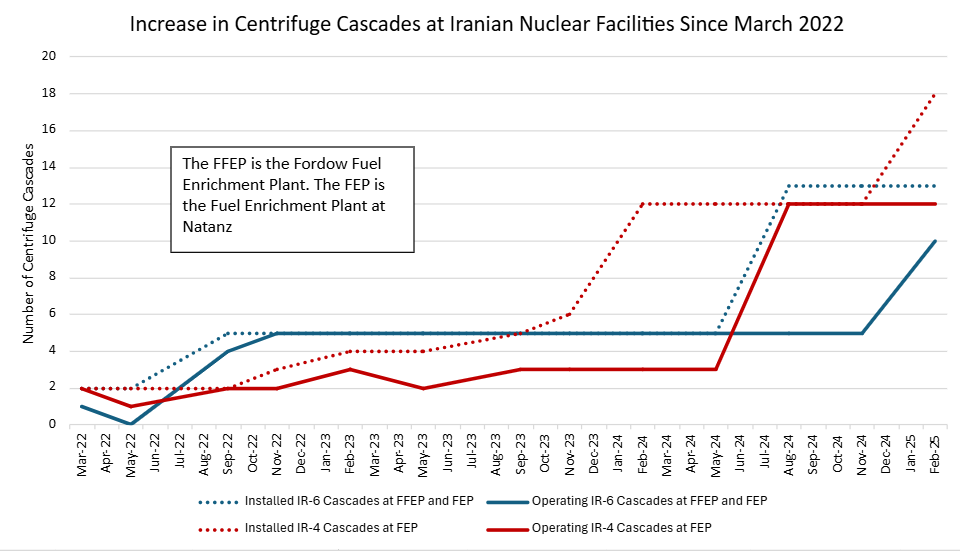
Source: IAEA Verification and Monitoring Reports[8]
This graphic shows the increase in centrifuge cascades at Iranian nuclear facilities since March 2022. The FFEP is the Fordow Fuel Enrichment Plant.[9] The FEP is the Fuel Enrichment Plant at Natanz.[10] The International Atomic Energy Agency (IAEA) defines an operating cascade as cascades that “have been fed with UF6 for enrichment of collected product.”[11] The JCPOA limited Iran's enrichment capacity at the Natanz FEP to no more than 5,060 IR-1 centrifuges in no more than 30 cascades.[12] IR-4 and IR-6 centrifuges are more advanced than IR-1 centrifuges, enabling Iran to enrich uranium at a faster rate.[13]
https://www.understandingwar.org/backgrounder/iran-update-april-18-2025