Iran Update, February 25, 2025
The British ambassador to Israel stated on February 25 that the E3 (the United Kingdom, France, and Germany) has given Iran until the end of June 2025 to conclude a new nuclear deal and prevent the imposition of snapback sanctions. It is very unlikely that Iran will conclude a deal with the E3 and the United States by June 2025, given that such a deal would require Iran to completely change its current policy on negotiations.[1] The JCPOA snapback mechanism allows JCPOA signatories to reimpose UN Security Council sanctions on Iran in the event of “significant non-performance by Iran of JCPOA commitments.” The snapback mechanism expires in October 2025. The JCPOA itself will also effectively expire in October 2025, which means that Iran and the E3 would essentially have to draft a new agreement from scratch. It is very unlikely that Iran, the E3, and the United States would be able to draft such an agreement by June 2025 given that the negotiations that resulted in the JCPOA lasted for years. A new deal would also require Iran to completely change its stance on negotiations. Iranian Supreme Leader Ali Khamenei categorically rejected nuclear negotiations with the United States in a speech on February 7.[2] Iranian officials who previously supported and were involved in negotiations with the United States have since then echoed Khamenei’s rejection of negotiations.[3] The conclusion of a nuclear deal by June 2025 would require Khamenei to reverse his policy on negotiations, which he is unlikely to do.
The International Atomic Energy Agency (IAEA) previously passed a censure resolution proposed by the E3 in November 2024 that requires the IAEA to produce a “comprehensive report” on Iranian nuclear activities by spring 2025.[4] CTP-ISW previously assessed that the IAEA report would almost certainly confirm Iranian noncompliance with the JCPOA and lay the foundation for the E3 to reimpose snapback sanctions in early March 2025.[5] IAEA Director General Rafael Grossi stated on February 14 that the IAEA Board of Governors will not discuss the “comprehensive report” in its March 2025 meeting, however.[6]
The Iranian Artesh and IRGC conducted a joint exercise in the Persian Gulf, Sea of Oman, and the Indian Ocean between February 22 and February 25 that was likely part of Iran’s efforts to project power ahead of a potential Israeli strike on Iran. The Artesh and IRGC concluded the “Zolfaghar 1403” military exercise on February 25.[15] The Artesh Navy and IRGC Aerospace Force conducted their first joint missile operation in which cruise and ballistic missiles ”fully sank” a simulated target in the northern Indian Ocean.[16] This joint effort could help Iran improve its coordination in the event it needs to conduct real-world military operations as part of a retaliation for an Israeli strike. The Artesh reportedly tested the long-range Iranian-made ”Arash” drone, which Iranian officials claim has a range of 1,200 kilometers.[17] The Artesh Navy also displayed its surface and submarine fleet, including destroyers, missile-launching vessels, troop carriers, and Fateh- and Ghadir-class submarines.[18] The focus on missile strikes in this exercise suggests that Iran may have sought to use the exercise to signal that it might respond forcefully to an attack on Iran.
The Iranian rial depreciated from 912,900 rials to one US dollar on February 24 to 918,300 rials to one US dollar on February 25. [68]
https://www.understandingwar.org/backgrounder/iran-update-february-25-2025
1,287 posted on
02/26/2025 12:59:22 AM PST by
AdmSmith
(GCTGATATGTCTATGATTACTCAT)
Iran Update, February 26, 2025
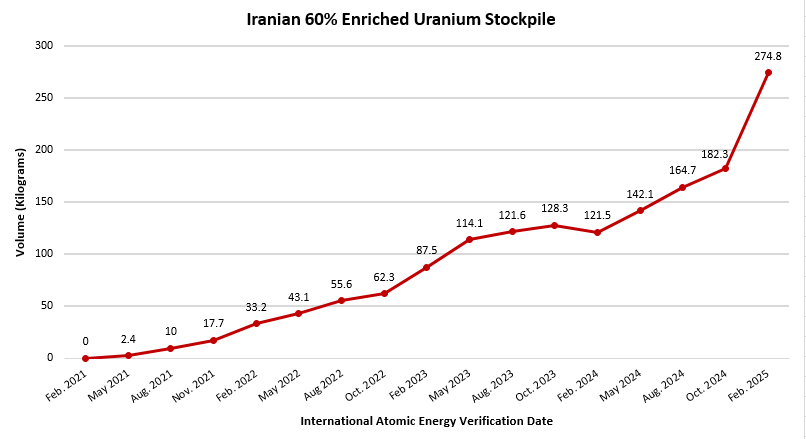
Iran increased its stockpile of 60 percent enriched uranium by 92.5 kilograms (kg), or 2.2 significant quantities, according to an unreleased International Atomic Energy Agency (IAEA) report.[1] A significant quantity is the “approximate amount of nuclear material for which the possibility of manufacturing a nuclear explosive device cannot be excluded.”[2] The Associated Press reported on February 26 that Iran possesses 274.8 kilograms (kg) of uranium enriched up to 60 percent, or 6.6 significant quantities, as of February 8, citing an unreleased IAEA report. This amount marks a 92.5 kg increase in Iran's stockpile of 60 percent enriched uranium and a 2.2 increase in significant quantities since the IAEA published its last report in November 2024.[3] The IAEA report stated that Iran's total stockpile of enriched uranium is at 8,294.4 kgs, marking a 1,690 kg increase since November 2024.[4] The IAEA report also noted that Iranian officials continued to prevent four additional experienced IAEA inspectors from monitoring the Iranian nuclear program.
The significant expansion in Iran's enriched uranium stockpile coupled with Iran's categorical rejection of nuclear negotiations with the United States makes it very unlikely that Iran will conclude a deal with the E3 and the United States ahead of June 2025. The E3 reportedly gave Iran a June 2025 deadline to conclude a nuclear deal before the E3 imposes snapback sanctions.[5] The JCPOA snapback mechanism allows JCPOA signatories to reimpose UN Security Council sanctions on Iran in the event of “significant non-performance by Iran of JCPOA commitments.”[6]
Iran is continuing its preparations for a potential Israeli strike on Iranian nuclear facilities. Atomic Energy Organization of Iran Head Mohammad Eslami stated that Iran will hold nuclear defense exercises at nuclear facilities in Iran on February 26 and 27.[7] The Islamic Revolutionary Guards Corps (IRGC) Aerospace Force and the Artesh previously conducted air defense exercises around Iranian nuclear facilities in Fordow, Natanz, and Arak in January 2025.[8] Two unspecified senior Iranian officials recently stated that Iran is bolstering its air defenses ahead of a potential Israeli strike on Iran.[9]
Senior Iranian military commanders continued to threaten on February 26 that Iran could attack the United States and Israel in response to a potential Israeli attack on Iran. IRGC Commander Major General Hossein Salami stated that the United States and Israel should “expect humiliation.”[10] Artesh Commander Major General Abdol Rahim Mousavi similarly stated that Iran will “attack [US and Israeli] security without hesitation” if the United States and Israel attack Iran.[11] These statements come after senior Iranian military commanders have resurfaced threats to conduct direct attacks on US and Israeli interests in the region, likely to deter a potential Israeli strike on Iran.[12] Iran still retains a large number of short-range ballistic missiles that it could use to strike US bases in the Middle East if it chooses to do so. IRGC Aerospace Force Commander Brigadier General Amir Ali Hajji Zadeh recently warned that Iran could attack US bases with short-range missiles in response to an Israeli attack.[13]
The United States sanctioned six Hong Kong and China-based entities that supply the Iranian drone and ballistic missile program. These sanctions are part of the US ”maximum pressure” policy.[54] Iranian supply firm Pishtazan Kavosh Gostar Boshra (PKGB) and its subsidiary Narin Sepehr Mobin Isatis (NSMI) have used the following six front companies to procure the following items after the United States sanctioned a Hong Kong-based PKGB network last year:[55]
https://www.understandingwar.org/backgrounder/iran-update-february-26-2025
1,288 posted on
02/26/2025 11:57:56 PM PST by
AdmSmith
(GCTGATATGTCTATGATTACTCAT)
FreeRepublic.com is powered by software copyright 2000-2008 John Robinson