Iran received a large shipment of a chemical precursor for solid missile propellant from China on February 13.[13] Western media reported on January 22 that two Iranian cargo vessels, Golbon and Jairan, carrying over 1100 tons of sodium perchlorate, will travel from China to Iran over the “next few weeks.”[14] The Golbon arrived at Bandar Abbas port, Hormozgan Province, on February 13 with “most” of the total shipment, according to two unspecified European intelligence sources.[15] The Islamic Revolutionary Guard Corps Procurement Department of the Self Sufficiency Jihad Organization (SSJO) reportedly received the shipment. The SSJO is partially responsible for Iran's ballistic missile research and development and was sanctioned by the United States in 2017 for contributing to the proliferation and delivery of weapons of mass destruction.[16]
One thousand one hundred tons of sodium perchlorate can be converted to slightly over 1000 tons of ammonium perchlorate, which is the main component for solid propellant for missiles. Unspecified Western officials estimated that 1000 tons of ammonium perchlorate can—if converted to solid fuel propellant—fuel up to 260 mid-range Iranian ballistic missiles.[17] These officials may be referring to medium-range ballistic missiles (MRBM), which have a range of between 1,000km and 3,000km. Iran used MRBMs to target Israel in April and October 2024. That amount of ammonium perchlorate can also produce larger quantities of other types of smaller munitions that require less solid fuel, including shorter-range ballistic missiles. It is unclear when the second vessel, Jairan, will depart from China.
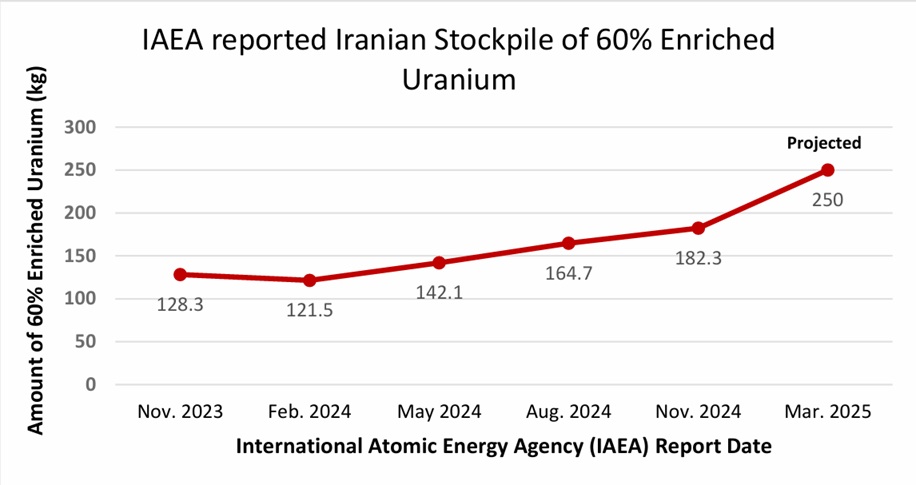
International Atomic Energy Agency (IAEA) Director Raphael Grossi stated that Iran will likely have 250kg of uranium enriched up to 60% by the next IAEA report in March 2025. This marks a significant increase in Iran's stockpile of 60 percent enriched uranium since the IAEA’s last report in November 2024.[18] The IAEA reported in November 2024 that Iran had 182.3 kg of enriched uranium, up to 60 percent.[19] 250 kg of enriched uranium up to 60 percent is equivalent to 6 significant quantities, marking over a 1.5 increase in significant quantities since the IAEA’s last report.[20] The IAEA defines a significant quantity as the “approximate amount of nuclear material for which the possibility of manufacturing a nuclear explosive device cannot be excluded.”[21] Grossi also told Reuters that the IAEA would likely delay issuing a comprehensive report on Iran's nuclear activities beyond March, when the IAEA initially intended to release the report.[22]
The IAEA passed an E3 (the United Kingdom, France, and Germany) censure resolution against Iran in November 2024 that requires the IAEA to produce a “comprehensive report” on Iranian nuclear activities by spring 2025.[23] CTP-ISW previously assessed that the report would almost certainly confirm Iranian noncompliance with the 2015 Joint Comprehensive Plan of Action (JCPOA) and lay the foundation for further action against Iran's nuclear program.[24]
https://www.understandingwar.org/backgrounder/iran-update-february-14-2025