Yeah right.
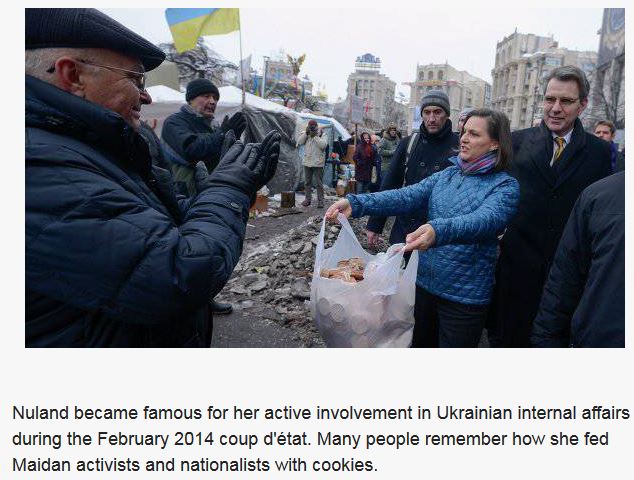

Yeah right.
It was not a coup, it was a popular revolution... by the time parliament voted, Ukrainian parliament voted to remove Yanukovych from office by 328 to 0
Revolution of Dignity
https://en.wikipedia.org/wiki/Revolution_of_Dignity
This article is about the 2014 Ukrainian revolution. For other uses, see Revolution of Dignity (disambiguation).
Revolution of Dignity
Goals
Removal of President Viktor Yanukovych
Restoration of the 2004 amendments to the Constitution of Ukraine
Methods
Protesting, rioting, civil disobedience, insurrection
Resulted in Euromaidan / Opposition victory
Full results
Parties to the civil conflict
Euromaidan protestors
Ukraine Government of Ukraine
Supported by:
Russia (alleged)
Lead figures
Arseniy Yatsenyuk
Vitali Klitschko
Oleh Tyahnybok
Petro Poroshenko
Yuriy Lutsenko
Oleksandr Turchynov
Yulia Tymoshenko
Andriy Parubiy
Andriy Sadovyi
Arsen Avakov
Dmytro Yarosh
Ruslana
Viktor Yanukovych
Serhiy Arbuzov
Vitaliy Zakharchenko
Oleksandr Yefremov
Andriy Klyuyev
Hennadiy Kernes
Mikhail Dobkin
Viktor Pshonka
Olena Lukash
Yuriy Boyko
Leonid Kozhara
Dmytro Tabachnyk
Number
Kyiv:
400,000–800,000 protesters[8]
12,000 “self-defense sotnia”[9][10]
Across Ukraine:
50,000 (Lviv)[11]
20,000 (Cherkasy)[12]
10,000+ (Ternopil)[13]
other cities and towns
Law enforcement in Kyiv:
4,000 Berkut
1,000 Internal Troops
3,000–4,000 titushky[14]
Pro-government/anti-EU demonstrations:
20,000–60,000 (Kyiv)
40,000 (Kharkiv)[15]
15,000 (Donetsk)[16]
10,000 (Simferopol)[17]
2,500 pro-Russia (Sevastopol)[18]
Casualties and losses
Deaths: 108 (January–February)[19]
Injured: 1,100+[20][21]
Arrested: 77[22]
Deaths: 13[19]
Injured: 272[21]
Captured: 67[23]
Overall deaths: 121[19]
Overall injuries: 1,811
Ministry of Healthcare totals (16 April 2014 @6:00 LST)[24]
Not to be confused with Maidan Uprising the previous year.
The Revolution of Dignity (Ukrainian: Революція гідності, romanized: Revoliutsiia hidnosti), also known as the Maidan Revolution,[2] took place in Ukraine in February 2014[2][1] at the end of the Euromaidan protests,[1] when deadly clashes between protesters and the security forces in the Ukrainian capital Kyiv culminated in the ousting of elected President Viktor Yanukovych just prior to him being impeached.
In November 2013, a wave of large-scale protests (known as Euromaidan) erupted in response to President Yanukovych’s sudden decision not to sign a political association and free trade agreement with the European Union (EU), instead choosing closer ties to Russia and the Eurasian Economic Union. In February of that year, the Verkhovna Rada (Ukrainian parliament) had overwhelmingly approved of finalizing the agreement with the EU.[25] Russia had put pressure on Ukraine to reject it.[26] These protests continued for months and their scope widened, with calls for the resignation of Yanukovych and the Azarov Government.[27] Protesters opposed what they saw as widespread government corruption and abuse of power, the influence of oligarchs, police brutality, and violation of human rights in Ukraine.[28][29] Repressive anti-protest laws fuelled further anger.[28] A large, barricaded protest camp occupied Independence Square in central Kyiv throughout the ‘Maidan Uprising’.
The first protesters were killed in fierce clashes with police on Hrushevsky Street on 19–22 January. Thousands of protesters advanced towards parliament, led by activists with shields and helmets, and were fired on by police snipers.[19] On 21 February, an agreement between President Yanukovych and the leaders of the parliamentary opposition was signed that called for the formation of an interim unity government, constitutional reforms and early elections.[31] The following day, police withdrew from central Kyiv, which came under effective control of the protesters. Yanukovych fled the city and then the country.[32] That day, the Ukrainian parliament voted to remove Yanukovych from office by 328 to 0 (72.8% of the parliament’s 450 members).[33][34][35][31]
The interim government, led by Arseniy Yatsenyuk, signed the EU association agreement and disbanded the Berkut. Petro Poroshenko became president after a victory in the 2014 presidential elections (54.7% of the votes cast in the first round). The new government restored the 2004 amendments to the Ukrainian constitution that had been controversially repealed as unconstitutional in 2010,[39] and initiated a large-scale purge of civil servants associated with the overthrown regime.[40][41][42] There was also a widespread decommunization of the country.