Obviously you lack the historical context surrounding Crimea and how it became part of Ukraine. Moreover, you don't grasp the importance of Crimea as a Russian strategic military asset long before Ukraine became independent.
Crimea was part of Russia/Soviet Union since 1783. On 19 February 1954, the Presidium of the Supreme Soviet of the USSR issued a decree on the transfer of the Crimean region of the RSFSR to the Ukrainian SSR. This Supreme Soviet Decree states that this transfer was motivated by "the commonality of the economy, the proximity, and close economic and cultural relations between the Crimean region and the Ukrainian SSR".
At that time no vote or referendum took place, and Crimean population had no say in the transfer (also typical of other Soviet border changes). After the annexation of Crimea by the Russian Federation, doubts have been expressed – from the Russian side by all means, but even by Western historians (Richard Sakwa, "Frontline Ukraine. Crisis in the Borderlands", 2015) – about the very legitimacy of the 1954 transition of Crimea to Ukraine; in the critics' view the transition contradicted even the Soviet law.
With dissolution of the Soviet Union underway, the Ukrainian SSR declared its sovereignty. Half year later in January 1991, the Crimean Oblast held a referendum, and voters approved on restoring autonomy to the region the Crimean Autonomous Soviet Socialist Republic. The Crimean ASSR was restored for less than a year as part of Soviet Ukraine before Ukrainian independence. Newly independent Ukraine maintained Crimea's autonomous status, while the Supreme Council of Crimea affirmed the peninsula's "sovereignty" as a part of Ukraine. with a slight majority of Crimean voters approving Ukrainian independence in a December referendum.
After the Revolution of Dignity and the flight of Ukrainian President Viktor Yanukovych from Kyiv on 21 February 2014, Russian President Vladimir Putin stated to colleagues that "we must start working on returning Crimea to Russia." Within days, unmarked forces with local militias took over the Autonomous Republic of Crimea and Sevastopol, as well as occupying several localities in Kherson Oblast on the Arabat Spit, which is geographically a part of Crimea. A 2014 referendum on merging Crimea with Russia was supported by 96.7% of voters with a 83.1% turnout according to official counts, although it was boycotted by many loyal to Ukraine and denounced as illegitimate by Western governments. The United Nations General Assembly approved a resolution declaring the vote illegal and invalid.
The fact is, Ukraine is a state but not yet a nation. In the thirty years of its independence, it has not yet found a leader who can unite its citizens in a shared concept of Ukrainian identity. Yes, Russia has interfered, but it is not Russian interference that created Ukrainian disunity but rather the haphazard way the country was assembled from parts that were not always mutually compatible.
The territory of the Ukrainian state claimed by the government in Kyiv was assembled, not by Ukrainians themselves but by outsiders, and took its present form following the end of World War II. To think of it as a traditional or primordial whole is absurd. This applies a fortiori to the two most recent additions to Ukraine—that of some eastern portions of interwar Poland and Czechoslovakia, annexed by Stalin at the end of the war, and the largely Russian-speaking Crimea, which was transferred from the Russian Socialist Federated Soviet Republic (RSFSR) well after the war, when Nikita Khrushchev controlled the Communist Party of the Soviet Union.
Since all constituent parts of the USSR were ruled from Moscow, it seemed at the time a paper transfer of no practical significance. (Even then, the city of Sevastopol, the headquarters of the Black Sea Fleet, was subordinated directly to Moscow, not Kyiv.) Up to then, the Crimea had been considered an integral part of Russia since Catherine II “the Great” conquered it in the 18th century.
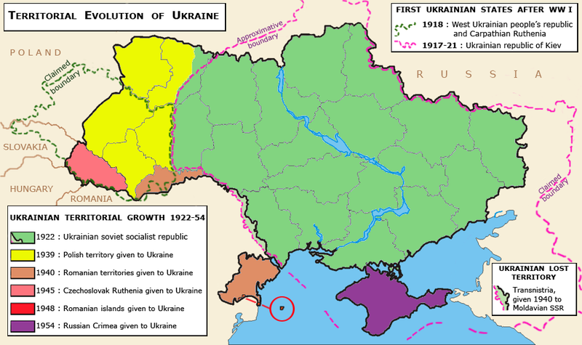
The lumping together of people with strikingly different historical experience and comfortable in different (though closely related) languages underlies the current divisions. Over 75% of Crimea speak Russian as the first language.
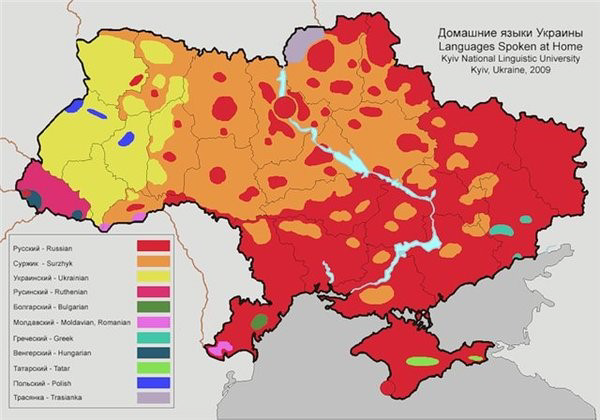
From its inception as an internationally recognized independent state, Ukraine has been deeply divided along linguistic and cultural lines. Nevertheless, it has maintained a unitary central government rather than a federal one that would permit a degree of local autonomy.
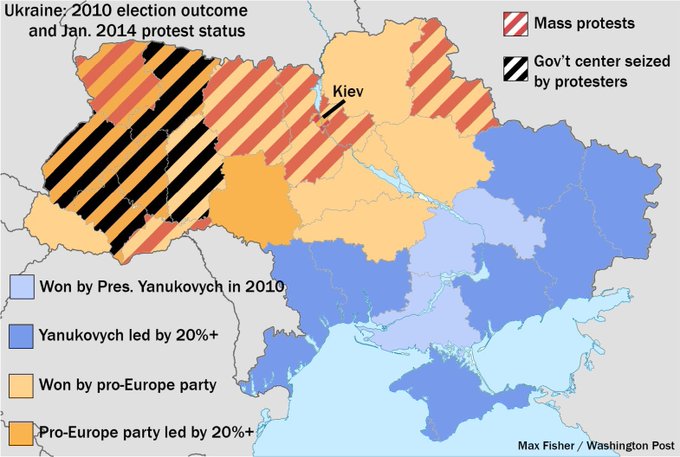
Note in the following map of election results in 2010, how closely the political divide in Ukraine parallels the linguistic divide. Yanukovych was the pro-Russian candidate.

The Ukrainian revolution of 2014 started with protests over President Yanukovich’s decision not to sign an agreement with the European Union. The United States and the EU openly supported the demonstrators and spoke of detaching Ukraine from what one might call the Russian (past Soviet) security sphere and attaching it to the West through EU and NATO membership. Never mind that Ukraine was unable at that time to meet the normal requirements for either EU or NATO membership. Violence started, first in the Ukrainian nationalist West, with irregular militias taking over the local offices headed by Yanukovich appointees.
On February 20, 2014, demonstrations in Kyiv, which up to then had been largely peaceful, turned violent even though a compromise agreement had been reached to hold early elections. Many demonstrators were shot by sniper fire and President Yanukovich fled the country. Demonstration leaders claimed that the government’s security force, the Berkut, was responsible for initiating the shooting, but subsequent trials failed to substantiate this. In fact, most of the sniper fire came from buildings controlled by the demonstrators. The Obama/Biden Administration played a role in taking down the elected government. Victoria Nuland, the current Deputy Secretary of State, was the tip of the spear in this effort.
The United States and most Western countries immediately recognized the successor government, but Russia and many Russian-speaking Ukrainians considered Yanukovich’s ouster the result of an illegal coup d’état. A rebellion occurred in the Eastern provinces of Donetsk and Luhansk and Russia supported the rebels with military equipment and irregular forces.
In Crimea, local leaders declared independence and requested annexation by Russia. A referendum was conducted under the watchful eye of “little green men” infiltrated from Russia. There was no resistance by Ukrainian military or police forces, and Russia officially annexed the peninsula when the referendum resulted in an overwhelming pro-Russian vote. There was no fighting and no casualties in Crimea.
Russia is extremely sensitive about foreign military activity adjacent to its borders, as any other country would be and the United States always has been. It has signaled repeatedly that it will stop at nothing to prevent NATO membership for Ukraine. Nevertheless, eventual Ukrainian membership in NATO has been an avowed objective of U.S. and NATO policy since the Bush-Cheney administration. This makes absolutely no sense. It is also dangerous to confront a nuclear-armed power with military threats on its border.>/b>
As for the future, the only thing that will convince Moscow to withdraw its military support from the separatist regimes in the Donbas will be Kyiv’s willingness to implement the Minsk agreement.
As for the Crimea,it is likely to be a de facto part of Russia for the foreseeable future, whether or not the West recognizes that as “legal.” For decades, the U.S. and most of its Western allies refused to recognize the incorporation of the three Baltic countries in the Soviet Union. This eventually was an important factor in their liberation. However, the Crimea is quite different in one key respect: most of its people, being Russian, prefer to be in Russia. In fact, one can argue that it is in the political interest of Ukrainian nationalists to have Crimea in Russia. Without the votes from Crimea, Viktor Yanukovich would never have been elected president.