You do realize that comets have two basic tails - dust and ion? And that tails are composed largely of dust and ions? That would do nothing more that give a meteor shower?
There is nothing in that picture that violates what physics currently theorizes about comets. From wiki:
The streams of dust and gas each form their own distinct tail, pointing in slightly different directions. The tail of dust is left behind in the comet's orbit in such a manner that it often forms a curved tail called the antitail, only when it seems that it is directed towards the Sun. At the same time, the ion tail, made of gases, always points along the streamlines of the solar wind as it is strongly affected by the magnetic field of the plasma of the solar wind. The ion tail follows the magnetic field lines rather than an orbital trajectory. Parallax viewing from the Earth may sometimes mean the tails appear to point in opposite directions.[1]


Question:
Does Ion gas glow on its own through static electricity or radiation given off and blown through space by stars?
Or does it only give off light by refection from stars?
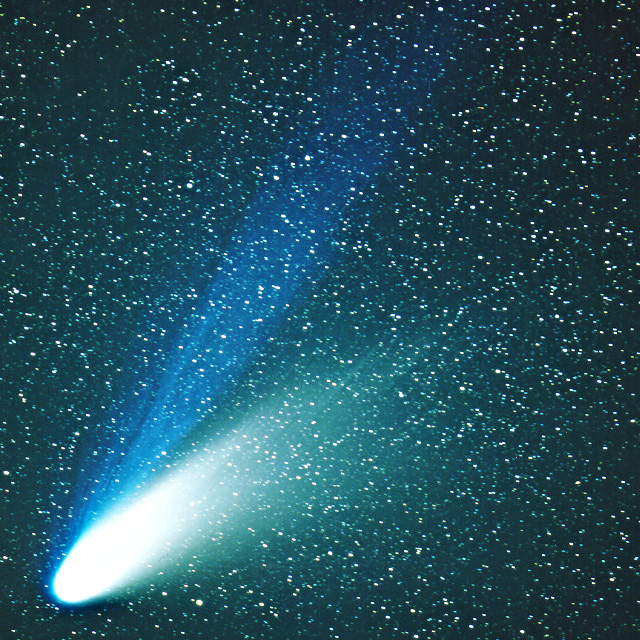
I can remember before I retired out of "Eglin AFB/Duke Field " going out deep into the air-to-ground range, to get away from light, to view the March 21 -22, 1997 Comet Hale-Bopp.
It was in the wee hours of the morning after a swing shift.
It took about 15 or 20 minutes for me to naturally get my night vision going, buty the comet was huge, and covered about half the length of the night sky.
I laid on the hood of my truck on that very cold night until I couldn't take the cold any more.
As I was leaving the range, a range officer stopped me and asked me what I was doing out there at 3:30 am.
Not only did I tell him, but I took him out to where I had parked and waited until he got his night vision going, and he was surprised because he didn't even know it was passing.
I guess that's what started my interest in comets.