To: Darksheare
You do realize that the camera there operates on emitted/reflected light, not size of the object? And comets have a nasty habit of outgassing, which reflects light. And not at all in correlation to size of the comet? Actually contrary to what was posted regarding the STEREO-A image, ISON was actually closer to the camera than Eneke and by a very large factor. (See my previous post and links.)
Comet Eneke while larger than ISON, is a periodic comet that completes an orbit of the Sun once every three years — the shortest period of any known comet. Unlike ISON which was making its first trip into the inner solar system and is (was) a close sun grazer, and rather unsuccessfully since it broke up and disintegrated, Eneke is not a close sun grazer but its regular orbit through our solar system and around the sun has what astronomers call “hardened” it, i.e. its regular orbit of once every three years has created a tough outer shell and hence a rather small coma. Eneke also has a very low albedo, reflecting only 4.6% of the light it receives.
ISON on the other hand, while its nucleolus was smaller than Eneke, being “a comsic virgin”, it had a larger coma on its inbound path because it had a lot more icy material to outgass.
To: MD Expat in PA
" ISON was actually closer to the camera than Eneke and by a very large factor"
WRONG !
Here's some more proof
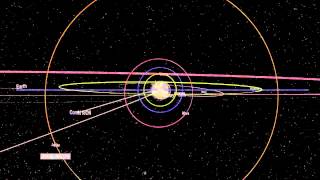
Look at this one, too at about 45 seconds into the video.
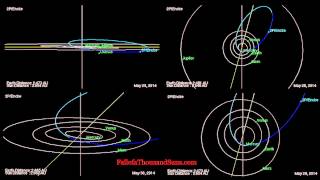
Look at about 15 or 16 seconds into Comet Encke's orbit video.
If you're fast you can stop it on 2013/11/20.
Look at this on, too.
You can get a better view of both on BREarthWatch's video that shows three different diagrams that clearly depicts all the items concerned, from 2:00 minutes in his video diagrams up to 2 minutes 45 seconds and even beyond.
The FACTS ARE, that even on November 22, 2013, and on November 21, and on November 20th,
ISON was outside of Mercury's orbit, between Mercury and Venus;
But on the 19th of November Encke comes very close to Mercury and PASSED IT TO GO SLIGHTLY INSIDE OF MERCURY'S ORBIT, between Mercury and the Sun (16 seconds into this video).
So the FACTS blow your
theory into the "FALSE" category. Look at this one, too at about 45 seconds into the video.
255 posted on
12/15/2013 9:58:59 AM PST by
Yosemitest
(It's Simple ! Fight, ... or Die !)
To: MD Expat in PA
CORRECTION TO ERROR:
" ISON was actually closer to the camera than Eneke and by a very large factor"
WRONG !
Here's some more proof:
Look at this one, too at about 45 seconds into the video.
Look at about 15 or 16 seconds into Comet Encke's orbit video.
If you're fast you can stop it on 2013/11/20.
Look at this on, too.
You can get a better view of both on BREarthWatch's video that shows three different diagrams that clearly depicts all the items concerned, from 2:00 minutes in his video diagrams up to 2 minutes 45 seconds and even beyond.
The FACTS ARE, that even on November 22, 2013, and on November 21, and on November 20th,ISON was outside of Mercury's orbit, between Mercury and Venus;
But on the 19th of November Encke comes very close to Mercury and PASSED IT TO GO SLIGHTLY INSIDE OF MERCURY'S ORBIT, between Mercury and the Sun (16 seconds into this video).
So the FACTS blow your theory into the "FALSE" category.
Look at this one, too at about 45 seconds into the video.
258 posted on
12/15/2013 10:12:14 AM PST by
Yosemitest
(It's Simple ! Fight, ... or Die !)
FreeRepublic.com is powered by software copyright 2000-2008 John Robinson