More from Anandtech:
More Details on NVIDIA's Tegra 4 & i500: 5th core is A15, 28nm HPL, UE Category 3 LTE
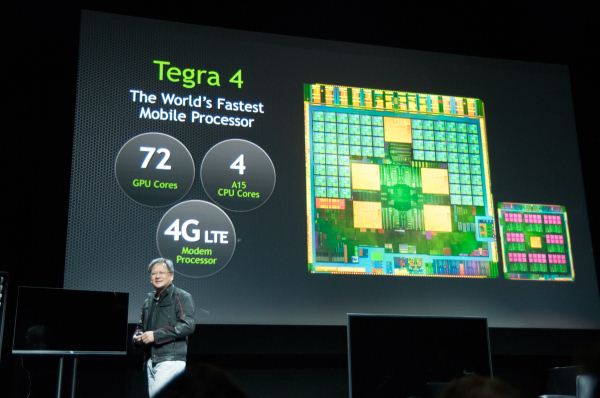
We just finished NVIDIA's CES press conference where it introduced the Tegra 4 SoC and Shield mobile gaming console. Immediately following the press event we snagged some more information about Tegra 4 and the NVIDIA i500 Baseband silicon:
- Tegra 4 is built on TSMC's 28nm HPm process (low power 28nm with High-K + Metal Gate)
Just confirmed that our initial information was incorrect, it's 28nm HPL (28nm low power with high-k + metal gates). The difference between HPL and HPM is a optimization for leakage vs. peak performance. This helps explain the 1.9GHz max frequency for the A15s in Tegra 4.
- The fifth/companion core is also a Cortex A15, but synthesized to run at lower frequencies/voltages/power. This isn't the same G in and island of LP process that was Tegra 2/3.
- The fifth/companion core isn't visible to the OS, it's not big.LITTLE but it'll work similarly to how Tegra 3 worked. This probably means no companion core in Windows RT.
- The four Cortex A15s will run at up to 1.9GHz.
- NEW: die size is around 80mm^2, slightly bigger than Tegra 3 but on a much higher density process
- NEW: the shaders aren't unified, the majority are 20-bit pixel shader cores though. No idea on the ratio yet.
- dual-channel memory interface, LP-DDR3 is supported
- NVIDIA's i500 will launch with LTE UE Category 3 (100Mbps downlink) support, eventually we'll see an update to UE Category 4 (150Mbps downlink).
- i500 will launch with carrier aggregation for WCDMA, no idea what 3GPP release.
Shield
- As far as Shield goes, I wanted to correct one thing about how the PC display streaming works. The PC will stream to the display directly, not through Shield. Shield will pass controller commands to the PC.
- Shield will launch in Q2 at a price competitive with other mobile gaming systems and tablets.
- All of the games during the Shield demo were 720p, except for one which was 1080p.
- Miracast is supported, but something better will come later.

