The Sun has changed its character
A number of solar parameters are weak, and none is weaker than the Ap Index:
Figure 1: Ap Index 1932 to 2026
Figure 1 shows the Ap Index from 1932 with a projection to the end of Solar Cycle 24 in 2026. The Ap Index has not risen much above the previous floor of activity in the second half of the 20th Century. It is also now far less volatile. With now less than a year to solar maximum in 2013, the Ap Index is now projected to trail off to a new low next decade.
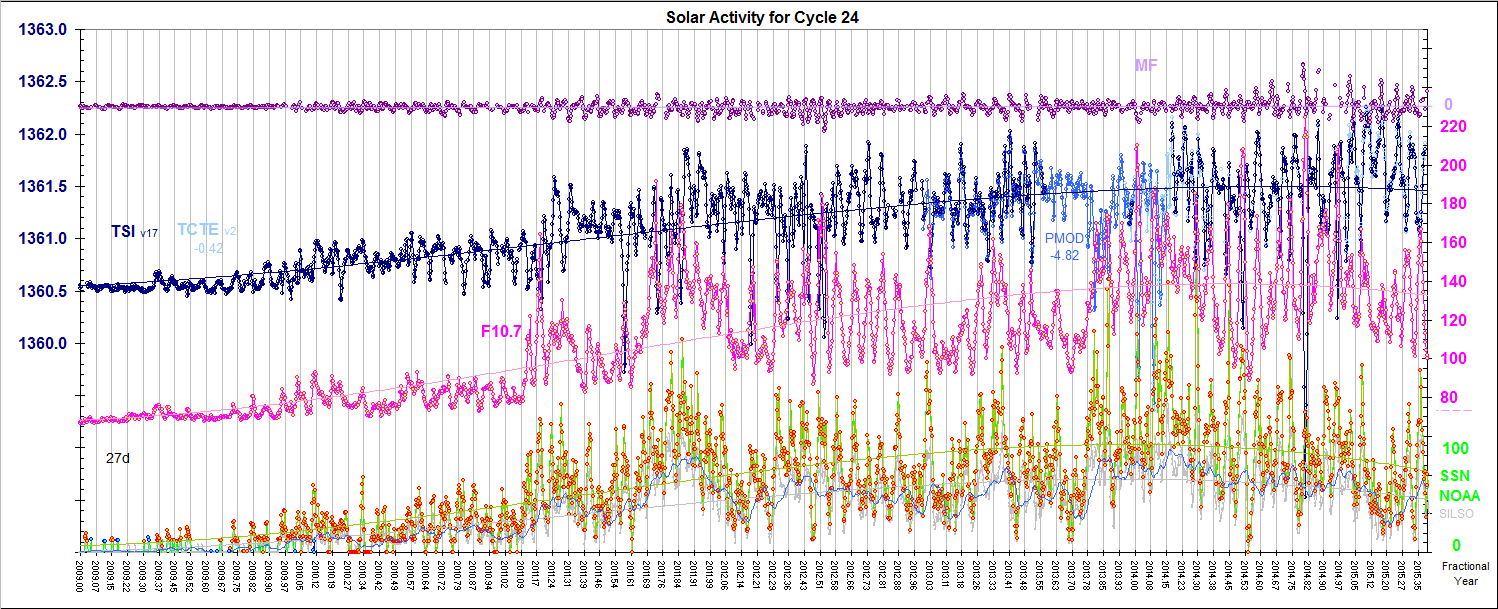
Figure 2: Mean Field, TSI, F10.7 Flux and Sunspot Count from 2008
This figure is from: http://www.leif.org/research/TSI-SORCE-2008-now.png
What is evident from Figure 2 is that the spikes down in the F10.7 flux and sunspot count are almost to absolute minimum levels. The underlying level of activity is only a little above that of solar minimum.
Figure 3: Oulu Neutron Count 1964 – 2026
Similar to the Ap Index, activity is only slightly above levels of previous solar minima. The figure includes a projection to the end of Solar Cycle 24 in 2026 which assumes that the neutron count in the next minimum will be similar to that of the 23/24 minimum. Previous cold periods have been associated with significant spikes in Be10 and C14. Perhaps the neutron count might get much higher yet into the 24/25 minimum.
Figure 4: UAH Monthly Temperature versus Low Global Cloud Cover
The cloud cover data for this figure was provided by Professor Ole Humlum. There is a significant relationship between low global cloud cover and global temperature. Assuming that the relationship is linear and remains linear at higher cloud cover percentages, this figure attempts to derive what cloud cover percentage is required to get the temperature decline of 0.9°C predicted by Solheim, Stordahl and Humlum in their paper entitled “The long sunspot cycle 23 predicts a significant temperature decrease in cycle 24” available at: http://arxiv.org/pdf/1202.1954v1.pdf
Figure 4 suggests that the predicted result will be associated with a significant increase in cloudiness.
Figure 5: Low Level Cloud Cover plotted against Oulu Neutron Count
This figure, most likely repeating other people’s work, suggests that there is little correlation between neutron count and cloud cover. Higher neutron counts may be a coincident with colder climate than a significant causative factor. Perhaps EUV, the Ap Index and other factors are more significant in climate change. Also, on a planet with a bistable climate of either ice age or interglacial, it may be that accidents of survival of snowpack over the northern summer are also important.
Perth-based scientist David Archibald is a Visiting Fellow of the Institute of World Politics in Washington where he teaches a course in Strategic Energy Policy.


No … the the sky is falling AGW proponents simply could not let “clean” natural gas from frac wells go unchallenged – lowered CO2 will never do – must maintain alarm at all costs – even if it means cooking the books and fibbing.
The NEW attack is that natural gas from shale frac’ing is WORSE THAN COAL! Yep – Horwath and Ingraffea from Cornell published a doom and gloom report claiming exactly that … claiming that the frac process releases large amounts of methane to the atmosphere – and that all that methane – a greenhouse gas more potent than CO2 – actually makes natural gas from frac processing worse than coal when it comes to CAGW.
It would be nice to say they conveniently ignore some very key facts – but the truth is they carefully crafted their report to ignore and avoid important relevant facts that disprove their claim. Worse – they are supported and cheered on by “Gas Land” filmmaker and pro scare monger Josh Fox – he of the burning faucets videos.
The most important is that while methane is more potent as a greenhouse gas – it also has a very short residence time in the atmosphere compared to CO2. A number of others who appear to actually be real scientists who care about truth and accuracy as opposed to advocacy masquerading as science all thoroughly refuted.
It was shown their claims largely ignored that most methane is burned off at the well head – never reaching the atmosphere. Data from 90,000 wells show they dramatically overstate – hard data reduced their claims by half. And that methane is a valuable commodity – that is increasingly being captured at the well head.
Paulina Jaramillo of Carnegie Mellon University is an expert on carbon footprint. She went back and studied the issue and found that even with high rates of methane leaking out, shale gas was still better than coal.
Even the geology department at Cornell thinks their claims are bordering on silly. Larry Catho’s and his colleagues authored a rebuttal paper that showed these claims were vastly overstated
AND as noted, they criticized the improper use of – or ignoring of – time scales. CO2 stays in atmosphere for 100+ years – methane a decade or less. Even if the methane had 100% of the global warming equivalency as the CO2 it reduces it is still a vast improvement. Ten years later it is gone – while the CO2 it replaces is around 100 years or more.
This is IMO simple intellectual fraud. Ignoring clear facts to promote and advocate for the “cause.”
Ingraffea says their scientific fraud doesn’t matter:
There is the smoking gun right there. You know they’re lying – that they are not scientists but simple blind advocates, when they ignore the fraud and excuse it with unsuppoorted and ridiculous scare mongering.
Bring in the Clowns ….
MORE HERE
The GUARDIANS GARBAGE HERE
Revkin weighs in HERE