James Madison addresses this very point.
The great mass of suits in every State lie between Citizen & Citizen, and relate to matters not of federal cognizance. . . . What can he mean by saying that the Common law is not secured by the new constitution, though it has been adopted by the State Constitutions. The common law is nothing more than the unwritten law, and is left by all the constitutions equally liable to legislative alterations. I am not sure that any notice is particularly taken of it in the Constitutions of the States. If there is, nothing more is provided than a general declaration that it shall continue along with other branches of law to be in force till legally changed. The constitution of Virga. drawn up by Col Mason himself, is absolutely silent on the subject. An ordinance passed during the same Session, declared the Common law as heretofore & all Statutes of prior date to the 4 of James I. to be still the law of the land, merely to obviate pretexts that the separation from G. Britain threw us into a State of nature, and abolished all civil rights and Obligations. Since the Revolution every State has made great inroads & with great propriety in many instances on this monarchical code. The "revisal of the laws" by a Committe[e] of wch. Col. Mason was a member, though not an acting one, abounds with such innovations. The abolition of the right of primogeniture, which I am sure Col. Mason does not disapprove, falls under this head. What could the Convention have done? If they had in general terms declared the Common law to be in force, they would have broken in upon the legal Code of every State in the most material points: they wd. have done more, they would have brought over from G.B. a thousand heterogeneous & antirepublican doctrines, and even the ecclesiastical Hierarchy itself, for that is a part of the Common law. If they had undertaken a discrimination, they must have formed a digest of laws, instead of a Constitution.
There have been several SC cases but no solid definition of natural born citizen that eliminates a person that is born on US soil from being a natural born citizen.
There are three solid definitions of the term from the Era of 1787 of which I am aware. There is the Vattel Definition, which was Cited by Chief Justice of the Supreme Court John Marshall and Justice Washington in 1811 in the case of "The Venus."
The Venus, 12 U.S. 8 Cranch 253 253 (1814)
Supreme Court Justice Washington:
"1. The writers upon the law of nations distinguish between a temporary residence in a foreign country for a special purpose and a residence accompanied with an intention to make it a permanent place of abode. The latter is styled by Vattel "domicile," which he defines to be, "a habitation fixed in any place, with an intention of always staying there." Such a person, says this author, becomes a member of the new society, at least as a permanent inhabitant, and is a kind of citizen of an inferior order from the native citizens, but is nevertheless united and subject to the society without participating in all its advantages. This right of domicile, he continues, is not established unless the person makes sufficiently known his intention of fixing there, either tacitly or by an express declaration. Vatt. 92-93. Grotius nowhere uses the word "domicile," but he also distinguishes between those who stay in a foreign country by the necessity of their affairs or from any other temporary cause and those who reside there from a permanent cause. The former he denominates "strangers" and the latter "subjects," and it will presently be seen by a reference to the same author what different consequences these two characters draw after them.
Chief Justice Marshall:
The whole system of decisions applicable to this subject rests on the law of nations as its base. It is therefore of some importance to inquire how far the writers on that law consider the subjects of one power residing within the territory of another, as retaining their original character or partaking of the character of the nation in which they reside.
Vattel, who, though not very full to this point, is more explicit and more satisfactory on it than any other whose work has fallen into my hands, says
"The citizens are the members of the civil society; bound to this society by certain duties, and subject to its authority, they equally participate in its advantages. The natives or indigenes are those born in the country of parents who are citizens. Society not being able to subsist and to perpetuate itself but by the children of the citizens, those children naturally follow the condition of their fathers, and succeed to all their rights."
"The inhabitants, as distinguished from citizens, are strangers who are permitted to settle and stay in the country. Bound by their residence to the society, they are subject to the laws of the state while they reside there, and they are obliged to defend it because it grants them protection, though they do not participate in all the rights of citizens. They enjoy only the advantages which the laws or custom gives them. The perpetual inhabitants are those who have received the right of perpetual residence. These are a kind of citizens of an inferior order, and are united and subject to the society, without participating in all its advantages."
"The domicile is the habitation fixed in any place with an intention of always staying there. A man does not, then, establish his domicile in any place unless he makes sufficiently known his intention of fixing there, either tacitly or by an express declaration. However, this declaration is no reason why, if he afterwards changes his mind, he may not remove his domicile elsewhere. In this sense, he who stops, even for a long time, in a place for the management of his affairs has only a simple habitation there, but has no domicile."
A domicile, then, in the sense in which this term is used by Vattel, requires not only actual residence in a foreign country, but "an intention of always staying there." Actual residence without this intention amounts to no more than "simple habitation."
There is the definition obtained from John Adams Personal law book written by Mathew Bacon in 1736:
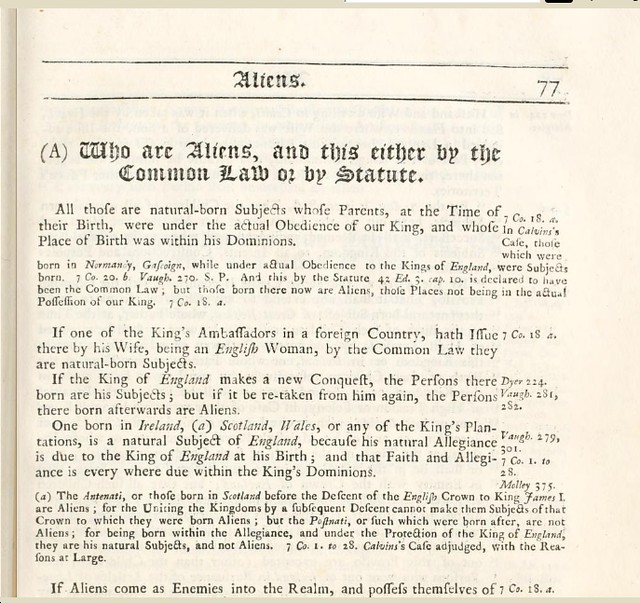
And then finally, there is the "Dissertation On The Manner Of Acquiring The Character And Privileges Of A Citizen Of The United States By Dr. David Ramsay in 1789."(Widely circulated among the members of the first Congress)In it he says:
The citizenship of no man could be previous to the declaration of independence, and, as a natural right, belongs to none but those who have been born of citizens since the 4th of July, 1776.
While we're at it, we might as well throw in Aristotle.(322 BC)
Who is the citizen, and what is the meaning of the term?...Leaving out of consideration those who have been made citizens, or who have obtained the name of citizen any other accidental manner, we may say, first, that a citizen is not a citizen because he lives in a certain place, for resident aliens and slaves share in the place;
...But the citizen whom we are seeking to define is a citizen in the strictest sense, against whom no such exception can be taken, and his special characteristic is that he shares in the administration of justice, and in offices.
...a citizen is defined to be one of whom both the parents are citizens;
Look it up yourself. Aristotle, Book 3, Section II, First Sentence.
So yeah, the correct definition was pretty ubiquitous at that time period. They didn't NEED to write it in the Constitution. Like Madison said: "If they had undertaken a discrimination, they must have formed a digest of laws, instead of a Constitution.