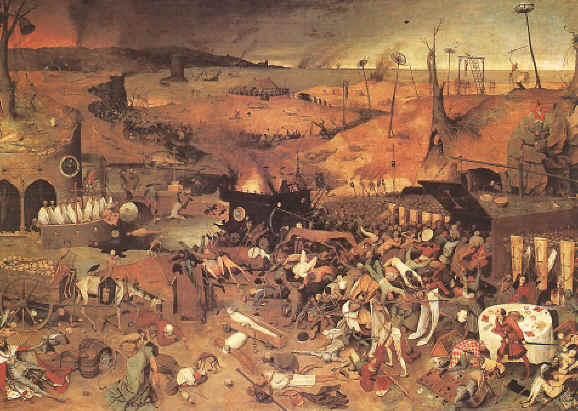
Black Death, by Brueghel
Excerpt:
As it happens, in the 1340s there was a veritable rash of earthquakes. In Rosemary Horrox's book, The Black Death, quoted by Baillie, we find that a contemporary writer in Padua reported that not only was there a great earthquake on 25 January 1348, but it was at the twenty-third hour. In the thirty-first year of Emperoro Lewis, around the feast of the Conversion of St. Paul (25 January) there was an earthquake throughout Carinthia and Carniola which was so severe that everyone feared for their lives. There were repeated shocks, and on one night the earth shook 20 times. Sixteen cities were destroyed and their inhabitants killed.... Thirty-six mountain fortresses and their in habitants were destroyed and it was calculated that more than 40,000 men were swallowed up or overwhelmed. (The author goes on to say that he received information from "a letter of the house of Friesach to the provincial prior of Germany):
It says in the same letter that in this year [1348] fire falling from heaven consumed the land of the Turks for 16 days; that for a few days it rained toads and snakes, by which many men were killed: that a pestilence has gathered strength in many parts of the world. (Horrox) From Samuel Cohn's book: ... a dragon at Jerusalem like that of Saint George that devoured all that crossed its path .... A city of 40,000 ... totally demolished by the fall from heaven of a great quantity of worms, big as a fist with eight legs, which killed all by their stench and poisonous vapours. (Cohn)
A story by the Dominican friar Bartolomeo: ... massive rains of worms and serpents in parts of China, which devoured large numbers of people. Also in those parts fire rained from Heaven in the form of snow (ash), which burnt mountains, the land, and men. And from this fire arose a pestilential smoke that killed all who smelt it within twelve hours, as well as those who only saw the poison of that pestilential smoke. (Cohn) Cohn writes:
Nor were such stories merely the introductory grist of naïve merchants and possibly crazed friars ... [even] ... Petrarch's closes friend, Louis Sanctus, before embarking on his careful reporting of the plague... claimed that in September floods of frogs and serpents throughout India had presaged the coming to Europe in January of the three pestilential Genoese galleys... [even] ... the English chronicler Henry Knighton ... [reported how] ... at Naples the whole city was destroyed by earthquake and tempest. Numerous chroniclers reported earthquakes around the world, which prefigured the unprecedented plague. Most narrowed the event to Vespers, 25 January 1348. [...]
Of these earthquakes that "destroyed many cities, towns, churches, monasteries, towers, along with their people and beasts of burden, the worst hit was Villach in southern Austria. Chroniclers in Italy, Germany, Austria, Slavonia, and Poland said it was totally submerged by the quake with one in 10 surviving. (Cohn) A continental text dated Sunday 27 April 1348 states: They say that in the three months from 25 January [1348] to the present day, a total of 62,000 bodies were buried in Avignon. (Horrox)