http://www.sacbee.com/static/weblogs/real_estate/archives/2009/08/california-unem-1.html
A blog about the economy and the Sacramento-area real estate market.
August 21, 2009
California unemployment: 11.9 percent
California’s unemployment rate continued climbing to 11.9 percent last month but there was encouraging news as the pace of job losses moderated.
The Employment Development Department said the state’s unemployment rate jumped three-tenths of a percentage point during the month. The 11.9 percent was the highest posted in the state’s modern records, which date to 1976.
But the state lost just 35,800 jobs during the month. That’s the smallest loss since last August and may suggest an easing of the downturn. The state has been losing at least 60,000 jobs a month for the past several months.
Continued.............
[A play with it recipe, I keep thinking sweet breads,donuts,cake or any other good thing, that fits the class of leftovers, dehydrated and used for the cookie crumbs..........???
granny]
No-Bake Cookie Balls
Recipe By : Real Food for Real People
Serving Size : 30 Preparation Time :0:00
Categories : Cakes & Cookies
Amount Measure Ingredient — Preparation Method
———— —————— —————— -———— -———— —
6 ounces Chocolate Chips
3 cups Powdered Sugar
1 3/4 cups Vanilla Wafer Crumbs
1 cup Chopped Walnuts
1/3 cup Orange Juice
3 tablespoons Light Corn Syrup
Using a large, microwave-safe bowl, melt chocolate chips and stir until smooth. Stir in powdered sugar, vanilla wafer crumbs, walnuts, orange juice and corn syrup. Roll into 1-inch balls, and roll in powdered sugar. Store in an airtight container.
- - - - - - - - - - - - - - - - - - -
Per Serving (excluding unknown items): 127 Calories; 5g Fat (32.0% calories from fat); 2g Protein; 21g Carbohydrate; 1g Dietary Fiber; 2mg Cholesterol; 18mg Sodium.
Exchanges: 0 Grain(Starch) ; 0 Lean Meat; 0 Fruit; 1 Fat; 1 1/2 Other Carbohydrates.
http://www.realfood4realpeople.com
RICKETTSIOSIS - MEXICO: (BAJA CALIFORNIA)
*****************************************
A ProMED-mail post
http://www.promedmail.org
ProMED-mail is a program of the
International Society for Infectious Diseases
http://www.isid.org
Date: Wed 13 Aug 2009
Source: El Sol de Tijuana [in Spanish, trans.& summ. Sr.Tech.Ed.MJ, edited]
http://www.oem.com.mx/elsoldetijuana/notas/n1282858.htm
In the 5 months since the State Health Secretariat implemented the
hospital notification network because of the outbreak of rickettsial
infection, 52 persons have been admitted to hospitals, 50 individuals
recovered and were released, and there were 2 deaths.
One of the biggest health problems in Baja California, said the
secretary of health Jose Guadalupe Bustamante Moreno, has been
[rickettsial infection].
In February 2009, after an outbreak [of rickettsial infection] that
resulted in 4 deaths, the health secretariat began an active
surveillance system for cases in the localities of Los Santorales and
Mexicali.
Extensive surveillance for ticks on domestic dogs and fumigation
campaigns are being carried out in the area.
[Byline: Fernando Barroso]
—
Communicated by:
Healthmap.org via ProMED-mail
promed@promedmail.org
[The species of rickettsiae here is not specifically mentioned but
the attention to dogs and ticks suggests that the illness is due to
_Rickettsia rickettsii_. Indeed, a March 2009 CDC posting regarding
the initial phase of this outbreak
http://www.cdc.gov/nczved/blog/2009/03/18/mexicali-rickettsia.html
confirms that the Rocky Mountain spotted fever organism was the cause.
_R. rickettsii_ infections have been identified in southern Canada,
the USA, northern Mexico, Costa Rica, Panama, Brazil, and Argentina
(1-6). Some synonyms for Rocky Mountain spotted fever in other
countries include tick typhus, Tobia fever (Colombia), Sao Paulo
fever and fiebre maculosa (Brazil), and fiebre manchada (Mexico).
References
Maps of Mexico showing Baja California can be found at
http://mxbirds.com/wp-content/uploads/2007/08/mexico-states.gif
and the HealthMap/ProMED-mail interactive map at
http://healthmap.org/r/00HZ
- Mod.LL]
[see also:
2003
POTATO DISEASES - UK, USA
*************************
A ProMED-mail post
http://www.promedmail.org
ProMED-mail is a program of the
International Society for Infectious Diseases
http://www.isid.org
[1] Dickeya soft rot, cyst nematodes - UK
[2] Late blight, nematodes - UK: impact of EU pesticides directive
[3] _Tobacco etch virus_, undiagnosed diseases - USA (Massachusetts,
Connecticut)
******
[1] Dickeya soft rot, cyst nematodes - UK
Date: Mon 17 Aug 2009
Source: FarmingUK [edited]
http://www.farminguk.com/news/PiP-warning-on-hidden-potato-threats_16827.html
Warning on hidden potato threats
“The more we understand about _Dickeya_, the more serious we realise
the implications are for the British crop,” warned SCRI’s [Scottish
Crop Research Institute] Ian Toth. Scottish government and Potato
Council funded research, as well as collaboration with international
partners, is “producing some interesting but uncomfortable findings,”
he told growers.
On the continent _Dickeya_ has already cut a deep swathe through
potato profitability. Over 20 percent of the 2007 Dutch seed crop was
downgraded as a result of the disease, while losses in the country
have increased fivefold in recent years to a staggering 25 million
Euro [approx. USD 35.6 million]. Early reports suggest this season
[2009] could be similar to 2007. “We don’t yet have a problem in
Scotland, but it’s an on-going concern in England and Wales. At
present sourcing seed through the Safe Haven Accreditation Scheme is
just about the only way we can limit introduction of the disease.”
SASA’s [Science and Advice for Scottish Agriculture) Jon Pickup
brought growers up-to-date with the latest developments of the PCN
directive in Scotland. “A key issue is the PCN control and waste
disposal measures for ware production on infested land, which growers
may be faced with as a result of the wider sampling programme,” noted
Dr Pickup. Farm-saved seed and ware land will be included and a much
greater sample size will be taken. This will increase the chances of
detection.
Britain, and Scotland in particular, trades on its high health
status, noted Potato Council head of seed and export Mark Prentice.
“There needs to be a clear focus on protecting clean land,” he said.
But it is in the long-term interest of the industry to address hidden
plant health threats, he said. “Issues such as _Dickeya_, PCN, and
ring rot are often out of sight, so it is easy to disregard them. PiP
has been hugely beneficial at highlighting not only the scale of
these threats, but also the fundamental and practical research needed
to address them.”
—
Communicated by:
ProMED-mail
promed@promedmail.org
******
[2] Late blight, nematodes - UK: impact of EU pesticides directive
Date: Mon 17 Aug 2009
Source: FreshPlaza, The Scotsman report [edited]
http://www.freshplaza.com/news_detail.asp?id=48911
Sixth of potato production under EU threat
One of the biggest problems for growers of the humble spud is the
damage that blight can cause. Over the past 200 years, many a crop
has been left devastated by this disease and only in the past 50
years has the grower had a chemical means of controlling it.
“We are really under pressure with [late] blight now,” she said. “We
have a new strain coming in that attacks crops 2 weeks earlier than
normal and we have a real battle with late blight attacking the crop
just before it ripens. That means we have at least 2 additional
sprays to add to a normal control programme.” Ironically, a surge in
people growing their own potatoes has increased the spread of blight.
“We believe these small plots of potatoes are now inoculants that
help spread blight into commercial crops.”
Almost two-thirds of all potato growing land in the UK is infected by
eelworm. On land growing crops for the eating market, soil treatment
can help reduce eelworm cysts but again one of the main control
chemicals is under threat of removal. While the short-term solution
to this problem might be in widening the interval in which crops can
be grown, the longer-term solution lies with producing varieties that
have resistance to the pests.
—
Communicated by:
ProMED-mail
promed@promedmail.org
******
[3] _Tobacco etch virus_, undiagnosed diseases - USA (Massachusetts,
Connecticut)
Date: Mon 17 Aug 2009
Source: The Hartford Courant [edited]
http://www.courant.com/health/hc-tobacco-virus0817.artaug17,0,6618167.story
A plant virus is spreading into Connecticut from Massachusetts
“It got to be more lucrative to grow potatoes again and the
Massachusetts guys were equipped for it,” said a tobacco grower. But
many diseases can be passed between tomatoes, potatoes, and tobacco,
and the etch virus, which is spread by aphids, jumped between the
crops. “Massachusetts was hurt very bad and they are finding it in
some Connecticut fields,” the grower said.
[Byline: Carolyn Moreau]
—
Communicated by:
ProMED-mail
promed@promedmail.org
[_Dickeya chrysanthemi_ causes soft rot on potato and can also affect
some other crops. The rot rapidly destroys potato tubers, and the
bacteria are spread with contaminated plant or other material, by
mechanical means and water. The pathogen has been included on the
quarantine list of the European Plant Protection Organisation (EPPO).
For more information see ProMED-mail post 20081112.3567.
Both golden (_Globodera rostochiensis_) and pale (_G. pallida_)
potato cyst nematodes (PCNs) cause serious crop losses in potato.
They can also infect other solanaceous crops and weeds, and cysts
containing viable eggs can survive in the soil for up to 20 years.
Disease management includes exclusion and crop rotation with non-host
species. For more information on the PCNs see data sheet links below.
There are also several species of free living nematodes
(_Pratylenchus_ species) affecting potato crops in the UK (see
ProMED-mail post 20090212.0628).
Ring rot of potato is caused by the bacterium _Clavibacter
michiganensis_ subsp. _sepedonicus_, which is listed as a quarantine
pathogen by EPPO. For more information on this disease see
ProMED-mail post 20071105.3601 and links below.
Potato late blight (PLB) is caused by the fungus-like organism
_Phytophthora infestans_ and can cause 100 percent crop losses in
potato and tomato. The emergence of new strains with increased
virulence and fungicide resistances causes worldwide concern, and an
estimated 20 percent of world potato production is lost to this
pathogen every year. For more information see links and previous
posts below.
_Tobacco etch virus_ (TEV; genus _Potyvirus_) is one of around 40
viruses known to affect potato. It is transmitted by more than 10
aphid species (including _Myzus persicae_) and is spreading in East
Asia and the Americas. Item 3 above is an interesting example of
virus spread between crops due to insect vectors with a wide host
range.
Maps
UK:
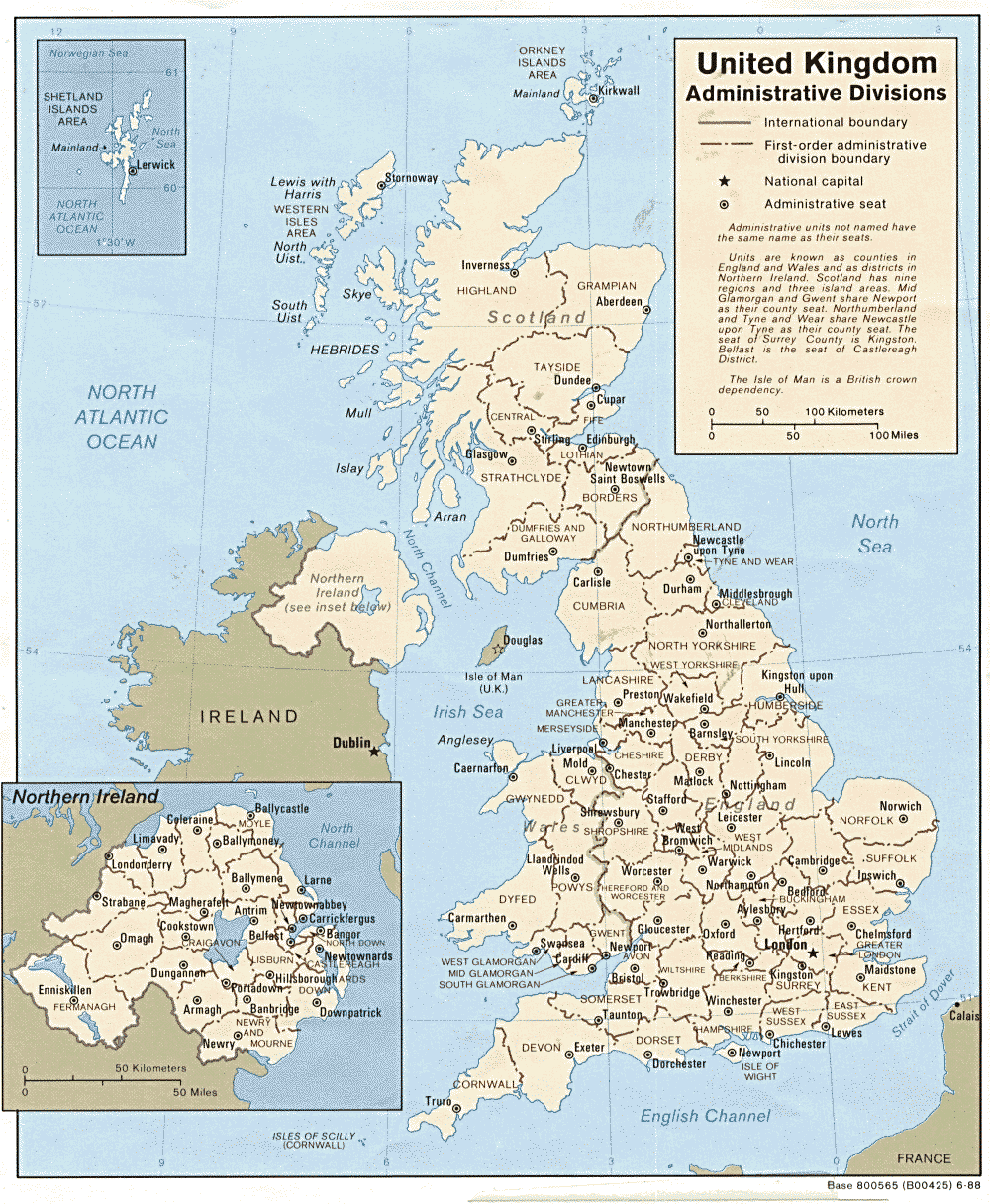
http://www.lib.utexas.edu/maps/europe/united_kingdom.gif
and
http://healthmap.org/r/008E
USA:
http://www.mapsofworld.com/usa/usa-road-map-enlarge-view.html
and
http://www.mapsofworld.com/usa/usa-state-and-capital-map.html
http://healthmap.org/r/009x
_D. chrysanthemi_ worldwide distribution (July 2008):
http://www.eppo.org/QUARANTINE/bacteria/Erwinia_chrysanthemi/ERWICH_map.htm
Pictures
Soft rot on potato tubers:
http://www.ctahr.hawaii.edu/nelsons/Misc/1_potato_bacterial_soft_rot_2.jpg
and
http://www.omafra.gov.on.ca/english/crops/hort/news/hortmatt/2003/20hrt03a7f7.jpg
Symptoms of golden cyst nematode on potato plants:
http://www.dpi.vic.gov.au/CA25677D007DC87D/LUbyDesc/Ag0572a/$File/Ag0572a.jpg
and
http://www.nysaes.cornell.edu/ent/bcconf/talks/images/brodie2.gif
Potato ring rot symptoms:
http://www.eppo.org/QUARANTINE/bacteria/Clavibacter_m_sepedonicus/CORBSE_images.htm
and
http://www.ag.ndsu.edu/pubs/plantsci/rowcrops/pp877-3b.gif
Late blight affected potato plants:
http://www.potatomuseum.com/images/exblightfieldwithinsert.jpg
and
http://www.apsnet.org/education/LessonsPlantPath/LateBlight/images/fig29.jpg
Links
Information on potato soft rot:
http://www.ipm.ucdavis.edu/PMG/r607100111.html
and
http://www.omafra.gov.on.ca/english/crops/hort/news/hortmatt/2003/20hrt03a7.htm
Information on _D. chrysanthemi_:
http://www.scri.ac.uk/scri/file/PiP/Erwinia.pdf
and
http://www.eppo.org/QUARANTINE/bacteria/Erwinia_chrysanthemi/ERWICH_ds.pdf
_D. chrysanthemi_ taxonomy:
http://www.bacterio.cict.fr/d/dickeya.html
and
http://ijs.sgmjournals.org/cgi/content/abstract/55/4/1415
Data sheets on both potato cyst nematodes:
http://www.dpi.qld.gov.au/cps/rde/dpi/hs.xsl/4790_12368_ENA_HTML.htm
http://www.eppo.org/QUARANTINE/nematodes/Globodera_pallida/HETDSP_ds.pdf
and
http://www.inspection.gc.ca/english/plaveg/pestrava/gloros/tech/glorose.shtml
Ring rot fact sheets with pictures:
http://www.fera.defra.gov.uk/plants/publications/plantHealth/documents/ringrot.pdf
and
http://ohioline.osu.edu/hyg-fact/3000/3103.html
Late blight fact sheets and background:
http://ohioline.osu.edu/hyg-fact/3000/3102.html
http://vegetablemdonline.ppath.cornell.edu/factsheets/Potato_LateBlt.htm
and
http://www.apsnet.org/online/feature/lateblit/
_P. infestans_ taxonomy:
http://www.indexfungorum.org/Names/NamesRecord.asp?RecordID=232148
_Tobacco etch virus_ taxonomy and description:
http://www.ncbi.nlm.nih.gov/ICTVdb/ICTVdB/00.057.0.01.067.htm
and
http://www.dpvweb.net/dpv/showdpv.php?dpvno=258
EPPO quarantine lists via:
http://www.eppo.org/QUARANTINE/quarantine.htm
Information on the EU pesticides directive:
http://ec.europa.eu/environment/ppps/home.htm
UK Potato Council:
http://www.potato.org.uk/
SASA:
http://www.sasa.gov.uk/
- Mod.DHA]
[see also:
Late blight, potato - UK: sources 20090427.1592
Late blight, potato - UK, Bangladesh 20090406.1332
Viruses & nematodes, potato - UK: alert 20090212.0628
2008
[Article has many hidden urls........]
A Veggie That Cuts Cancer By Up To Forty Percent
Just about everybody knows if you want to stay healthy and fight off disease, you’ve got to eat your veggies.
In every grocery store, there are foods that aren’t so good for you and foods that can fight disease.
Pharmacologists estimate that up to 40 percent of all cancers could be prevented by eating more fruits and vegetables.
Now, Add Broccoli Sprouts to the List.
“What we’ve found is that broccoli sprouts, the little baby broccoli plants that are a few days old, are very, very rich in what we think is probably the most important naturally occurring chemical in broccoli,” Jed Fahey, Sc.D., a pharmacologist at John Hopkins University in Baltimore, Md., told us.
A new study by Dr. Fahey shows that munching on this tiny, little-known veggie may help protect the stomach from a common bacterial infection that can cause gastritis, ulcers and stomach cancer.
“Our best guess is that about an ounce or two a day is a good amount of broccoli sprouts to eat,” Dr. Fahey said.
All broccoli contains a bio-chemical called sulforaphane, which has been shown to help fight off cancer.
But baby broccoli sprouts contain huge levels of this cancer fighting ingredient.
“The levels of sulforaphane in broccoli sprouts are 10-, 20-, 30-, 50-times higher than the levels in market stage broccoli or heads of broccoli.
Researchers believe high levels of sulforaphane slow down or reduce the level of harmful bacteria in the gastrointestinal tract which can cause inflammation of the stomach lining and could lead to cancer.
A tiny, easy way to stay healthy and fight disease
Sulforaphane can also be found in lower levels in: brussels sprouts, cabbage, cauliflower, bok choy, kale, collards, turnips, radishes, arugula and watercress.
What is an Antioxidant?
We need oxygen to survive: our bodies rely on it for proper function of cells, metabolism, and energy production.
But in the process of being used by the body, oxygen can produce harmful byproducts, called free radicals.
Free radicals are atoms with an odd (unpaired) number of electrons that are highly reactive.
They can bind to DNA molecules, and damage or kill cells by binding to their protective membranes.
It’s the same thing that happens when oils turn rancid, peeled apples turn brown, and iron turns to rust.
Antioxidants protect cells by binding with the free radicals and neutralizing them before they can cause any damage.
Cell damage is the root cause of most age-related health problems.
If left unchecked, free radicals may cause arthritis, heart damage, cancer, stroke, cataracts, or a weakened immune system and may play a role in the development of Alzheimer’s disease.
Scientists believe free radicals may also speed up hardening of the arteries.
It’s impossible to avoid all damage by free radicals, but consuming antioxidants can help reduce it.
Consuming Antioxidants:
Sulfurophane is present in foods such as broccoli, cabbage and Brussels sprouts and acts as an anti-oxidant in the body.
The four most common antioxidants are vitamins-E and C, beta-carotene, and selenium.
It’s always best to get your daily dose through food instead of supplements.
For vitamin-E, look to walnuts, peanuts, almonds, olives, avocado, wheat germ, and liver.
Leafy green vegetables are an excellent source of both vitamin-E and vitamin-C.
Citrus fruits, tomatoes, peppers, potatoes and broccoli can also boost your vitamin-C intake.
Common sources of beta-carotene include mangoes, papaya, pumpkin, spinach, kale, squash and apricots.
Finally, you can get your required dose of selenium by eating seafood, beef, pork, chicken, brown rice, and whole wheat bread.
And speaking of seafood, if you’re wondering what to have for dinner this evening, might we suggest;
30-Minute Shrimp Stir-Fry
Low in calories and high in fiber, this sizzling shrimp and veggie dish fills you up without leaving you feeling stuffed.
Plus, this one-dish meal leaves only one pot to clean!
Ingredients
* 2 ounces peeled and de-veined medium shrimp
* 1 cup broccoli florets
* 1/2 cup snow peas
* 1/2 cup matchstick-cut carrots
* 1/2 cup whole shiitake mushrooms
* 2 teaspoons low-sodium soy sauce
* 1 teaspoon canola oil
* 1 tablespoon lime juice
* 2 teaspoons crushed fresh ginger
* 1 teaspoon cornstarch
* 1 teaspoon minced garlic
* 1 teaspoon toasted sesame oil
* 2 tablespoons water
* pinch of coarsely ground sea salt
* pinch of freshly ground black pepper
Directions
1. Season the shrimp to taste with salt and pepper.
Heat the canola oil in a large heavy skillet over high heat.
The pan should be as hot as possible.
Place the shrimp in the pan and sear for 45 to 60 seconds.
Remove and set aside.
2. In a large bowl, blend the lime juice, ginger, cornstarch, garlic, and sesame oil until the cornstarch is dissolved.
Mix in the broccoli, peas, carrots, and mushrooms, tossing to lightly coat. In the same pan used for the shrimp, cook the vegetables for 2 minutes, stirring constantly.
Stir in the soy sauce and water.
Cook for about 10 minutes, or until the vegetables are crisp-tender.
3. Place the vegetables on a plate and top with the shrimp.
Nutritionals
249 cal, 17 g pro, 21 g carb, 5 g fiber, 11 g fat, 1 g sat fat, 653 mg sodium
Unfortunately, that’s all the time we have for today.
We hope you found some value in this edition and,
Until next time,
Live Longer & Live Younger!
JR & Marilyn
“To ensure continued receipt of our Newsletters, please add
marilyn@natures-health-foods.com
to your Address Book.”
P.S. Please, feel free to forward our newsletter to all your friends and family and if you haven’t been to our website (http://www.natures-health-foods.com) in a while, you’ll want to check out some of our new and exciting sponsors and articles!
10 Organic Aids & Natural Planting Tips For Gardening
Posted By TipNut On June 5, 2007 @ 7:38 am In Garden & Plants | 4 Comments
Epson Salt Spray: 2 ounces of salt per 2 gallons water.
Benefits: Helps with Black Spot, Mildew, Wilt and Rust
Mineral Oil Spray: 3 parts oil per 100 parts water.
Benefits: Helps with Aphids, Codling Moth, Leaf Roller, Mealybugs, Scaled Insects, White Fly
Beer: Stale or mixed with molasses
Benefits: Helps control Slugs
Tomato Leaves Spray: Crush leaves and soak in water for a couple days. Strain then spray.
Benefits: Grasshopper and White Fly control
Soap Spray: 2 TBS soap flakes dissolved in 1 quart water. *Don’t use detergents.
Benefits: Aphid control
Basil: Plant in pots and place around patio or deck
Benefits: Repels flies and mosquitoes
Rosemary, Mint, Thyme: Plant near cabbage
Benefits: Repels cabbage worms
Nasturtiums: Plant near cucumbers, melons and squashes.
Benefits: Repels squash bugs
Summer Savory: Plant near beans
Benefits: Repels bean beetles
Radishes: Plant near cucumbers
Benefits: Repels cucumber beetles
Don’t Miss These Tips:
* Natural Pesticides: Recipes & Tips [1]
* Get Rid Of Gnats: Tips & Remedies [2]
* Make Your Own Organic Potting Soil [3]
Article printed from TipNut.com: http://tipnut.com
URL to article: http://tipnut.com/organic-aids-natural-planting-tips-for-gardening/
URLs in this post:
[1] Natural Pesticides: Recipes & Tips: http://tipnut.com/natural-pesticides/
[2] Get Rid Of Gnats: Tips & Remedies: http://tipnut.com/gnats-tips/
[3] Make Your Own Organic Potting Soil: http://tipnut.com/make-your-own-organic-potting-soil/
Copyright © 2008 TipNut.com. All rights reserved.
Homemade Shower Spray Recipes
Posted By TipNut On November 1, 2007 @ 10:39 am In Homemade Cleaners | 5 Comments
Daily Shower Spray
1/3 cup rubbing alcohol
1 cup water
* Mix in a spray bottle and shake. Spray on, no rinsing required.
Tile and Grout Cleaner
1/2 cup of baking soda
1/3 cup of ammonia
1/4 cup of white vinegar
7 cups of water
* Combine all the ingredients in a labeled spray bottle and shake well to mix. Spray on then wipe off with a damp sponge. Do not use with bleach.
*Source: Queen of Clean [1]
Shower Spray Cleaner
3 cups hot water
1/2 cup Vinegar
1 TBS Dish Detergent
1 TBS Borax
* Mix together in a spray bottle, shake then spray.
Don’t Miss These Tips:
* Homemade Herbal Cleaner Recipes [2]
* Freshen Your Home With Eucalyptus: Recipes [3]
* Homemade Oven Cleaner Recipes [4]
Article printed from TipNut.com: http://tipnut.com
URL to article: http://tipnut.com/homemade-shower-spray-recipes/
URLs in this post:
[1] Queen of Clean: http://www.queenofclean.com/
[2] Homemade Herbal Cleaner Recipes: http://tipnut.com/homemade-herbal-cleaner-recipes/
[3] Freshen Your Home With Eucalyptus: Recipes: http://tipnut.com/eucalyptus-recipes/
[4] Homemade Oven Cleaner Recipes: http://tipnut.com/oven-cleaner-recipes/
Copyright © 2008 TipNut.com. All rights reserved.
Natural Pesticides: Recipes & Tips
Posted By TipNut On June 30, 2009 @ 9:50 am In Garden & Plants | 8 Comments
Shadow Of Bugs On Leaves
These homemade pesticides are cheap and easy to make with many being just as effective as some commercial products on the market. No fancy ingredients required, everything you need is likely stocked in your kitchen and garden. Most of the ingredients are earth friendly and natural with the harshest being liquid dish detergent–no need to spray your garden with toxic chemicals!
Tip: The best method of pest control in the garden is to keep your plants healthy so they don’t attract bugs. Fertilize plants as needed (see How To Make Compost Tea [1]) and stay on top of weeds by pulling them as they appear or using weed killers (see Homemade Weed Killer Recipes & Tips [2]). Begin treating for insects as soon as you notice signs of an infestation, the sooner you start the easier it will be to get rid of the pests.
Note: For recipes that require liquid dish detergent, use the basic stuff–nothing fancy with added bleach, nothing concentrated and no special antibacterial formulas. You can also substitute with a gentler liquid soap such as liquid castille or a perfume free, gentle liquid hand soap.
Update: As with all pesticides, take care when applying to food bearing plants, handling and storage of the pesticide. No one needs reminding I’m sure, but make sure to wash all produce well before consuming.
Natural Pesticides: Recipes
Rhubarb Leaf Pesticide Spray
1 cup rhubarb leaves
6.5 cups water
1 tsp liquid dish detergent or soap flakes
* Cover rhubarb leaves with water and bring to a boil. Boil for 20 minutes then remove from heat and cool. Strain then add 1/4 cup liquid dish detergent. Spray on plants. Good for aphids, june beetles, spider mites, thrips.
* Rhubarb leaves are poisonous, take care when preparing and handling. Do not use on food bearing plants.
Garlic Tea Spray
* Make your own garlic spray by boiling a pint of water, throw in roughly chopped garlic cloves and steep until the water cools. Remove garlic bits then spray on plants (from Quick Tips For Plants & Garden [3]).
Garlic, Peppers & Onion Insecticide
2 hot peppers
1 large onion
1 whole bulb of garlic
1/4 cup water
* Toss in the food processor and add water, blend until a mash is made. Cover mash with 1 gallon hot (not boiling) water and let stand 24 hours. Strain. Spray on roses, azaleas, vegetables to kill bug infestations. Bury mash in ground where bugs are heaviest. Good for thrips, aphids, grasshoppers, chewing and sucking insects.
Tomato Leaves Spray
* Crush leaves from a tomato plant and soak in water for a couple days. Strain then spray. Good for grasshopper and white fly control.
* Tomato leaves are poisonous, take care when preparing and handling. Do not use on food bearing plants.
Basil Tea Spray
4 cups water
1 cup fresh basil (or 2 TBS dried)
1 tsp liquid dish detergent
* Bring water to a boil then add basil. Remove from heat, cover and steep until cool. Strain. Mix in the liquid detergent then spray on plants. Good for aphids.
Onion Insect Repellent For Plants
* See details here: Organic Insect Repellent For Plants [4].
Salt Spray
2 TBS salt
1.5 gallons warm water
* Mix salt and water to dissolve, allow to cool to room temperature. Use for spider mites, caterpillars, cabbage worms and chewing insects.
Slug Bait Trap
* Set out beer in shallow containers to attract slugs, they’ll drown in the beer.
Diatomaceous Earth
* An all natural solution for insects of all kinds (ants [5], snails, slugs, etc.). Sprinkle diatomaceous earth on top of soil around plants with pest infestations.
Horticultural Oil Spray
1 TBS vegetable oil
1 tsp liquid dish detergent
2 cups water
* Fill a spray bottle with the ingredients then shake to mix.
Hot Pepper Spray
1/2 cup hot peppers (or 2 teaspoons cayenne pepper)
1 quart water
1 tsp liquid dish detergent
* Bring water to a boil, remove from heat and add peppers. Cover and steep until cool. Strain then mix in soap. If using cayenne pepper, no need to bring water to a boil first. Spray on plants.
Citrus Spray
2 cups orange peels (or lemons)
4 cups water
* Bring water to a boil, remove from heat and add peels. Cover and steep until cool. Strain and spray. Use the lemon mixture to repel white flies.
Dish Detergent & Baking Soda
2 TBS liquid dish detergent
2 TBS baking soda
1 gallon water
* Mix all ingredients together then spray on plants.
Peppermint Tea
1 TBS peppermint essential oil (can also use an infusion made with mint leaves, increase amount to 1 cup infusion)
1 quart water
* Mix together and use as an insect spray (good for ants).
Japanese Beetle Bait Trap
2 cups water
1 mashed banana
1/2 cup sugar
1/2 cup wine
1/2 tsp yeast
* Mix ingredients together and put in an old margarine container, cover with lid and set container out in the hot sun for a day. The next day, remove lid and set in garden where the beetles have been spotted (use a shallow container).
Potato Leaves Tea
1 cup potato plant leaves
2 cups water
* Chop leaves then cover with hot water. Seal container and leave 24 hours in a sunny window. Strain then spray.
* Potato leaves are poisonous, take care when preparing and handling. Do not use on food bearing plants.
Neem Spray
1 TBS Neem soap (shavings)
1 liter water
* Add soap to water then let sit for an hour. Shake bottle then spray.
Working With Homemade Pesticides: Tips
* Apply the pesticide on top of the leaves as well as underneath–don’t overdo it, excess spraying can cause damage to plants.
* Most recipes can be used effectively with just a weekly spray. Excessive spraying may affect the plant as well as kill the good insects you want to encourage in your garden (earthworms, bees, ladybugs, etc.). If you aren’t seeing results with a 7 day spray, you can bump it up to 5 days but watch the plant carefully to make sure it can handle it without being damaged.
* Avoid spraying during hot sunny weather, spray later in the day to reduce the risk of plants burning.
* If it looks like rain, delay spraying the plants until the weather is clear since any rain will wash away the new treatment. If it has recently rained, wait till the plants are dry before applying treatment to prevent the recipe being diluted with water.
* When trying a new pesticide recipe on a plant, test a couple leaves before spraying the whole plant (spray then watch how the test leaves react after two or three days, if no signs of damage proceed with spraying the whole plant).
Some of the recipes above were previously mentioned on 10 Organic Aids & Natural Planting Tips For Gardening [6].
Don’t Miss These Tips:
* 10 Organic Aids & Natural Planting Tips For Gardening [6]
* Homemade Window Cleaner Recipes & Tips [7]
* Homemade Shower Spray Recipes [8]
Article printed from TipNut.com: http://tipnut.com
URL to article: http://tipnut.com/natural-pesticides/
URLs in this post:
[1] How To Make Compost Tea: http://tipnut.com/compost-tea/
[2] Homemade Weed Killer Recipes & Tips: http://tipnut.com/weed-killers/
[3] Quick Tips For Plants & Garden: http://tipnut.com/tips-plants-garden/
[4] Organic Insect Repellent For Plants: http://tipnut.com/organic-insect-repellent-for-plants/
[5] ants: http://tipnut.com/ant-killer/
[6] 10 Organic Aids & Natural Planting Tips For Gardening: http://tipnut.com/organic-aids-natural-planting-tips-for-gardening/
[7] Homemade Window Cleaner Recipes & Tips: http://tipnut.com/more-homemade-window-cleaner-recipes-to-try/
[8] Homemade Shower Spray Recipes: http://tipnut.com/homemade-shower-spray-recipes/
Copyright © 2008 TipNut.com. All rights reserved.
Get Rid Of Fleas: Tips & Info
Posted By TipNut On August 10, 2009 @ 6:03 am In Household, Pets | 3 Comments
Fleas are one of the bloodsucking species of insects. While certain fleas confine their feeding to animals, other types are equally satisfied with human blood. Of those likely to come into the house, there are the cat flea, the dog flea, the human flea and, occasionally in the South, the sticktight flea.
Scratching A Flea Bite
Cat and dog fleas resemble each other closely, feed interchangeably on cats or on dogs and are usually found in the Eastern States. The human flea lives on all sorts of animals, wild and domestic, being particularly fond of hogs, in whose litters it will breed prolifically. Sticktights breed on poultry and only occasionally transfer their attention to man.
Fleas must have the blood of warm animals to reproduce. Once the eggs are laid, however, the flea can develop from egg to larva, pupa and adult and continue to live in the latter stage for several weeks with no food at all. They will breed in hordes wherever animals sleep, especially in basements and out-buildings. From there they may be brought into the house on a dog or cat and will migrate upstairs through the various living rooms, where they will cause no end of annoyance and embarrassment.
How To Get Rid Of Fleas
To get rid of fleas, it’s imperative that you kill both the adult fleas and the flea eggs. You must treat your house, your pets and your yard at the same time to prevent one area being a safe haven to fleas that allows them to move into another area (after you’ve cleaned it). If you find that you seem to get rid of all the fleas but have them back within a few days, chances are you aren’t getting to all the flea eggs (they’re hatching after cleanup).
You can buy commercial flea powders and sprays or mix homemade concoctions for flea control (I have a few recipes below), but if you prefer something natural and is pet & child friendly, consider Diatomaceous Earth. It’s a non-toxic pesticide that can be found in garden centers (look for the food grade stuff). It’s a soft, chalk-like sedimentary rock that is crumbled into a fine white to off-white powder. This powder has an abrasive feel, similar to pumice powder, and is very light, due to its high porosity. The typical chemical composition of diatomaceous earth is 86% silica, 5% sodium, 3% magnesium and 2% iron (Source: Wikipedia [1]).
As I mentioned in a previous article about ant control [2], Diatomaceous Earth is easily picked up by the hairy bodies of most insects, whereupon it scratches through their protective wax layers and they also absorb some of this material. The result being that the insects lose water rapidly, dry up and die. Further protection is provided by the powder’s property of repelling many insects. In houses it can be used effectively to prevent the entry of certain insects such as earwigs, ants, and cockroaches, and to control these and others that are present in cupboards containing food, carpets, basements, attics, window ledges, pet areas (for fleas), etc. In all of these examples it is important to place a small amount of the powder in corners, cracks, crevices and other areas where insects might hide (Source: Ecological Agriculture Projects, McGill University [3]).
Treatment Of The Home
* Wash all bedding and draperies in hot, soapy water to kill the fleas that may be living in them.
* Treat all carpeting with flea powder, or Diatomaceous Earth, or a homemade flea carpet mix (8 cups Borax + 1 cup table salt). Follow the directions for the flea powder. If you choose to use Diatomaceous Earth or the homemade flea carpet mix, spread evenly over the carpet with a shaker container (such as a baby powder container) and leave on the carpet for about 8 days before vacuuming up. Repeat again. Wear protective eyewear and a face mask to prevent irritation to the eyes and throat while spreading any powder or sprays. After vacuuming, remove contents from the vacuum and dispose of immediately in an outside sealed container for garbage pickup.
* Wash flooring and dog or pet bed with hot soapy water then spread Diatomaceous Earth in the pet bed and surrounding area (make sure to get the powder into all floor cracks where fleas may be hiding).
* Sprinkle Diatomaceous Earth or flea powder over upholstered furniture and vacuum up after 8 days, repeating process again (or follow directions on the flea powder).
* Wash all surfaces clean with hot soapy water.
Determine If Pets Have Fleas
As soon as their living areas are free of fleas, the animals themselves should be treated. How can you tell if your dog or cat has fleas? The first sign is he’ll be very itchy and scratching a lot. You can do this test to see if your pet has fleas:
* Stand your dog on a white sheet or towel and comb through his fur with a fine toothed flea comb (give it a few strokes), if you see a flea or two on the comb, you can bet there’s more. If black flecks fall off his coat onto the towel, see if they’re flea dirt by sprinkling them with water. They’ll turn red if they are (flea dirt is the blood excrement from fleas from feeding).
* You can also spot check fur by spreading it apart and looking for flea dirt (black specks), hot spots are behind the ears and at the base of his tail. You’ll also be able to feel them as you run your hands through your dog’s fur, they’re gritty and coarse.
Animal Flea Treatment
* Bathe pet thoroughly with a flea shampoo.
* Brush fur daily with a fine tooth flea comb to remove as many flea eggs as possible.
* Use a commercial flea powder or Diatomaceous Earth on fur, rubbing the powder deep into the fur to reach the skin. Keep out of your pet’s eyes, ears and nose to prevent irritation.
Treatment Of Lawns
As a supplementary measure to clearing your home and pets of fleas, keep the grass cut short as contact with sun and rain kills fleas readily. If these measures still do no good, spread diatomaceous earth around the yard paying attention to shady areas and low shrubbery.
Flea Prevention Tips
* Bathe the dog (pets) regularly, fleas will drown
* Use cedar chips, shavings or sawdust in your pet’s bedding, this helps repel fleas
* Pine needles spread on the dog house floor (outside) will also help repel fleas
* Vinegar: Add a teaspoon of Apple Cider Vinegar to the pet water dish, helps prevent ticks and fleas
* Flea Repellent Floor Cleaner: 15 drops lavender essential oil + 1/4 cup liquid Ivory Soap + 1 gallon hot water. Mop floor with cleaner and do not rinse. You could also use rosemary essential oil rather than lavender.
Flea Bite Itch Relief (For Humans)
* Vaseline
* Vicks Vapo Rub
* Calamine Lotion
* Ice
Did You Know
* It’s the saliva from flea bites that make them so itchy
* Fleas can transmit tapeworms to your dog
* Fleas don’t fly, they jump from one victim to another
* Each flea can lay dozens of eggs per day
* Fleas thrive in warm & humid climates
Source: Some of the information above is from Woman’s Home Companion Household Book (1948)
Don’t Miss These Tips:
* Bed Bugs: Treatment & Tips For Getting Rid Of Them [4]
* Rid Your Pet of Skunk Spray Smell [5]
* Cat & Dog Hair Cleanup Tips [6]
Article printed from TipNut.com: http://tipnut.com
URL to article: http://tipnut.com/get-rid-fleas/
URLs in this post:
[1] Wikipedia: http://en.wikipedia.org/wiki/Diatomaceous_earth
[2] ant control: http://tipnut.com/ant-killer/
[3] Ecological Agriculture Projects, McGill University: http://eap.mcgill.ca/publications/eap4.htm
[4] Bed Bugs: Treatment & Tips For Getting Rid Of Them: http://tipnut.com/bed-bugs/
[5] Rid Your Pet of Skunk Spray Smell: http://tipnut.com/rid-your-pet-of-skunk-spray-smell/
[6] Cat & Dog Hair Cleanup Tips: http://tipnut.com/cat-dog-hair-cleanup-tips/
Copyright © 2008 TipNut.com. All rights reserved.
Pantry Pests: Getting Rid Of Flour Bugs
Posted By TipNut On March 2, 2009 @ 8:26 am In Kitchen Cleaning | 5 Comments
How To Get Rid Of Flour Bugs
Opening a bag of flour and noticing the contents crawling with little bugs is horrifying, but it happens. Throwing out the bag will not necessarily solve the bug problem and you may find frequent occurrences.
The secret is starving the pests and their access to food and a thorough cleaning job. Here’s how to reclaim your pantry and get bug-free…
Cleaning Tips:
* Remove everything from the pantry and wash the entire area well with a bleach and water solution (about 1/4 cup bleach per gallon of hot water), wear rubber gloves and use a scrub brush so that you can get into any cracks and corners. Wash both top and bottom of each shelf, all walls and the floor.
* Keep pantry door open and leave it overnight to dry completely before adding stock back to the shelves. Wait until the pantry is no longer humid from the washing before re-stocking the pantry.
* Check all food boxes and bags for bugs, throw out those that are infested or those you’re unsure about (bag and cart out to the garbage immediately–don’t keep in the house) and put the rest in the freezer for 5 days before storing in the pantry.
Preventive Steps:
* Keep all flour, cereals, rice, pasta, starch foods in canisters, glass jars with sealed lids or airtight plastic containers.
* Stack a few Bugs-Be-Gone Bags [1] in the pantry.
* Freeze new foods for 4 or 5 days before storing in the pantry (to kill the larvae and eggs).
* Keep a bay leaf or two in the flour cannister and crushed bay leaves sprinkled throughout the pantry (weevils don’t like them).
Watch For:
* Drips and spills from syrups, honey, etc.–wash off immediately or your pantry will attract ants and other bugs.
* Once you notice an infestation and have done a thorough cleaning job, keep a diligent eye on your stock. Each time you notice a weevil or other pest, empty the pantry, wash everything well and repeat the steps above until you are bug-free. There’s no way around it, you have to remove every single bug, egg & larvae or the pests will grow in numbers until you do.
Did you know: The pantry pests may be coming home with you from the store? Weevils or mealy bugs can already be in the bags and boxes before you even pay for them. Before storing items in your pantry, you can freeze the bags and boxes first (for about 4 or 5 days), seal them in plastic bags or airtight containers. This way nothing else in your pantry will get contaminated.
Don’t Miss These Tips:
* Bed Bugs: Treatment & Tips For Getting Rid Of Them [2]
* Bugs-Be-Gone Bags [1]
* How To Get Rid Of Fruit Flies [3]
Article printed from TipNut.com: http://tipnut.com
URL to article: http://tipnut.com/pantry-pests/
URLs in this post:
[1] Bugs-Be-Gone Bags: http://tipnut.com/bugs-be-gone-bags/
[2] Bed Bugs: Treatment & Tips For Getting Rid Of Them: http://tipnut.com/bed-bugs/
[3] How To Get Rid Of Fruit Flies: http://tipnut.com/fruit-flies/
Copyright © 2008 TipNut.com. All rights reserved.
Bed Bugs: Treatment & Tips For Getting Rid Of Them
Posted By TipNut On August 21, 2009 @ 6:12 am In Cleaning, Household | No Comments
No Matter How Clean You Keep Your Home—Bed Bugs Can Thrive As Long As They Have A Host To Feed On: You
Bed bugs (bedbugs) are usually brought into the house from the outside, on clothing, baggage, second-hand furniture or in laundry done in an infested home. Social stigma is attached to the bed bug more than to any other insect. This is unfair since the most conscientious homemaker may bring them in on his or her clothing after brushing up against someone while shopping or spending an afternoon at the movies.
Once in the house, the bed bug will hide all day in the most out-of-the-way place it can find. Its hiding place may be a good distance away from the bed–in wall spaces, floor cracks, behind partitions, in furniture cracks–or it may burrow into the mattress tufts or crawl in among the crevices in the bed frame. Wherever it hides, it has an uncanny instinct for finding its way easily to the bed when the lights are out. They will climb up from the floor, climb walls and drop from ceilings with ease to get at their victims. They are attracted to your body warmth and the carbon dioxide you exhale–sure signs that there’s a live one waiting to be feasted on.
Because of the increased amount of traveling we do today compared to a few decades ago, bed bugs can be a real problem in hotels, buses, airplanes and other areas where groups of people gather together. Buildings that house several people or families at once can also cause infestation problems (apartment buildings, condos, senior citizen homes, etc.) since the bed bugs can travel between walls with ease.
What Bed Bugs Look Like
Picture Of Bedbug Feeding On A Human Source: Wikipedia.org
Before eating, the bedbug (Cimex lectularius–also known as a chinch, a red-coat or a mahogany flat) is a small one-quarter to three-eighths of an inch, wingless, paper-thin insect, oval in shape and dark brown in color. After becoming engorged, the body thickens and is elongated. The ingested blood changes its color to a dull red. The mouth is constructed in the shape of a beak, which it plunges into the body of its victim, sucking the blood up through it. At the same time a fluid is being secreted to facilitate the eating process. This fluid is extremely irritating to the skin of most human beings and causes swelling, irritation and itching.
Habits Of Bed Bugs
* After eating, which takes from three to five minutes, the bedbug returns to its hiding place for several days in order to digest its food.
* In the house, its attack is invariably launched at night, but if the bug has infested public restrooms, theaters, etc., it will bite at any opportunity.
* In a lifespan of six to eight months, given the right climatic conditions, female bedbugs will lay hundreds of sticky white eggs, the shells of which may be found in habitual hiding places. The eggs hatch in about a week and a half and the young bedbugs begin to eat nearly at once.
* If no food is available, the bedbug can live a long time without it. If, however, it is accustomed to eating regularly, it will die much sooner when provisions are cut off. Extremely cold weather will take away its appetite but lengthen its life considerably.
* One characteristic of the bedbug is its smell, caused by the secretion of an oily liquid from the scent glands. It is usually particularly noticeable around places long used by groups of the bugs for daytime seclusion.
Tip:
When sleeping in an unfamiliar bed (at a hotel for example), pull back the bed sheets and look at the bare mattress–if you see bed bug excrement (it will look like rust spots on the mattress), leave the room immediately and find another hotel to stay at.
How To Get Rid Of Bed Bugs
You can call in a professional exterminator to fumigate the home and furniture inside, this is preferable since professional exterminators are familiar with the hiding habits of the bedbugs and the chemicals they use are usually very effective. However, if fumigation is out of your budget or you’d like to try a more natural remedy to kill the bed bugs, food grade Diatomaceous Earth is a safe and harsh-chemical free method.
Diatomaceous Earth is a natural, effective means of pest control (I’ve previously recommended it for fleas [1] and ant control [2]). You can find it in garden centers (make sure to buy the food grade stuff). It’s a soft, chalk-like sedimentary rock that is crumbled into a fine white to off-white powder.
Diatomaceous Earth is easily picked up by the hairy bodies of most insects, whereupon it scratches through their protective wax layers and they also absorb some of this material. The result being that the insects lose water rapidly, dry up and die. Further protection is provided by the powder’s property of repelling many insects. In houses it can be used effectively to prevent the entry of certain insects such as earwigs, ants, and cockroaches, and to control these and others that are present in cupboards containing food, carpets, basements, attics, window ledges, pet areas (for fleas), etc. In all of these examples it is important to place a small amount of the powder in corners, cracks, crevices and other areas where insects might hide.
(Source: Ecological Agriculture Projects, McGill University [3]).
Steps To Take:
* Thoroughly inspect the room that is housing the bedbugs. Seal all cracks and crevices with caulking or dust with Diatomaceous Earth. The bed bugs can be hiding between walls, underneath floor boards, inside of dressers and underneath drawers or hide in clothing hanging in the closet.
* Apply a layer of Diatomaceous Earth between mattresses, around floor boards and in cracks or crevices that you can’t seal.
* Apply a thick layer of petroleum jelly around each leg of the bed to prevent the bed bugs from crawling up the legs.
* Empty and clean out the closet and dresser drawers, washing all clothing in hot water and moving them into another room until all the bed bugs have been killed.
* Wash all bedding and curtains/draperies in hot water.
* Spread Diatomaceous Earth throughout all carpeting and flooring, leaving on for a few days, vacuum up then reapply.
It will take a few weeks before all the bed bugs will be killed (you have to ensure that the entire life cycle has been halted–no new eggs waiting to hatch, etc.). Keep applying the Diatomaceous Earth and petroleum jelly until all signs of the bed bug infestation are gone.
Treatment Of Bites
Treat bed bug bites by applying one of the following for relief:
* Hydrogen peroxide
* Household ammonia
* Vinegar
* Hot water (as hot as you can stand it without burning skin)
If there is a danger of infection, use iodine as a topical antiseptic to control it.
Source: Some of the information above is from Woman’s Home Companion Household Book (1948)
Don’t Miss These Tips:
* Pantry Pests: Getting Rid Of Flour Bugs [4]
* Get Rid Of Fleas: Tips & Info [1]
* Natural Pesticides: Recipes & Tips [5]
Article printed from TipNut.com: http://tipnut.com
URL to article: http://tipnut.com/bed-bugs/
URLs in this post:
[1] fleas: http://tipnut.com/get-rid-fleas/
[2] ant control: http://tipnut.com/ant-killer/
[3] Ecological Agriculture Projects, McGill University: http://eap.mcgill.ca/publications/eap4.htm
[4] Pantry Pests: Getting Rid Of Flour Bugs: http://tipnut.com/pantry-pests/
[5] Natural Pesticides: Recipes & Tips: http://tipnut.com/natural-pesticides/
Copyright © 2008 TipNut.com. All rights reserved.
MedWatch logo MedWatch - The FDA Safety Information and Adverse Event Reporting Program
You are subscribed to MedWatch Safety Alerts for U.S. Food & Drug Administration (FDA). This information has recently been updated, and is now available.
Ibuprofen (Unapproved) topical drug products
Audience: Consumers, pharmacists
FDA informed consumers and healthcare professionals of its intent to take action against eight companies that market unlawful over-the-counter (OTC) topical drug products containing the pain reliever ibuprofen. The products, which contain ibuprofen in combination with a variety of other active ingredients and are marketed for pain relief, are unapproved new drugs that require an approved new drug application in order to be legally marketed. Orally administered ibuprofen has been approved as a safe and effective treatment for pain and inflammation. There are no approved applications for topical ibuprofen products. Topical ibuprofen is often promoted as a “safer” alternative that can be used in place of oral ibuprofen because of certain side effects, such as stomach ulcers and cardiovascular effects that are associated with prolonged use of oral ibuprofen. However, these safety claims for topical ibuprofen have not been reviewed by the FDA, nor has the agency evaluated what side effects might be associated with such products.
The names of the products and manufacturers that received warning letters are:
Emuprofen (Progressive Emu, Inc.)
BioEntopic 15% Ibuprofen Crème (BioCentric Laboratories, Inc.)
Ibunex Topical Ibuprofen (Core Products International, Inc.)
LoPain AF 15% Ibuprofen Crème (Geromatrix Health Products)
IB-RELIEF (MEKT LLC)
Profen HP (Ridge Medical Products)
IbuPRO-10 Plus (Meditrend, Inc. dba Progena Professional Formulations)
IBU-RELIEF 12 (Wonder Laboratories)
Read the complete MedWatch 2009 Safety summary including a link to the FDA press release, at: http://www.fda.gov/Safety/MedWatch/SafetyInformation/SafetyAlertsforHumanMedicalProducts/ucm179925.htm
You are encouraged to report all serious adverse events and product quality problems to FDA MedWatch at www.fda.gov/medwatch/report.htm
US-CERT Current Activity
Adobe Releases Security Bulletin for Flex SDK
Original release date: August 21, 2009 at 9:02 am
Last revised: August 21, 2009 at 9:02 am
Adobe has released security bulletin APSB09-13 to address a
vulnerability in Flex 3.3 SDK and earlier versions. This vulnerability
may allow an attacker to conduct a cross-site scripting attack.
US-CERT encourages users and administrators to review Adobe security
bulletin APSB09-13 and update to Flex 3.4 SDK to help mitigate the
risks. Additionally, the bulletin indicates that this update includes
the latest version of Adobe Flash Player.
Relevant Url(s):
http://opensource.adobe.com/wiki/display/flexsdk/Download+Flex+3
http://www.adobe.com/support/security/bulletins/apsb09-13.html
http://www.fda.gov/Safety/Recalls/ucm179863.htm
Quesos Mi Pueblito, LLT Issues a Recall on Mi Pueblito Queso Fresco Authentic Mexican Style Soft Cheese
Contact:
Martha Acevedo
973-473-4494
FOR IMMEDIATE RELEASE — August 18, 2009 — Passaic, NJ — Quesos Mi Pueblito is recalling its Mi Pueblito Queso Fresco 14 oz., with Sell by Date 09/08/09, because it may contain listeria monocytogenes. This is an organism which can cause serious and sometimes fatal infections in young children, frail or elderly people, and others with weakened immune systems. Although healthy individuals may suffer only short-term symptoms, such as high fever, severe headache, stiffness, nausea, abdominal pain and diarrhea, Listeria infection can cause miscarriages and still births among pregnant women.
The recalled cheese is distributed in the New Jersey/New York City area as well as, Delaware and Virgina, through Puebla Foods, Inc., Passaic, N. J. to retail stores and wholesalers.
The product comes in a 14 oz, clear plastic package, with a sell by label dated 09/08/09 on top, UPC code 2407710025.
No illnesses have been reported to date in connection with this problem.
The recall is a result of a sample collected by the NJ Dept. of Health and Senior Services.
Consumers who have purchased this product are urged to return them to the place of purchase for a full refund. Consumers with questions may call the company at 973-473-4494, Monday - Friday, 8:00 - 4:30 p. m.
###
Photo: Product Label
Page Last Updated: 08/21/2009
http://www.fda.gov/Safety/Recalls/ucm179901.htm
Undeclared Sulfites in “Cleopatra Candy” Mixed Nuts
Contact:
Jessica Chittenden
518-457-3136
FOR IMMEDIATE RELEASE — August 20, 2009 — New York State Agriculture Commissioner Patrick Hooker today alerted consumers that Cleopatra Candy Inc., located at 1135 E 95th Street, Brooklyn, New York is recalling “Cleopatra Candy” Mixed Nuts due to the presence of undeclared sulfites. People who have severe sensitivity to sulfites may run the risk of serious or life-threatening reactions if they consume this product.
The recalled “Cleopatra Candy” Mixed Nuts are packaged in an uncoded, 4 oz. plastic bag and is distributed in metropolitan New York and New Jersey. This packaged product also contains undeclared dried apricots, pineapple, papaya, banana chips and raisins.
Routine sampling by New York State Department of Agriculture and Markets Food Inspectors and subsequent analysis of the product by Food Laboratory personnel revealed the product contained high levels of sulfites which were not declared on the label. The consumption of 10 milligrams of sulfites per serving has been reported to elicit severe reactions in some asthmatics. Anaphylactic shock could occur in certain sulfite sensitive individuals upon ingesting 10 milligrams or more of sulfites.
No illnesses have been reported to date to this Department in connection with this product. Consumers who have purchased “Cleopatra Candy” Mixed Nuts should contact Nael Burqawi of Cleopatra Candy at (718) 649-8298.
###
Photo: Product Label
Page Last Updated: 08/21/2009
Las Vegas has had several deaths due to the swine flu, every couple weeks, the news alert that I get, will say 2 more deaths.
Let your mind roll with this dispatch that was on the Las Vegas Police Scanner only 5 minutes ago.
“Ice Cream Truck Driver stopped the truck, got out and is now passed out at the back door”!!!
Heat alone, maybe for it is extreme today, or if he has the flu, how many did he share it with???
http://www.radioreference.com/apps/audio/?ctid=1745
Choose on line web player and the “Police and Fire”.
[Difficult to follow in a soil conservation group, but interesting and I hope I am posting it more clearly than I got it...granny]
On Thu, 20 Aug 2009, St
> | Keep in mind that the author of this bit has a vested interest in
> selling
> | you gold investments.
> |
> | But allowing for that . . . he seems spot on!
> |
> | http://matterhornassetmanagement.com/newsletter/?newsletter=20
> |
>
> St
> A lot of the observations about the financial system that these people
> make are sorta true. I agree that “we” have a crisis of the financial
> system. And that “we” are in the middle of a restructuring of the
> financial system.
>
>
> However, the authors predictions about the future are based mainly on
> their unfounded belief that monney matters.
>
>
> You see, I come from a Communist country. Money did not exist in this
> country for half a century. So obviously, it could not matter. And
> nobody in the country had any problems with that. Money is totally
> irellevant to the question of whether you have food on the table or not,
> whether you have a roof over your head, or whether the kiddies can go play
> and have fun, or read books and learn.
>
>
> In physics, we were taught to look for aspects of the system that are
> “invariant” — whatever you do, you cannot change it for closed system,
> you can only morph them from one for to another.
>
> Energy is notoriously one of the (physical) invariants of a closed system.
>
>
> Money is not an invariant. You can change the money totally, even remove
> it completely, whithout changing the underlying system one iota.
>
> Food can continue to be produced, clothing made, wood cut, kids playing,
> and you can call the money dollars, rubbles, euro, leva, coupons,
> connections, promises, or vaporware — this does not affect the underlying
> system of food production and distribution.
>
>
> If the point of the authors is that the way the money system works will
> change, I agree.
>
> But if the point is that money has any connection to food whatsoever, I
> strongly disagree.
>
> I’ve lived in a system without money. There were periods with food, and
> then, there were periods without food. Money had nothing to do with it.
>
>
> Ditto for electricity, gasoline, cold and hot water.
>
> —clean, just scratching
>
>
>
>
> | Welcome to the coming dark age . . . already. Hopefully it’ll work out
> to be
> | a brief couple of decades as this author expects . . . and not a descent
> | into millennia of increased suffering.
> |
> | St
> |
________________________________________________________________________
10b. Re: the dark years are already here
Posted by: “John
Date: Thu Aug 20, 2009 2:18 pm ((PDT))
I concur almost completely Peter. Money does not matter provided we are
living in a community that is not exclusively money based. One of the most
important necessities for survival are/will be social structures conductive
to survival. And in most all our countries these structures have been eroded
away over the last 50 years. What we need are tribes! and we have even lost
the multi-generational family.
Even one generation ago it would have been possible to survive the coming
crisis in many areas of the world but not any more. Here in Ireland most of
the population are only one or two generations removed from the land but I
have never seen a country where the genertal public so hates the land and
anything to do with agriculure. Even the farmers have lost all knowledge of
natural food production. When the oil flow stops food production here stops.
In fact every other aspect of life will stop as well. I think the same is
true more or less for most countries.
Which forces us to the conclusion that ,if you are correct in saying this is
not the case in Bulgaria, that the world will be speaking Bulgarian before
long. So please keep it coming :)
john
On Fri, 21 Aug 2009, Steve Solomon wrote:
| You are right Peter . . . and not seeing something, too.
|
| Yes, people are entirely capable of organizing survival without money or
| government.
|
My point was, under Communism, people survived perfectly well under
government (when it was not rabidly killing them, that is).
Even against the backdrop of “everything belonging to the state needs to
be broken, if it resist being stolen.” Or may be because of it.
| But the devil is in the details . . . in the transition from what is now to
| what may be coming.
Gorby is advising O-Bama on Perestroyka 2.0. Saks Fifth, anyone:
http://www.notcot.com/archives/2009/03/saks_and_shepar.php
|
| Perhaps the more complex the society and the more dependent it has
| become on financial capitalism (gone criminal) then the more violent
| will be the experience of having that system shatter or crumble.
|
Well, they are managing it quite well so far in the US (and I am presuming
elsewhere) GM bankruptcy anyone?
Joe Blow in the bowels of the bureaucracy receives an order from some
think tank that we don’t even know where it is, a similar order is
received by the judge, and voila — complete disregard of money, long-term
contracts, and bankruptcy law.
There is an expression in Bulgaria “blow the soup” which is an euphemism
for “blow the d...” So for GM case, all “stake holders” of GM —
creditors, investors, suppliers, retirees, are left to blow the soup with
one swell 35-day move.
Money does not matter. Contracts do not matter. Law does not matter.
All of the above is propaganda for the middle class. Those at the top
cannot be bothered with that shit. Neither can those at the bottom.
Under Communism these organizations at least had names. In this
particular case it would have been the “State Planning Commission.” And it
would have been the actual one that makes the decision. The “administration
task force on the auto industry,” on the other hand, is just the
publically-visible visible puppet.
In Bulgaria they call this PARLAMA — some loud and public verbal
hullaballoo that’s intended to hide the real players. Something like Tim
Geitner (former head of NY Fed) and Ben Bernanke (current head of Fed)
quarreling on TeeVee. Yeah, right! Gimme a break!
Or Obama and McCain sucking up to the master behind the scene:
http://ridgeliner7.files.wordpress.com/2008/10/2008-al-smith-dinner.jpg
PARLAMA is probably where “parliament” comes from.
Aaahhh ... and under Communism the formality of legal proceedings were
eschewed altogether. You can have a completely well-functioning society,
including an oppressive one, with a government, including with a puppet
government, without any bankers or lawyers.
Some might call it a good start.
... but don’t hold your breath ... the goons are exactly the same ... just
one system is more efficient in terms of resource utilization ... the
other, in terms of people submitting without being physically beaten too
much ...
Hegel used to say:
THESIS + ANTI-THESIS => SYN-THESIS
... well ... welcome to the new era ...
... the synthesis is coming to both the US and the SU.
“Government-mandated salary and bonus caps” anyone?
The relevant document in Bulgaria used to be called “Unified Table of
Positions and Salaries” ... something like the “prevailing wage
compilation” with the exception that “the table” was a product of the
vision of some bureuacrat as to how things *should* be.
Well ... welcome to Ha’merka ... Perestroyka 2.0 is coming here as we speak.
|
| Perhaps the more complex the society and the more dependent it has become on
| financial capitalism (gone criminal) then the more violent will be the
| experience of having that system shatter or crumble.
|
I personally don’t see it crumbling. Or at least not under its own
weight. It’s gonna need help to crumble. They will shrink the money
supply to just a tad below the available oil and will let it froth and
skim off the scum and bury it gradually. Or even reprocess it.
Catherine Austin Fitts used to call this “the slow burn.” Well, modulo
some (sufficiently small, but sufficiently large) shocks now and then, to
keep the sheople disoriented and scared.
During Peak Oil in Bulgaria there were a ton of new political parties and
in the weekly of one of them I read the following riddle:
— One government increased prices five times. Another government first
increased prices ten times, then decreased prices two times. Which one
is the smarter government?
Ohh-Baaa-Ma! Ohhh-Baaaaaaaa-Ma!
To visit your group on the web, go to:
http://groups.yahoo.com/group/soilandhealth/
Friends of the Library,
I am pleased, really hugely pleased, to announce that J. Russell Smith’s
permaculture classic Tree Crops: A Permanent Agriculture, that has recently
been determined to be a public domain book, is at last available for
download in the ag library. The scan is a little different than usual, the
original pagination and layout is preserved perfectly and the index at the
back works, however, the download is about double the usual size (11 mb).
All the best,
[I don’t have the link right now, but there is a library for this group that has the best farm and garden books of the world, some can be copied......granny]
Do check and read this page:
http://www.notcot.com/archives/2009/03/saks_and_shepar.php
It is an eye opener, brainwashing advertising?
Faintly official o shield and marxist lettering, on a Saks handbag.
granny
[A good blog for book readers]
http://joyfullyretired.com/2009/08/21/friday-finds-the-farm-edition/
Back in the days when I was employed I was a fan of TGIF. Now Friday means Friday Finds – a day to share those book-gems I’ve found. This week was all about chickens.
On Tuesday I saw an announcement in Shelf Awareness that perked my interest. What did I see that was so exciting? It was the announcement of the Midwest Booksellers’ Choice Awards; Baccante Literary Prize. (The Midwest Booksellers’ Choice Awards honor “authors from the Midwest Booksellers Association region and/or books about the region” and are voted on by MBA members.) Some of you will recall that I love chickens – the animals and their products. (You can see my original post HERE.) Out of a list of about ten MBA winners two of them had my chicken-heart racing – they were about CHICKENS.
1. The winner for Nonfiction: Coop: A Year of Poultry, Pigs and Parenting by Michael Perry (HarperCollins). I’ve taken a quote from his book. As you can see he loves the little guys just like I do.
CoopThese Troubled Times seem to have precipitated a fowl renaissance. Mail carriers labor under a groaning load of multicolored hatchery catalogs, the latest issue of Backyard Poultry, and perforated containers that peep. . . . The online world is alive with Subaru- driving NPR supporters trading tips on eco-friendly coop construction and the pros and cons of laying mash; my NASCAR-loving brother-in-law tenderly minds a box of chicks beneath a heat lamp in his garage; my biker bar bouncer–turned–Zen Buddhist pal Billy and his wife the certified nursing assistant are building their second backyard coop with an eye toward expanding into ornamentals. Anecdotal evidence to be sure, and a drop in the Colonel’s bucket, but something is afoot. . . . My wife and I are enthused by the idea of fresh eggs, homegrown coq au vin, and (at least until butchering day) a twenty-four-hour turnaround on the compost. In addition, it is my long-standing opinion that entertainment-wise, chickens beat TV.
Doesn’t that make you want to run down to the feed store and see if they if they have any baby chicks left? No? Then how about this:
2. The winner for Children’s Picture Book: Louise, The Adventures of a Chicken by Kate DiCamillo, illustrated by Harry Bliss (Joanna Cotler Books/HarperCollins). From the publisher:
LouiseShe longed for adventure.
So she left her home and ventured out into the wide world.
The pleasures and perils she met proved plentiful: marauding pirates on the majestic seas, a ferocious lion under the bright lights of the big top, a mysterious stranger in an exotic and bustling bazaar.
Yet in the face of such daunting danger, our heroine . . .
She was brave
She was fearless.
She was feathered.
She was a chicken.
A not-so-chicken chicken.
Her name?
This last book was not on the list of Midwest Awards but sounds like a winner to me. At least it’s in keeping with my idea of chickens and all things farm-ish.
3. Farm City: The Education of an Urban Farmer by Novella Carpenter
farmscityFrom the publisher:
Urban and rural collide in this wry, inspiring memoir of a woman who turned a vacant lot in downtown Oakland into a thriving farm. Novella Carpenter loves cities — the culture, the crowds, the energy. At the same time, she can’t shake the fact that she is the daughter of two back-to-the-land hippies who taught her to love nature and eat vegetables. Ambivalent about repeating her parents’ disastrous mistakes, yet drawn to the idea of backyard self-sufficiency, Carpenter decided that it might be possible to have it both ways: a homegrown vegetable plot as well as museums, bars, concerts, and a twenty-four-hour convenience mart mere minutes away. Especially when she moved to a ramshackle house in inner city Oakland and discovered a weed-choked, garbage-strewn abandoned lot next door. She closed her eyes and pictured heirloom tomatoes, a beehive, and a chicken coop. (I saw this on Heather’s High and Hidden Place on August 16th.)
I’m dedicating this stack of Friday Finds:The Farm Edition to Christopher and Genevieve who are living the chicken dream. (See them at Sustainable Chicken)
[An Interesting blog of information on raising organic/natural chickens, worth taking a look at.....granny]
http://www.sustainablechicken.com/
Welcome to Sustainable Chicken!
We’re working to help expand local and sustainable food options for backyard chickens.
The problem: 99.4% of all sustainability minded folks (SMF) in suburban settings or on small farms purchase feed for their chickens from the local feed store. The feed however is grown throughout the Midwest and Canada, aggregated, mixed and bagged somewhere else, and then shipped across the country to the feed store, where the SMFs must then drive and pick up the feed to deliver to their hungry chicks. As committed locavores, that just doesn’t seem right. For more on the full set of problems connected to purchased poultry feed, see this post.
Website intent: Present information and resources on how to satisfy the food needs for chickens locally. We will profile best practices from around the globe about how folks are currently supplanting store bought feed, and will share all of our research here. We are looking for more ideas and experiences on how to sustainably provide for chicken sustenance. If you have information on how to create a more sustainable backyard chicken culture, please share your solutions with us in the comments.
This site will also document Christopher Peck and Genevieve Taylor’s on-going experiments with sustainable chicken rearing at their developing sustainable green homestead: GreeningGumview.com, check us out!
May 5th, 2009 | Tags: locavore, sustainable chicken | Category: Philosophy | One comment
Assumptions for sustainable chicken enthusiasts
Barred Rocks on grass, photo by Thomas Kriese of urbanchickens.net
Barred Rocks on grass, photo by Thomas Kriese of urbanchickens.net
As we begin this project on relocalizing the source of chicken nutrition, we thought it would be beneficial to post some of our assumptions. These are primarily assumptions we make about you, the people who raise chickens.
* a flock of 5 chickens would be the norm (this also appears to be the legal limit in most jurisdictions), though the techniques discussed here could scale up or down depending on circumstances.
* the enthusiast has sufficient yard and garden space to house chickens and allow them access to the outdoors (no confinement operations).
* the chicken enthusiast is handy and probably also an enterprising gardener.
* you’re not daunted by thinking about nutrition; conversations about protein, carbs, minerals don’t scare you, nor do the details of chicken food preferences make you squeamish (bugs, worms, scratching through poop, etc)
* you share our vision of small flocks of chickens in every backyard, eating grass and herbs and insects and food scraps, with no smell or required medications, and happy people enjoying super fresh, high-CLA, homegrown eggs.
We will likely discuss each of these posts in dedicated future posts, but that’s a good start for now!
Clothes-Drying - What to do when you don’t have a dryer
Dry clothes - save energy!
Dry clothes - save energy!
When we moved in, we chose not to purchase a dryer. in our energy star research, it turned out that dryers, no matter how old they were, were about equally efficient - it was more a matter of keeping them lint free than the newness. So we went all winter hangdrying our clothes - and are quite happy it is now hot outside, and our clothes tend to get all the way dry, instead of mostly dry (Sonoma County is WET in the winter, even inside where we were hanging our clothes.
Our happy handiman sent us a little email about hangdrying clothes that I thought I would share:
THE BASIC RULES FOR CLOTHESLINES:
1. You had to wash the clothes line before hanging any clothes-walk the
entire lengths of each line with a damp cloth around the lines.
2. You had to hang the clothes in a certain order, and always hang “whites”
with “whites,” and hang them first.
3. You never hung a shirt by the shoulders - always by the tail! What
would the neighbors think?
4. Wash day on a Monday! . . . Never hang clothes on the weekend, or
Sunday, for Heaven’s sake!
5. Hang the sheets and towels on the outside lines so you could hide your
“unmentionables” in the middle (perverts & busybodies, y’know!)
6. It didn’t matter if it was sub zero weather . . . Clothes would
“freeze-dry.”
7. Always gather the clothes pins when taking down dry clothes! Pins left
on the lines were “tacky!”
8. If you were efficient, you would line the clothes up so that each item did
not need two clothes pins, but shared one of the clothes pins with the next
washed item.
9. Clothes off of the line before dinner time, neatly folded in the clothes
basket, and ready to be ironed.
10. IRONED?! Well, that’s a whole other subject!
A POEM
A clothesline was a news forecast
To neighbors passing by.
There were no secrets you could keep
When clothes were hung to dry.
It also was a friendly link
For neighbors always knew
If company had stopped on by
To spend a night or two.
For then you’d see the “fancy sheets”
And towels upon the line;
You’d see the “company table cloths”
With intricate designs.
The line announced a baby’s birth
From folks who lived inside -
As brand new infant clothes were hung,
So carefully with pride!
The ages of the children could
So readily be known
By watching how the sizes changed,
You’d know how much they’d grown!
It also told when illness struck,
As extra sheets were hung;
Then nightclothes, and a bathrobe, too,
Haphazardly were strung.
It also said, “Gone on vacation now”
When lines hung limp and bare.
It told, “We’re back!” when full lines sagged
With not an inch to spare!
New folks in town were scorned upon
If wash was dingy and gray,
As neighbors carefully raised their brows,
And looked the other way . . ..
But clotheslines now are of the past,
For dryers make work much less.
Now what goes on inside a home
Is anybody’s guess!
I really miss that way of life.
It was a friendly sign
When neighbors knew each other best
By what hung on the line!
Thanks, Jay!
Definition of Permaculture
drawing of a permaculture treeI first heard the word “permaculture” in 1990 in Santa Fe, New Mexico, during my junior year in college. The co-originator of the concept, Bill Mollison, was coming to Santa Fe to be a part of an Earth Day festivity, and there were flyers around town with compelling line drawings that caught my attention. The word “permaculture” is a contraction of permanent and agriculture, coined in Permaculture One, written in 1978 with fellow Australian David Holmgren.
I didn’t get to meet Bill, but I did attend a memorable talk by Scott Pittman, a long-time friend of Bill’s. I had recently read Mansanobu Fukuoka’s One Straw Revolution, and after the talk I asked Scott about a very provocative statement that Fukuoka-san made: “there is no rain in the desert because there are no plants.” Obviously we normally think of it the other way, that there’s no plants in the desert because of the lack of rain. In response Scott explained how Pseudomona syringe bacteria live on shrubs and trees and waft up into the atmosphere and become the ’seeds’ that rain drops form around. Interesting, a scientific explanation for Fukuoka-san’s spiritual insight. That was enough of a hook for me, after graduation I spent ten years developing a permaculture teaching and design practice.
Though I have spent the most recent ten years developing a slightly different line of work, permaculture is still near and dear to my heart, and we will be drawing out the process in the months to come as we develop our property.
When I was actively teaching classes I collected definitions of permaculture to share with students, here are a few I particularly like:
Permaculture: the use of ecology as the basis for designing integrated systems of food production, housing, appropriate technology, and community development. Permaculture is built upon an ethic of caring for the earth and interacting with the environment in mutually beneficial ways.
~from Sustainable Living in Drylands
Permaculture is a philosophy of working with, rather than against nature; of protracted and thoughtful observation, rather protracted and thoughtless labor; and of looking at plants and animals in all their functions, rather than treating any area as a single-product system.
We’ll post more in time, the diversity of definitions is delightful!