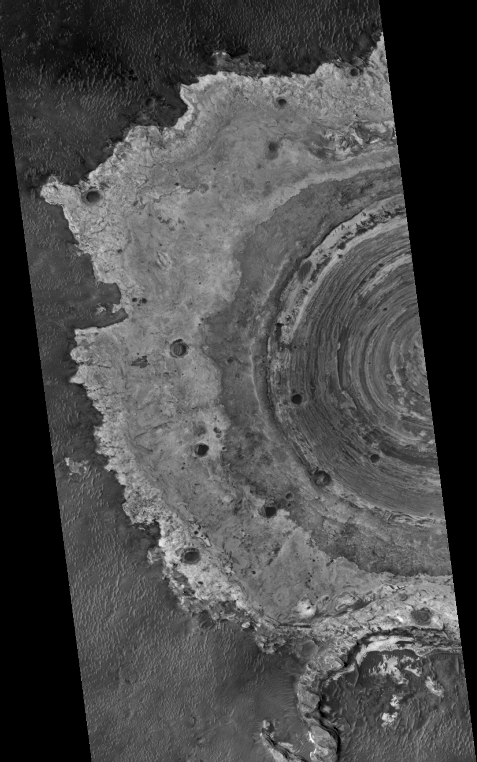
great link, thanks, went to the Main Menu and found this one on Mars:
http://www.thelivingmoon.com/43ancients/04images/Mars2/Open_Pit01_sm.png
Reminds me of the Silverpit Impact Crater in the North Sea, discovered in 2002 by oil geologists:
http://news.bbc.co.uk/media/images/38168000/jpg/_38168726_crater150.jpg
http://news.bbc.co.uk/2/hi/science/nature/2164058.stm
But back to the article...”Much of the basins are composed of sediments that cannot be dated using any method. But Meert said the sediment also contains zircon, which can be dated using laser mass spectrometry – ...”
Question: And dating the zircon proves what?
Hmm, that cubic zirconium is often associated with dating? ;’)
Dating of the zircons that are inherited into the sandstones (via erosion of nearby older rocks) can supply an age as follows. Suppose that there are rocks surrounding the basin that are well-dated. Suppose that there are rocks 1.6 billion years old, 1.1 billion years old and 800 million years old. If the basins are really 600 million years old, then the surrounding rocks would have eroded and supplied the mineral zircon (that is highly resistant to erosion) to the sandstone. When we looked in the sandstone, the youngest zircons we found were all older than 1 billion years. Thus, we concluded (along with some other confirming evidence) that the sediments were deposited around 1 billion years ago (they contained no 800 million year zircons from a nearby granite terrane.
Cheers
Joe Meert