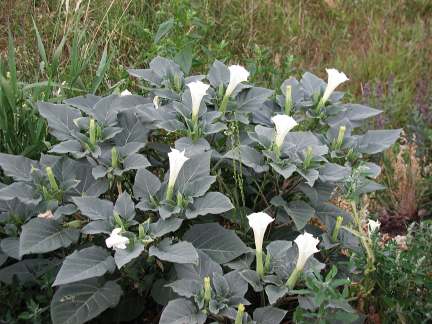
DATURA POISONING - USA (MARYLAND)
*********************************
A ProMED-mail post
http://www.isid.org
ProMED-mail is a program of the
International Society for Infectious Diseases
http://www.isid.org
Date: 16 Jul 2008
Source: The Gazette [edited]
http://www.gazette.net/stories/071608/gaitnew204310_32356.shtml
Officials: Weed turned potato stew into poison
Jimsonweed was mixed into a homemade potato stew the 6 ate at a
family dinner on 8 Jul 2008, a Montgomery County health department
spokeswoman said. An elderly family member made the stew using plants
from the family herb garden. Of the 12 people who attended the
dinner, the 6 people who ate the stew got sick.
County fire and rescue officials initially reported that the sick may
have been poisoned by mint leaves tainted with pesticides.
That changed Thursday [10 Jul 2008] after 2 experts from the county’s
disease control program and a botanist went to the family’s townhome
in the Montgomery Meadows Townhouses on the 1000 block of Travis
Lane, off Watkins Mill Road, said Mary Anderson, a spokeswoman for
the county’s department of Health and Human Services. They found
recently cut jimsonweed near the garden, which surprised the
botanist, who said the plant is usually found on farmland and in
fields, Anderson said.
Then the experts went inside.
“In the trash can were not only potato peels but more clippings of
jimsonweed and they thought ‘A-ha!’” Anderson said.
Jimsonweed contains belladonna alkaloids atropine and scopolamine,
ingredients that may cause symptoms such as: mental confusion,
agitation, rapid heart rate, incoherent speech, impaired
coordination, dry, flushed or hot skin, visual or auditory
hallucinations or cardiac arrest, Anderson said.
Satnam Singh, a relative who lives next door, said his 18-year-old
son attended the dinner. The 6 who ate the stew began hallucinating
one half-hour after eating the stew, he said. “They were acting wild
and everything, like hallucinating, they didn’t know what they were
saying, what they were doing, talking all kind of nonsense,” Singh
said. “The ones who didn’t eat, like the kids, noticed.”
His son described his sick relatives, who ranged in age from 20 to 70
years old as behaving “like when you’re high on pot,” he said. He
noticed that “they were not breathing properly” and called a friend
to the home who called the ambulance, Singh said.
Family members returned home in 1 to 3 days, his wife Kamajit Kaur
said Tuesday [15 Jul 2008].
“Everyone is better, everybody is fine, everybody is perfect...” she
said. “No medications, no treatment — they said ‘Just take a rest,’
then go see the primary doctor and that’s it.”
The episode “potentially could have been fatal,” said Chuck Schuster,
the Maryland Cooperative Extension botanist who identified the plant.
“We’re really lucky.” Jimsonweed is a “typically a waste area weed,
not a garden weed,” Schuster said. It was not planted in the family
yard. The surrounding area where the plant was growing was “rough”
and unmowed. Birds or dirt from recent construction could have
brought the plant to the neighborhood, he said. Normal lawn care such
as mowing and use of weed killer typically stops the plant’s spread,
Schuster said.
The family affected has since removed all plants from the herb garden
“to be on the safe side,” Anderson said.
“We did not know it was even there,” Singh said Tuesday. Family
members “thought it was just like a spinach-type of a plant,
something like that.”
Anderson said that jimsonweed does not resemble mint. Instead, the
weed, also known as “Downy thornapple” and “Devil’s trumpet” can grow
to 5 feet tall and has “coarsely serrated” 3- to 8-inch leaves according to
http://www.ansci.cornell.edu/plants , a Web site that contains the
Cornell University poisonous plants database. “You really have to be
careful,” she said. When it comes to eating homegrown herbs, “don’t
eat anything that you haven’t planted yourself and know exactly what it is.”
[Byline: Patricia M. Murrett]
—
Communicated by:
ProMED-mail
promed@promedmail.org
[Jimsonweed’s Latin name is _Datura_ spp. And there a number of
different species giving a slightly different shape to the leaves or
flowers. However, they all contain the same toxic agents, just in
slightly different proportions. A photo may be seen at:
http://www.wildflowersofontario.ca/jimsonweed1.jpg
or
http://www.1000wordsphotos.com/desertflowers/jimsonweed.html The
thorny fruit that contributes to its name may be viewed at:
http://www.ipm.ucdavis.edu/PMG/D/W-SO-DSTR-FR.001.html
The memory tool for Jimsonweed intoxication is “Red as a beet, dry as
a bone” (flushed, hot, red skin) and “mad as a hatter” (from Alice in
Wonderland, for its hallucinogenic properties.) The seeds have been
collected by addicts trying to get ‘high’ because of the
hallucinogenic properties. The article correctly states that it would
appear that intoxicated individuals can appear as if they have been
smoking marijuana. However, the cardiac affects have proven to be
fatal in many cases.
The texture of the leaves and stems would be far from that of spinach
or mint, so clearly this person did not know much about the herbs in
the garden, or it was done with the intent of “spiking” the stew
without knowledge of the plant’s deadly side effects. The plant has
an almost world wide distribution and is very adaptable to many
climates and habitats.
It is fortunate that this unfortunate event has had a relatively
happy outcome. It should be noted that pets can be come intoxicated
as well and this plant and its seed are much more dangerous to our
companion animals because of their relatively small size. - Mod.TG
To quote from the ProMED reference below:
“In Bangladesh, there is a tendency [to use] powder of Datura
(_Datura_ spp, most probably _D. fastuosa_) or some species of
Oleander seed in food items, drink or cigarettes by miscreants and
offering [th m] to [unsuspecting] people. Because of the action of
Datura or Oleander seed, people become unconscious and then [the
criminals] grab their valuable items. Datura or Oleander seed contain
alkaloids which are [potent] toxins for humans and higher doses may be
fatal.”
Photo of Jimsonweed:
http://www.delange.org/Jimson/Dsc00036.jpg
- Mod.JW]
[see also:
1999
[Almost 20 years ago, the local high school kids were drinking a tea made with Datura to get high, and about 5 of them died on one day.....after their lunch break and drinking the tea....granny]
*DATURA POISONING**
Sigh. I don’t know how some people get up and get dressed in the am. How stupid can you be? Maybe just ignorant. We were always taught growing up, that if you didn’t recognize a plant—don’t eat it! Although knowledge of that kind of stuff makes for great book plots! LOL
I have a beautiful peach colored Angel Trumpet. It’s about 10 x 10, can have as many as 3-500 blooms on it at a time. Never had any desire to munch on them!
Granny—re our discussions about rocks. Hubby went floundering the other night. Not sure how much you know about salt water fishing, not trying to talk down to you—just explaining. :) The guys take the boat out, try to catch a rising tide with no wind. They pole the boat, and try to gig flounder. A gig looks like Neptune’s trident. Flounder are flat fish with both eyes on the same side of their head and the ability to camoflague themselves on the bottom. You have to be really good at spotting their outlines and driving the gig down in the right spot, just behind their eyes. It is a lot of fun! It’s quiet, nothing but wind and water and starlight, and the big lights you have pointed at the water. Like rock hunting, you can get immersed/lost in what you are doing.
Back to the rocks. I told you there aren’t any native rocks here, and there aren’t. However—the ships from the old world used stones as ballast. There’s a spot where my guys were floundering the other night where the ships used to dump ballast stones. Hubby and son brought me back half a five gallon bucket of rocks! Hog heaven! All kinds of rocks. There’s the corner of a handmade brick, probably from the huge house that used to be located on Shell Castle Island. The house and the island are nothing more than memories. Sand moves. There’s a piece of lava rock, a dinner plate sized piece of slate, a chink of mica, some dark granite, all colors and shapes and sizes and kinds. A lot of the ballast stones are big balls of chalk—I often wonder if they came from the Dover area? I love rocks, and wondering where these came from. If they could only talk!