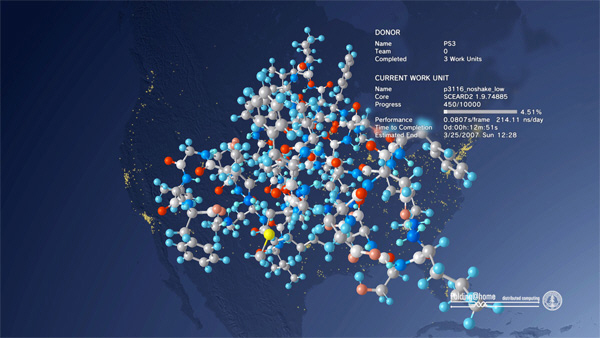
There is a group of about 300 FReepers that use their computers to help crunch proteins to advance medical research such as Alzheimer’s Disease, Parkinson’s Disease and many cancers.
In nature, misfolded proteins cause a slow buildup of poisons that eventually kill us. Computer simulation is the least expensive and quickest method to prove a conclusion.
The latest thread is here:
http://www.freerepublic.com/focus/f-chat/1929553/posts
A better thread with additional links is here:
http://www.freerepublic.com/focus/f-chat/1906532/posts
The main page at Stanford University is here:
From the front page of Folding@home:
“Folding@home is a distributed computing project — people from throughout the world download and run software to band together to make one of the largest supercomputers in the world. Every computer takes the project closer to our goals. Folding@home uses novel computational methods coupled to distributed computing, to simulate problems millions of times more challenging than previously achieved.”
Here are ideas concerning the paper:
1. This paper on MATH touches dozens of other disciplines, among them applied math, math and computers, pure scientific research, applied research, genetics and many more.
2. You will be able to show the interdisciplinary aspects of math and how it can advance other research beyond expectations.
3. Grab a PS3, load up F@H, and use it in your discussion. Talk about how the Cell processor uses math to speed up calculations to the PetaFLOP range. Also make for lots of pretty pictures, and all kids like game systems. Compare a PS3 running F@H with a desktop computer to see which is faster.
4. There is lots of material to pull from, lots of graphics to pretty up the report, and even Youtube videos to help explain the process if you make a multimedia presentation.
5. Show how you can combine all of the computers in the entire district into a gigantic supercomputer that will help cure someone’s grandmother’s Alzheimer's. This generates lots of statistics that can fill Excel sheets forever.
Some FReepers, Klutz Dohanger and josephw (I think) are education professionals that have converted computers to run F@H in the background. Klutz is the #82 folder in the entire world, and our team is #52 in the world. Many schools and colleges fold.
6. Look here for papers and results from F@H:
http://folding.stanford.edu/English/Papers
If you can understand these papers, then help explain them to us. Seriously.
“- 54.Calculation of the distribution of eigenvalues and eigenvectors in Markovian state models for molecular dynamics
- 53. Heterogeneity Even at the Speed Limit of Folding: Large-scale Molecular Dynamics Study of a Fast-folding Variant of the Villin Headpiece
- 52. Control of Membrane Fusion Mechanism by Lipid Composition: Predictions from Ensemble Molecular Dynamics.
- 51. Persistent voids: a new structural metric for membrane fusion.
- 50. Protein folding under confinement: a role for solvent.
- 49. Automatic State Decomposition Algorithm.”
And there are lots, lots more where these came from.
8. JMOL. Using math to simulate atomic scale interactions inside a computer. Look here:
9. In high schools, pretty pictures mean a lot (and take up space in a long report). There are dozens of images that can be used on Google. I still like the idea of a multimedia report. It is an honors class after all.
10. Ping generally and grey whiskers, who currently work with math or remember the math from long ago.
11. Ping me for questions that stump you.
In all seriousness, you could write a paper, come up with experiments that can be performed in the school that cost nothing except time, involve many branches of science, look good in a multimedia presentation, show how every day computers can be made to serve a higher purpose, start a race with other schools and universities across the world, and, if all else fails, you can tug on their heartstrings showing how this work can help save their GRANDMOTHER.
Hope that it helps.