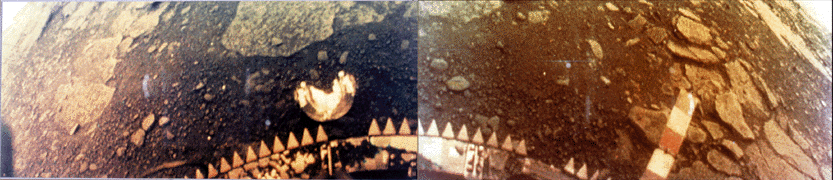

The curved object on the ground is a camera lens cover.
I don't know when that shot was released - but it was available in 1999. January 24, 1999 APOD.
As for the lander's inevitable demise, I'd say it was the temperature at first. We build deep-sea submersibles all the time which withstand 90 atmospheres of pressure. But the temps are low. I'm guessing that the high temps weakened the craft's structure at the view port, then sulfuric acid reactions further degraded the components until a breach was made, at which point the high pressure would have ruptured the lander.
| Title: |
|
Evolution of the Venera 13 imagery |
| Authors: |
|
Selivanov, A. S.; Gektin, Y. M.; Naraeva, M. K.; Panfilov, A. S.; Fokin, A. B. |
| Journal: |
|
(Pis'ma v Astronomicheskii Zhurnal, vol. 8, July 1982, p. 433-436) Soviet Astronomy Letters (ISSN 0360-0327), vol. 8, July-Aug. 1982, p. 235, 236. Translation. In Russian. In Russian. |
| Publication Date: |
|
08/1982 |
| Category: |
|
Lunar and Planetary Exploration |
| Origin: |
|
STI |
| NASA/STI Keywords: |
|
ASTRONOMICAL PHOTOGRAPHY, IMAGE ANALYSIS, SATELLITE IMAGERY, VENERA SATELLITES, VENUS SURFACE, IMAGE CONTRAST, VENUS ATMOSPHERE, WIND EFFECTS |
| Bibliographic Code: |
|
1982PAZh....8..433S |
Abstract
There are indications that the spacecraft may have changed its position slightly 50 min after the television cameras began to operate. Material which was spread over the landing ring of the spacecraft did not remain stationary. Wind is considered the most likely cause of the movement. Attention is called to the fact that the contrast of individual features tended to change with time. This affected both parts of the spacecraft and objects on the surface of the planet. It is suggested that this may derive from variability in the type of illumination, brought about, for example, by the motions of cloud formations in the atmosphere..
As for modern equipment and the "Mars curse", who knows? Perhaps it's just as simple as "more complex equals more ways to fail".