Posted on 09/15/2008 4:21:39 PM PDT by Fred Nerks
When Paul C. Sereno went hunting for dinosaur bones in the Sahara, his career took a sharp turn from paleontology to archaeology. The expedition found what has proved to be the largest known graveyard of Stone Age people who lived there when the desert was green.
The first traces of pottery, stone tools and human skeletons were discovered eight years ago at a site in the southern Sahara, in Niger. After preliminary research, Dr. Sereno, a University of Chicago scientist who had previously uncovered remains of the dinosaur Nigersaurus there, organized an international team of archaeologists to investigate what had been a lakeside hunting and fishing settlement for the better part of 5,000 years, originating some 10,000 years ago.
In its first comprehensive report, published Thursday, the team described finding about 200 graves belonging to two successive populations.
~snip
The most poignant scene was the triple burial of a petite woman lying on her side, facing two young children. The slender arms of the children reached out to the woman in an everlasting embrace. Pollen indicated that flowers had decorated the grave.
The sun-baked dunes at the site, known as Gobero, preserve the earliest and largest Stone Age cemetery in the Sahara, Dr. Serenos group reported in the online journal PLoS One. The findings, they wrote, open a new window on the funerary practices, distinctive skeletal anatomy, health and diet of early hunter-fisher-gatherers, who expanded into the Sahara when climatic conditions were favorable.
The research was also described at a news conference on Thursday in Washington at the National Geographic Society...
~snip
Other scientists said the discovery appeared to provide spectacular evidence that nothing, not even the arid expanse of the Sahara, was changeless. About 100 million years ago, this land was forested and occupied by dinosaurs and enormous crocodiles...
(Excerpt) Read more at nytimes.com ...
slideshow at link
place holder
Sahara graves ping
Did you notice the teeth? All straight and perfect with no decay, none missing.
What???!!! The Saraha desert was once GREEN??
I guess driving around in their stone age SUVs made their climate change! Oh when will we learn...
They died early back then and had a low sugar diet.
interesting.
The most poignant scene was the triple burial of a petite woman lying on her side, facing two young children. The slender arms of the children reached out to the woman in an everlasting embrace. Pollen indicated that flowers had decorated the grave.
I think they died suddenly, were covered by sand and silt; the pollen=grave theory isn't convincing.
That is very, very out of the ordinary. I would say very slim chances of a find like that.
I noticed. I guess that means they didn't emigrate to the British isles.
I knew you had but it has always been interesting to me how that people that didn’t do any of the things considered necessary to good dental health today had such beautiful chompers. What are we doing wrong?
The skull in the picture appears to be adult with all jaw teeth, no caries, none crooked. Something more than low sugar diet I think. If they find a skull with braces...now there’s news!
You mean pollen doesn’t equal flowers equals grave? Or area not green in past? I don’t understand.

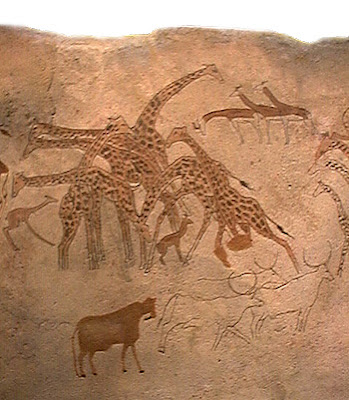
Tassili-n-Ajjer in Algeria is one of the most famous North African sites of rock painting. Its imagery documents a verdant Sahara teeming with life that stands in stark contrast to the arid desert the region has since become. Tassili paintings and engravings, like those of other rock art areas in the Sahara, are commonly divided into at least four chronological periods based on style and content. These are: an archaic tradition depicting wild animals whose antiquity is unknown but certainly goes back well before 4500 B.C.; a so-called bovidian tradition, which corresponds to the arrival of cattle in North Africa between 4500 and 4000 B.C.; a "horse" tradition, which corresponds to the appearance of horses in the North African archaeological record from about 2000 B.C. onward; and a "camel" tradition, which emerges around the time of Christ when these animals first appear in North Africa.
Engravings of animals such as the extinct giant buffalo are among the earliest works, followed later by paintings in which color is used to depict humans and animals with striking naturalism. In the last period, chariots, shields, and camels appear in the rock paintings. Although close to the Iberian Peninsula, it is currently believed that the rock art of Algeria and Tassili developed independently of that in Europe.

How do you know that they were not doing any of the things considered necessary to good dental health?
Tooth twigs and chewing certain plants clean the teeth, kill bacteria and freshen breath.
Some plants are very high in fluoride such as tea, drinking it or rinsing out your mouth keeps your teeth strong.
I do doubt they saw the dentist every six months though.

The great Tassili Park, vast and beautiful expanse of rock and sand reaching the far southeast of Algeria presents a huge concentration of prehistoric rock art. Located in a strange lunar landscape of great geological interest, this site has one of the most important groupings of prehistoric cave art in the world.
Archaeological discoveries made by Henri Loth in the 1950s made Tassili famous. According to the Tassili National Park Office, the Neolithic archaeological heritage is concentrated in the Djanet region, with more than 15,000 stone carvings and paintings., and Oued Djarat is one of the most prestigious sites in Tassili Park as itcontains 4,000 stone carvings and paintings, which have partially resisted the difficult climatic conditions. The archaeological heritage recorded up to now provides evidence of a civilisation that dates back 2.5 million years.
This civilisation experienced prosperity as it evolved from precariousness to stability as it discovered pottery and how domesticate animals.


They lived on the shores of an ancient Lake!
Both stick to the teeth and promote decay.
Starchy foods and boiled sweets, something they are very fond of but that this tribe would not have had much access to are also "sticky" foods.
I’m a bit slow tonite. Beautiful pix. I seem to recall ground pentrating radar showing ancient rivers flowed where it’s dry now.
Thanks.
You’re needed here!
Already posted, but I may just ping it again ‘coz it’s interesting.
Scientists Explore Lakefront Property, in the Sahara
The New York Times | January 27, 2004 | BRENDA FOWLER
Posted on 02/01/2004 1:36:28 PM PST by sarcasm
http://www.freerepublic.com/focus/f-news/1069653/posts
[snip] someone on the team, led by Dr. Paul Sereno of the University of Chicago, spotted something dark against the tawny dunes... In search of pieces of the 110-million-year-old Cretaceous puzzle, Dr. Sereno’s team had found what archaeologists in Niger say is a large Neolithic, or Stone Age, burial and settlement site tentatively dated at 5,000 years old. [end]
Stone Age Cemetery, Artifacts Un Earthed In Sahara
National Geographic | Brian Hanwerk
Posted on 10/23/2005 4:56:10 PM PDT by blam
http://www.freerepublic.com/focus/f-news/1507889/posts
[snip] Archaeologists have excavated a trove of Stone Age human skeletons and artifacts on the shores of an ancient lake in the Sahara... “They were living on a diet rich in catfish, mollusks, and shells,” said Paul Sereno, a University of Chicago paleontologist and National Geographic Society Explorer-in-Residence... “’There are whole human skeletons just over there,’ [Hettwer] said, pointing to a low ridge,” Sereno wrote in a 2000 online dispatch from the field. “Our jaws dropped as we tiptoed among skeletons that were buried thousands of years ago. Around the neck of one, we found a series of beads — the outline of a necklace!” In 2003 Sereno returned to map the site and stopped counting at 173 skeletons, which easily made it the largest New Stone Age cemetery ever found in the Sahara. “We saw jewelry on the surface, tools everywhere, the remains of hundreds of people,” Sereno recalled. “I knew that I had to help an archaeological team get a footing out there.” [end]
US scientists find stone age burial ground in Sahara
AFP | Aug 14, 2008 | Jean-Louis Santini
Posted on 08/14/2008 12:40:47 PM PDT by decimon
http://www.freerepublic.com/focus/f-chat/2061932/posts
Graves Found From Sahara’s Green Period
NYT | 08/15/08 | JOHN NOBLE WILFORD
Posted on 08/15/2008 1:06:10 AM PDT by TigerLikesRooster
http://www.freerepublic.com/focus/f-news/2062227/posts
-related-
Prehistoric Desert Town Found In Western Sahara (15,000 Years Old)
Reuters | 8-19-2004 | Reuters
Posted on 08/20/2004 9:10:09 AM PDT by blam
http://www.freerepublic.com/focus/f-news/1195560/posts
Scientists Find Fossil Proof Of Egypt’s Ancient Climate
Washington University At St Louis | 2-2-2005 | Tony Fitzpatrick
Posted on 02/03/2005 11:54:52 PM EST by blam
http://www.freerepublic.com/focus/f-news/1335616/posts
Ancient lakes of the Sahara
Innovations Report | Jan 19, 2006 | University of Reading
Posted on 01/21/2006 7:14:03 AM EST by Tyche
http://www.freerepublic.com/focus/f-news/1562135/posts
Sahara Desert Was Once Lush and Populated
LiveScience | 20 July 2006 | Bjorn Carey
Posted on 07/20/2006 3:55:53 PM PDT by Marius3188
http://www.freerepublic.com/focus/f-news/1669466/posts
Exodus From Drying Sahara Gave Rise to Pharaohs, Study Says
National Geographic News | July 20, 2006 | Sean Markey (no funky bunch)
Posted on 07/22/2006 6:34:42 PM PDT by SunkenCiv
http://www.freerepublic.com/focus/f-chat/1670680/posts
Ruins of 7,000-year-old city found in Egypt oasis
Source: ABC (Australia) | January 30, 2008 - 9:47AM | U/A
Posted on 01/29/2008 9:36:38 PM PST by Fred Nerks
http://www.freerepublic.com/focus/f-news/1961826/posts
Egypt’s Earliest Agricultural Settlement Unearthed
Science Daily | 2-15-2008 | University of California - Los Angeles
Posted on 02/15/2008 2:27:15 PM PST by blam
http://www.freerepublic.com/focus/f-news/1971126/posts
The Tassili n’Ajjer [Algeria] : birthplace of ancient Egypt ?
Journal 3 | 04-05-08 | Phillip Coppens
Posted on 04/05/2008 4:08:59 PM PDT by Renfield
http://www.freerepublic.com/focus/f-chat/1997350/posts
Sahara dried out slowly, not abruptly: study
Reuters | Thu May 8, 2008 2:10pm EDT | Alister Doyle, Environment Correspondent
Posted on 05/08/2008 2:12:41 PM PDT by suthener
http://www.freerepublic.com/focus/f-news/2013235/posts
Once Lush Sahara Dried Up Over Millennia, Study Says
National Geographic News | 5-8-2008 | James Owen
Posted on 05/08/2008 7:08:12 PM PDT by blam
http://www.freerepublic.com/focus/f-news/2013403/posts
-also-
Adventurer crosses sands that conquered a king
The Times Online | Jan 28, 2006 | Martin Penner
Posted on 01/27/2006 11:33:56 PM PST by Tyche
http://www.freerepublic.com/focus/f-news/1566712/posts
Egyptologists’ palm nearly extinct.
newscientist | 3 6
Posted on 06/06/2006 8:53:33 AM PDT by S0122017
http://www.freerepublic.com/focus/f-chat/1644323/posts
Dying Trade Of The Sahara Camel Trade
BBC | 10-22-2006 | John Pilkington
Posted on 10/22/2006 3:19:43 PM PDT by blam
http://www.freerepublic.com/focus/f-news/1724004/posts
In Search Of The Lost Sahara
eitb24.com | 5-15-2008
Posted on 05/18/2008 7:00:06 PM PDT by blam
http://www.freerepublic.com/focus/f-news/2017884/posts
UN vandals spray graffiti on Sahara’s prehistoric art
Times Online (UK) | January 31 2008 | Dalya Alberge
Posted on 01/31/2008 3:47:29 AM PST by knighthawk
http://www.freerepublic.com/focus/f-news/1962475/posts
|
|
|||
Gods |
Thanks Fred Nerks. It's a bit of a repeat, but I'm pinging it anyway. :') |
||
|
· Mirabilis · Texas AM Anthropology News · Yahoo Anthro & Archaeo · · History or Science & Nature Podcasts · Excerpt, or Link only? · cgk's list of ping lists · |
|||
Drought That Destroyed A Civilisation
The Herald (UK) | 11-11-2003 | Martin Willians
Posted on 11/16/2003 11:05:23 AM PST by blam
http://www.freerepublic.com/focus/f-news/1022897/posts
You left out a nice one.
Crocodiles found in the Sahara and adapted to the Desert.
http://news.nationalgeographic.com/news/2002/06/0617_020618_croc.html?fs=travel.nationalgeographic.com
‘The desert crocodiles have adapted to the changing environment in northern Africa; 8,000 to 10,000 years ago, what is now desert was probably lush savannah and grasslands. Today the Sahara is hot and arid, the land sandy, rainfall minimal, and vegetation sparse.
“The extension of range almost certainly reflects climatic changes,” said Ross. “We know that even in Roman times, the Sahara was much wetter and greener than it is now. As these places slowly dried up, remnant populations became isolated from the other crocodiles on the continent. How these populations adapted to the changing conditions is most interesting.” ‘
:’) I remember a nice NatGeo shot of crocs living in a spring-fed waterhole down in some crevasse in the Sahara. I had to wonder, what do they eat? :’) One of the linked topics up there had a short discussion of it, but (uh-oh) I can’t remember which one, I went through all of them in a hurry. :’)
and the race was?
You do an amazing job, putting out a ton of material for us.
I really appreciate it and it’s something I look forward to reading. Thanks again.
Two distinct cultures lived at Gobero. The Kiffians, like the male at left, were tall. This skull was dated at 9,500 years ago. A dry interlude chased the Kiffians away. When the rains returned, the Tenerians, who were shorter and leaner, populated the area. The Tenerian male, right, died when he was about 18. The skull was dated at 5,800 years old.
(Civ: What am I supposed to think about this? Did the brow-ridges disappear in less than a thousand years...or what? LOL!)
wow....look at the brain volume cavity in general on the right compared to the smaller left
that looks like Forrest Griffin’s skull on the left
There are 27 extinct species of humans...many of these lived at the same time. Maybe that's the explanation?

Thanks! I get plenty of help, and always have — blam was posting these topics at least 8 years ago; now you, decimon, benlurkin, fred nerks, and numerous others contribute these directly or indirectly, and you all have my thanks. :’)
one of your links mentions the ancient 'town' of d'Argilas, supposedly Berber, 15,000YA. Found this incredible piece of rockart from the area, sorry the caption is in French!
Profondément à lintérieur du territoire marocain, des scientifiques marocains sont tombés sur les ruines, recouvertes de sable, de la cité dArghilas, relevant dune antique civilisation berbère.
Hello!
And now there's only one? What happend to the others?
Some Brits and Irish hold a sugar cube in their teeth while they sip tea. And those front teeth rot out first. Kind of scary how the sugar destroys the teeth where it is actually held, in those few seconds of sipping. You’d think the bad effects would be a little more evenly distributed among the teeth. I see teenagers drinking sodas with sugar—and I’ve discovered that they’ve been told in government school that Splenda and Equal are dangerous poisons! Lefty Commie Red Maoist Democrat teachers!
I wish I could see the map of the rivers. Does anyone have more info on this?
Yes, I agree with your observation, it looks as if their fingers are locked.
http://eob.gsfc.nasa.gov/Newsroom/NewImages/images.php3?img_id=4900
enlarge this image to see numerous ancient river-courses that appear to end in a huge lake basin.
Today the best known remaining relict populations can be found in the Ennedi mountains of Chad (photo) and the Tagant in Mauritania. The Tagant population was thought to have disappeared in 1996 when the last head was brought in for scientific research after the animal itself had been eaten by local inhabitants (photo). It was a big surprise when in 2007 Ursula Steiner photographed at least three crocs. Unless there is permanent water, desert crocs aestivate in deep burrows during the hot season. This is probably why the Tagant group had been overlooked for so long.
You might try entering “rivers in the sahara pictures images” in google. There are a few there.

The Best Global Warming Videos on the Internet |
About 68% of Europeans have DNA haplogroups that are from the Iberian Ice Age Refuge, yDNA = R1b and mtDNA = 'H'.
I think it is informative to note the haplogroups amoung the Guanches of the Canary Islands. When the Ice Age began to end, the refugees migrated all over Europe and at the same time into Northern Africa.
My guess is that at one time, Northern Africa was probably inhabited by White people who mixed with Black Africans became Berbers and etc.
"The Guanches are the mysterious natives of the Canary Islands. They were conquered by the Spaniards during the turn of the 15th century. Tall, blond and blue-eyed, the Guanches have long intrigued the anthropologists, for blond natives are rarity. According to the reliable Encyclopedia Britannica, the Guanches "are thought to have been of Cro-Magnon origin... and had a brown complexion, blue or gray eyes, and blondish hair."
You and I will be in that book soon enough..lol
In my family we still have the brow ridges and the extended sternums.
There’s a lot of variability in the living human family that can’t be shown with a handful of specimens.
But I think the Geiko caveman jokes are funny. ;)
that (four horse?) chariot rock art piece makes one wonder what the actual age of such rock art happens to be. :’) Great find!
Nah! The coming Ice Age will save us.
http://www.metmuseum.org/toah/hd/tass/hd_tass.htm
...Tassili-n-Ajjer in Algeria is one of the most famous North African sites of rock painting. Its imagery documents a verdant Sahara teeming with life that stands in stark contrast to the arid desert the region has since become. Tassili paintings and engravings, like those of other rock art areas in the Sahara, are commonly divided into at least four chronological periods based on style and content. These are: an archaic tradition depicting wild animals whose antiquity is unknown but certainly goes back well before 4500 B.C.; a so-called bovidian tradition, which corresponds to the arrival of cattle in North Africa between 4500 and 4000 B.C.; a “horse” tradition, which corresponds to the appearance of horses in the North African archaeological record from about 2000 B.C. onward; ...
http://www.metrum.org/mapping/sahara.htm
...Our knowledge of the ancient Sahara was revolutionized by the publication, in 1957, or the results of Henri Lhotes investigations of the rock paintings of the central Sahara. These paintings indicate that there was a time when chariots drawn by horses crossed the Sahara from the Mediterranean coast to the river Niger. This indicates that the process of dissication of the Sahara had reached a point in which transportation by river was no longer possible from the Great Chots to the Ahaggar and from there to the Niger, but the land could still support horses. One principle used by Lhote in dating this chariot route is the fact that the horses are portrayed on the rock painting according to style conventions that occur in Mycenaean art. Lhote assumes that the Mycenaeans, like the Greeks who followed them, had colonized Cyrenaica and that from there had advanced into the Sahara area...

Ramses II at the battle of Kadesh.
Disclaimer: Opinions posted on Free Republic are those of the individual posters and do not necessarily represent the opinion of Free Republic or its management. All materials posted herein are protected by copyright law and the exemption for fair use of copyrighted works.