Skip to comments.
The FReeper Foxhole Profiles General Alexander Vandegrift - May 3rd, 2004
hqinet001.hqmc.usmc.mil ^
Posted on 05/03/2004 12:01:02 AM PDT by SAMWolf
|

Lord,
Keep our Troops forever in Your care
Give them victory over the enemy...
Grant them a safe and swift return...
Bless those who mourn the lost.
.
FReepers from the Foxhole join in prayer
for all those serving their country at this time.

...................................................................................... ........................................... |
|
|
|
|
|
|

.
|
U.S. Military History, Current Events and Veterans Issues
 Where Duty, Honor and Country
are acknowledged, affirmed and commemorated.
|
.

.
| Our Mission: The FReeper Foxhole is dedicated to Veterans of our Nation's military forces and to others who are affected in their relationships with Veterans. In the FReeper Foxhole, Veterans or their family members should feel free to address their specific circumstances or whatever issues concern them in an atmosphere of peace, understanding, brotherhood and support. The FReeper Foxhole hopes to share with it's readers an open forum where we can learn about and discuss military history, military news and other topics of concern or interest to our readers be they Veteran's, Current Duty or anyone interested in what we have to offer. If the Foxhole makes someone appreciate, even a little, what others have sacrificed for us, then it has accomplished one of it's missions. We hope the Foxhole in some small way helps us to remember and honor those who came before us.
To read previous Foxhole threads or
to add the Foxhole to your sidebar,
click on the books below.
|
|
|
|
|
.
.
|
 
.
 General Alexander Archer Vandegrift
(1887 - 1973)
.
|
General Alexander Archer Vandegrift, World War II Medal of Honor recipient and 18th Commandant of the Marine Corps, was born on 13 March 1887 in Charlottesville, Virginia. He attended the University of Virginia and was commissioned in the Marine Corps as a second lieutenant on 22 January 1909.

First Lieutenant Alexander A. Vandegrift, USMC
Portrait photograph. Though dated 5 April 1917, this image must have been taken in 1914-1916, as Vandegrift was promoted to Captain on 29 August of the latter year.
Following instruction at the Marine Officers' School, Port Royal, South Carolina, and a tour of duty at the Marine Barracks, Portsmouth, New Hampshire, he went to foreign shore duty in the Caribbean area. He participated in the bombardment, assault, and capture of Coyotepe in Nicaragua. He further participated in the engagement and occupation of Vera Cruz, Mexico.
In December 1914, following his promotion to first lieutenant, he attended the Advance Base Course at the Marine Barracks, Philadelphia. Upon completion of schooling, he sailed for Haiti with the 1st Brigade and participated in action against hostile Cacos bandits at LeTrou and Fort Capois.
In August 1916, he was promoted to captain and became a member of the Haitian Constabulary at Port Au Prince, where he remained until detached to the United States in December 1918. He returned to Haiti again in July 1919 to serve with the Gendarmerie d'Haiti as an Inspector of Constabulary. He was promoted to major in June 1920.

Major General Alexander A. Vandegrift, USMC
Portrait photograph taken circa 1942.
Major Vandegrift returned to the U.S. in April 1923 and was assigned to the Marine Barracks, Quantico, Virginia. He completed the Field Officers' Course, Marine Corps Schools in May 1926. He then was transferred to the Marine Corps Base, San Diego, California, as Assistant Chief of Staff.
In February 1927, he sailed for China where he served as Operations and Training Officer of the 3d Marine Brigade with Headquarters at Tientsin. He was ordered to Washington, D.C., in September 1928 where he became Assistant Chief Coordinator, Bureau of the Budget.
Following duty in Washington, he joined the Marine Barracks, Quantico, where he became Assistant Chief of Staff, G-1 Section, Fleet Marine Force (FMF). During this assignment, he was promoted to lieutenant colonel in June 1934.

Rear Admiral Richmond Kelly Turner, USN (left), and Major General Alexander A. Vandegrift, USMC
Working on the flag bridge of USS McCawley (AP-10), at the time of the Guadalcanal-Tulagi operation, circa July-August 1942.
Ordered to China in June 1935, LtCol Vandegrift served successively as Executive Officer and Commanding Officer of the Marine Detachment at the American Embassy in Peiping. Promoted to colonel in September 1936, Col Vandegrift reported to Headquarters Marine Corps (HQMC), Washington, D.C. in June 1937, where he became Military Secretary to the Major General Commandant. In March 1940, he was appointed Assistant to the Major General Commandant, and the following month was promoted to brigadier general.
Brigadier General Vandegrift was detached to the 1st Marine Division in November 1941, shortly before the outbreak of World War II. He was promoted to major general in March 1942 and sailed for the South Pacific Area that May as commanding general of the first Marine division to ever leave the shores of the United States. On 7 August 1942, in the Solomon Islands, he led ashore the 1st Marine Division in the first large-scale offensive action against the Japanese. For outstanding service as Commanding General of the 1st Marine Division during the attack on Guadalcanal, Tulagi, and Gavutu in the Solomon Islands, he was awarded the Navy Cross and for the subsequent occupation and defense from 7 August to 9 December 1942, was awarded the Medal of Honor.

Major General Alexander A. Vandegrift, USMC,
Commanding General, First Marine Division
At his field desk in the Division command tent on Guadalcanal, circa August-December 1942.
In July 1943, he assumed command of the I Marine Amphibious Corps and commanded this organization in the landing at Empress Augusta Bay, Bougainville, Northern Solomon Islands, on 1 November 1943. Upon establishing the initial beachhead, he relinquished command and returned to Washington, D.C. as Commandant-designate.
On 1 January 1944, as a lieutenant general, he was sworn in as the 18th Commandant of the Marine Corps. On 4 April 1945, he was appointed general, with date of rank from 21 March 1945, the first Marine officer on active duty to attain four-star rank.

For outstanding service as Commandant of the Marine Corps from 1 January 1944 to 30 June 1946, Gen Vandergrift was awarded the Distinguished Service Medal. He left active service on 31 December 1947 and was placed on the retired list 1 April 1949.
General Vandegrift died 8 May 1973 at the National Naval Medical Center, Bethesda, Maryland, after a long illness. He was 86. His interment was 10 May 1973 at Arlington National Cemetery.
General Vandegrift held an honorary degree of Doctor of Military Science from Pennsylvania Military College, and honorary degrees of Doctor of Law from Harvard, Colgate, Brown, Columbia, and Maryland Universities and John Marshall College.

In addition to the Medal of Honor, Navy Cross, and Distinguished Service Medal, his decorations and medals included:
- the Presidential Unit Citiation with one bronze star, Solomon Island, 1942;
- Navy Unit Commendation with one bronze star, Solomon Islands, 1943, and Okinawa, 1945;
- Expeditionary Medal with three bronze stars, Cuba, 1912, Nicaragua, 1912, Haiti, 1915-24, Cina, 1927-28;
- Nicaraguan Campaign Medal, Nicaragua, 1912;
- Mexican Service Medal, Mexico, 1914;
- Haitian Campaign Medal with one star, Haiti, 1915 and 1919-20;
- Victory Medal with West Indies Clasp and one star, Haiti, 1918;
- Yangtze Service Medal, Shanghai, 1927;
- American Defense Service Medal, 1939-1941;
- Asiatic-Pacific Campaign Medal with four bronze stars;
- Solomon Islands, 1942-43;
- American Campaign Medal;
- World War II Victory Medal.

He had received the following foreign decorations:
- Haitian Distinguished Service Medal, Haiti, 1919-20;
- Medaille Militaire with one silver star, Haiti, 1920-21;
- Honorary Knight Commander, Military Division of the Most Excellent Order of the British Empire;
- Companion (Honorary) of the Military Division of the Most Honorable Order of the Bath, British Solomon Islands, 1942;
- Cruz de Aviacion de Primera Clase, Peruvian Government, 1944;
- Abdon Calderon of the 1st Class, Equador, 1944;
- Knights Grand Cross in the Order of the Orange-Nassau with Swords, Netherlands, 1945;
- Order of Pao-Tine (Precious Tripod) with Special Clasp, China, 1947;
- Legion of Honor (Grand Officer), france.
|
|
|
|
|
TOPICS: VetsCoR
KEYWORDS: biography; freeperfoxhole; generalvandegrift; guadalcanal; japan; marinecorps; marines; pacifictheater; veterans; wwii
Navigation: use the links below to view more comments.
first previous 1-20, 21-40, 41-60, 61-80 ... 141-155 next last
To: bentfeather
We've been warm and suuny for almost a week now. It's beenr eal nice to sit on Snippy's deck and watch the ducks in the evening. :-)
41
posted on
05/03/2004 9:45:34 AM PDT
by
SAMWolf
(I used to be schizophrenic, but we're ok now.)
To: Professional Engineer
Communication has sure changed since the 60's.
42
posted on
05/03/2004 9:46:26 AM PDT
by
SAMWolf
(I used to be schizophrenic, but we're ok now.)
To: CholeraJoe
He claims there was no alcohol involved. LOL! There's always alcohol involved ;-)
43
posted on
05/03/2004 9:47:08 AM PDT
by
SAMWolf
(I used to be schizophrenic, but we're ok now.)
To: stand watie
Morning stand watie.
Free Dixie!
44
posted on
05/03/2004 9:48:00 AM PDT
by
SAMWolf
(I used to be schizophrenic, but we're ok now.)
To: SAMWolf
45
posted on
05/03/2004 9:48:39 AM PDT
by
stand watie
(Resistance to tyrants is obedience to God. -T. Jefferson)
To: Valin; Matthew Paul; snippy_about_it; All
1945 1st Polish armour brigade occupies Wilhelmshafen After the Normandy Campaign, the 1st Polish Armored Division drove on across Belgium helping liberate numerous towns and villages. The next major action of the Division took place at a city called Breda in Holland. The Germans had planned to turn Breda into a fortress and defend it to the last, yet General Maczek was able to outmaneuver his opponent and force the Germans to retreat without leveling the city. In the final stages of the war, the Poles formed the outside flank of the Allied advance into Germany in 1945. Their final action was the battle of Wilhelmshaven. The Poles captured the city and received the surrender of almost the entire German navy!
Despite their steadfast commitment to the Allied cause, and despite almost six years of fighting the nazis, Poland was handed over to Stalin and the Soviet Union at the War's conclusion.
(Bear in mind that the Communist Government of the Soviet Union bears the responsibility for the deaths of an estimated 700,000-1 million Poles during the years 1939-56.)
Polish soldiers who returned to Poland were at best mistreated, and at worst executed for being "Anti-Communist". They were even denied the right to march in the postwar victory parades in the West for fear of offending Stalin. There, the vast majority of them remained - in the West, not daring to return to their beloved Homeland, and sorely missed families.
Thankfully, the Polish spirit remained unbroken, and in the early 1990's the Polish democratic government based in London since 1940, was allowed to return to Poland. Sweeping changes had taken place in Eastern Europe, some say those sweeping changes can be directly credited to Poland's stubborn spirit to resist oppression, and to fight for freedom. World War Two had finally ended for Poland.
Niech Zyje Polska!
46
posted on
05/03/2004 9:53:58 AM PDT
by
SAMWolf
(I used to be schizophrenic, but we're ok now.)
To: E.G.C.
Thanks for the heads up E.G.C. Running ADAWARE as I type.
47
posted on
05/03/2004 9:54:50 AM PDT
by
SAMWolf
(I used to be schizophrenic, but we're ok now.)
To: SAMWolf
Good read today, Sam. I've read about the "Cactus Air Force", the various aviation units flying from Guadalcanal. Absoultely amazing the conditions they endured. All who served there earned every accolade they received.
48
posted on
05/03/2004 10:12:16 AM PDT
by
Professional Engineer
(We celebrated May Day with a bonfire made up of Tree Huggers and Environmentalists.)
To: Valin
1949 1st firing of a US Viking rocket; reached 80 km 
Viking number 12 (note the "12" on the fin below the workers) is undergoing final checkout in prepartation for launch, which occurred on February 4, 1955. Number 12 was the last Viking ever launched.
49
posted on
05/03/2004 10:44:16 AM PDT
by
Professional Engineer
(We celebrated May Day with a bonfire made up of Tree Huggers and Environmentalists.)
Comment #50 Removed by Moderator
Comment #51 Removed by Moderator
Comment #52 Removed by Moderator
To: SAMWolf; snippy_about_it
Afternoon, folks.
Comparing his Marines with the Japanese, he noted that the Japanese soldier "was trained to go to a place, stay there, fight and die. We train our men to go to a place, fight to win, and to live. I can assure you, it is a better theory."
Some things never change. Just substitute terrorist or islamo-fascist for Japanese.
Vandergrift was a hell of a leader. Guadalcanal was going to be hard enough as planned - I can just imagine what Vandergrift and his Marines thought as they watched Frank Jack Fletcher serenely sail away with half their supplies.
To: Matthew Paul; SAMWolf
The Poles are already giving the Frenchies hell in the European Parliament! I love it!
To: All
Here's a story in the local news sites:
Community Restores Rare Jet For Displayed On The Iron Range
May 3, 2004 11:56 am US/Central
Chisholm Mn(AP) A rare fighter jet is returning to the Iron Range.
An F-94C Starfire fighter jet, believed to be one of only five remaining nationwide, has been restored and will be dedicated May 22 as the newest addition to the veterans memorial at the Ironworld Discovery Center here.
"I said that before I die, I wanted to see that airplane up there," said Chisholm World War II Air Force veteran Lou Novak, who helped lead the project.
The $534,000 jet is one of 387 built by Lockheed in the 1950s. About 15 were stationed with the Minnesota Air National Guard in Duluth until 1959 as part of the nation's defense system.
In 1959, the F-94Cs were mothballed and replaced by F-89Js. This jet was salvaged from the scrap yard and turned over to the museum.
Equipped with 24 2.75-inch rockets in its nose and 12 in each wing pod, the Starfire was the first jet plane designed to use an all-rocket weaponry. That design, however, had an unusual flaw. If nose rockets were fired, exhaust smoke and fire would blind the two crew members. The airplanes never saw combat.
"It was a good airplane without the (wing) tanks on it," said retired Minnesota Air National Guard Major Gen. Wayne Gatlin of Duluth, who commanded the 148th Fighter Wing from 1966 to 1979. "The rockets came out of it like a shotgun. But if you fired the rockets on the nose, it would burn the paint off it."
After more than four decades of being displayed outdoors, the deteriorating airplane was taken apart in September 2003, transported in three pieces to Duluth and restored by volunteers from the 148th.
"It's a lot of hard work, but it's nice to see a community appreciate something like this," said Senior Master Sgt. Robert Bloom, 148th Fighter Wing fabrication element supervisor. "There's a lot of satisfaction in it, but the community is the driving force."
The 44-foot jet will be displayed on two pedestals near an M-60 tank and Huey helicopter at the veterans memorial along Highway 169 near the Ironworld entrance.
|
Air Power
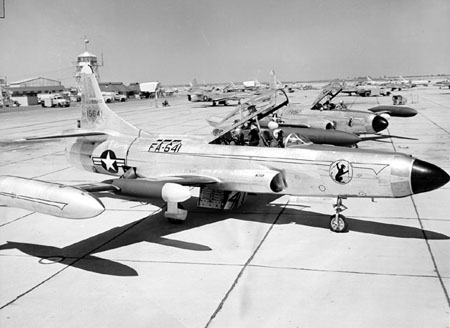
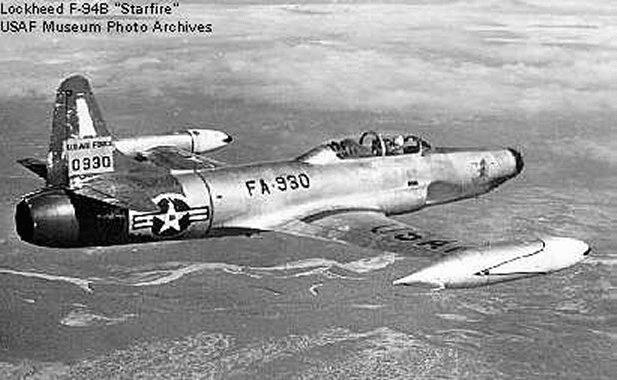
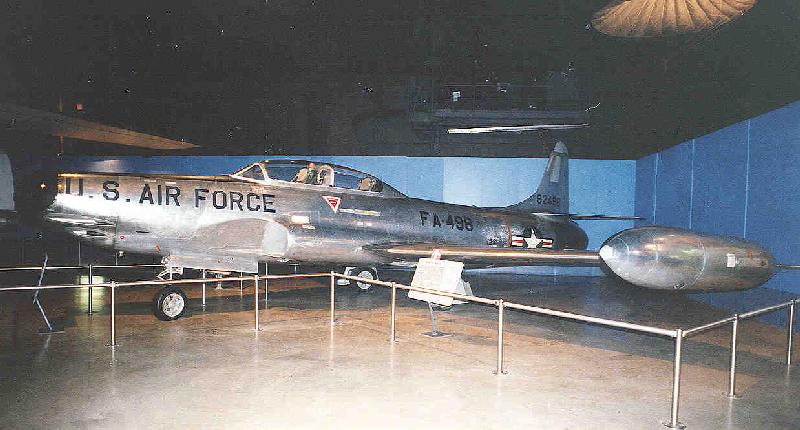
Lockheed F-94 "Starfire"
 |
The F-94 series all-weather interceptors were developed from the Lockheed F-80 Shooting Star. The prototype F-94 first flew on July 1, 1949. The Starfire was subsequently produced in the -A, -B, and -C series. The F-94C (originally designated the F-97A) was a fundamental redesign of the F-94B and made its first flight on January 18, 1950.
Improvements in the F-94C included a higher thrust engine, single point refueling, a redesigned wing, a sweptback horizontal stabilizer, upgraded fire-control and navigation systems and, later, mid-wing rocket pods. Twenty-four rockets were carried in the nose in a ring around the radome, shielded by retractable doors, with an additional 24 in the wing pods, if installed. The F-94C carried no guns. Starfires were employed in the air defense of the Continental U.S. in the 1950s. In the F-94A form, they served as the first all-jet all-weather interceptor for the Air Defense Command. The last F-94Cs were withdrawn from USAF service in 1959.
The two-place F-94 was this nation's first operational jet all-weather interceptor. It was developed from the single-seat F-80 Shooting Star which had been the Army Air Forces' first operational jet aircraft procured in significant quantities.
Although the F-94 had a redesigned fuselage, it used the F-80 tail, wing, and landing gear. The Starfire was also the first U.S. production jet to have an afterburner, which provided brief periods of additional engine thrust.
It was equipped with radar in the nose to permit the observer in the rear seat to locate an enemy aircraft at night or in poor weather. The pilot then flew the Starfire into proper position for an attack based upon the observer's radar indications.
F-94s were primarily deployed for the defense of the United States in the early 1950s, serving with Air Defense Command squadrons. Many Air National Guard units were later equipped with F-94s.
Specifications:
Primary Function: All-weather interceptors (F-94C stats below)
Contractor: Lockheed
Crew: Two
Unit Cost: $534,000
Powerplant: One Pratt & Whitney J48-P-5 or J48-P-5A at 8,750 lbs. thrust with afterburner
Dimensions:
Length: 44 ft 4 in
Wingspan: 37 ft 4 in
Height: 14 ft 11 in
Weights: Empty: 9,557 lbs. - Maximum Takeoff: 24,000 lbs
Performance :
Maximum speed: 640 mph.
Cruising speed: 476 mph.
Ceiling: 51,800 ft
Range: 1,275 miles
Armaments:
Twenty-four 2.75 in. Folding Fin Aerial Rockets in nose
and
Twenty-four FFARs in two wing pods.


All information and photos Copyright of their respectives sites and owners.
55
posted on
05/03/2004 12:52:21 PM PDT
by
Johnny Gage
(What's a free gift? Aren't all gifts free?)
To: Professional Engineer
One of the earlier threads we did covered the Catus Air Force.
Maybe time for a Foxhole Revisits thread.
56
posted on
05/03/2004 12:57:14 PM PDT
by
SAMWolf
(I used to be schizophrenic, but we're ok now.)
To: Matthew Paul
Jesus Christ, Mother of God and ....Ronald Reagan honored for the first time in the history of the European Parliament in Strasbourg.God Bless Poland. Let the EU know where you stand!
When M.Kaminski was paying special tribute of the Polish people to America and especially to Ronald Reagan, some french and german MPs left the Parliament, whistling and expressing their dissatisfaction out loud. (I wish you could see their faces! :-]
Typical arrogance of those Socialists. Should have locked them out and not let them back in.
57
posted on
05/03/2004 12:59:38 PM PDT
by
SAMWolf
(I used to be schizophrenic, but we're ok now.)
To: Matthew Paul
Thanks Matt. That "We don't beg for Freedom - We fight for it" poster always makes me teary eyed. I see that spirit in my Dad when he speaks of Poland.
58
posted on
05/03/2004 1:02:29 PM PDT
by
SAMWolf
(I used to be schizophrenic, but we're ok now.)
To: colorado tanker
Afternoon CT. He did a great job with what he had. It wasn't dubbed "Operation Shoestring" for nothing.
59
posted on
05/03/2004 1:03:40 PM PDT
by
SAMWolf
(I used to be schizophrenic, but we're ok now.)
To: Johnny Gage
Thanks Johnny.

60
posted on
05/03/2004 1:06:22 PM PDT
by
SAMWolf
(I used to be schizophrenic, but we're ok now.)
Navigation: use the links below to view more comments.
first previous 1-20, 21-40, 41-60, 61-80 ... 141-155 next last
Disclaimer:
Opinions posted on Free Republic are those of the individual
posters and do not necessarily represent the opinion of Free Republic or its
management. All materials posted herein are protected by copyright law and the
exemption for fair use of copyrighted works.
FreeRepublic.com is powered by software copyright 2000-2008 John Robinson
