Skip to comments.
Bill Clinton Is Not Peter Navarro: A Constitutional Distinction That Matters
American Greatness ^
| 02/14/2026
| Peter Navarro
Posted on 02/14/2026 7:44:23 PM PST by SeekAndFind
A lazy, surface-level media habitually conflates the statutory duty of a private citizen to comply with a congressional subpoena with the constitutional duty of a senior White House adviser to resist one that implicates executive privilege.
The latest example comes from National Review’s Rich Lowry, who lumps me together with Bill Clinton in a single moral bucket.
That analogy gets the stakes exactly backward.
Lowry’s free trade antipathy to the Trump tariff agenda I have championed in the White House is no secret. Fair enough. Policy disputes are part of democratic life.
What is harder to accept is Lowry’s tariff animus spilling into applause for my imprisonment—and then repackaged as precedent for future subpoena fights involving former presidents.
In urging Clinton to “simply comply” with a congressional subpoena in the Epstein inquiry, Lowry argued that any former restraint against using criminal contempt in politically charged investigations has already been abandoned because Steve Bannon and I went to prison.
The symmetry is rhetorically convenient. It is also legally wrong.
Clinton was subpoenaed as a private citizen regarding private conduct. However controversial the subject matter, a deposition about Jeffrey Epstein does not implicate confidential presidential deliberations or core Article II communications.
If Clinton has Fifth Amendment concerns, he may assert them question by question. But there is no meaningful executive-privilege issue at stake.
In my case, the January 6 Committee subpoena demanded testimony and documents concerning my work as a senior White House adviser, including communications and deliberations involving the president. That is precisely where Congress’s investigative power collides with the constitutional need for presidential independence and confidentiality.
For decades, the Supreme Court has recognized that executive privilege is rooted in the separation of powers. In United States v. Nixon, the Court acknowledged “the valid need for protection of communications between high government officials and those who advise and assist them in the performance of their manifold duties” and emphasized the president’s need for “complete candor and objectivity from advisers.” The privilege exists to protect the “confidentiality of high-level communications” essential to effective presidential decision-making.
That protection is not ornamental. It is structural.
For roughly five decades, Justice Department guidance has recognized the testimonial immunity of senior presidential advisers and cautioned against criminal contempt prosecutions in unresolved executive-privilege disputes. The purpose is not to elevate advisers above the law. It is to prevent Congress from converting the president’s immediate staff into compulsory witnesses against the presidency itself.
Lowry sidesteps that constitutional collision by reducing it to what might be called a “magic words” problem—the notion that executive privilege must be invoked with perfect procedural formality at precisely the right moment, or else the constitutional issue evaporates. But the dispute over how privilege is invoked—especially when a former president asserts it and an incumbent administration refuses to honor it—is itself a separation-of-powers controversy. Turning that unresolved conflict into a criminal prosecution transforms constitutional safeguards into procedural tripwires.
Conservatives should be wary of that approach. Once executive confidentiality depends on technical invocation rituals rather than constitutional substance, Congress and the Justice Department are handed a roadmap for piercing high-level deliberations whenever political incentives align.
Today, a Republican adviser; tomorrow, a Democratic one.
My case remains on appeal, even though I have already served my sentence. I have no personal incentive to pursue it. I continue the appeal to resolve constitutional questions of first impression that extend far beyond my own circumstances.
Do senior White House advisers possess absolute testimonial immunity when executive privilege is implicated, as the Justice Department has maintained for more than half a century? Is executive privilege presumptive in such disputes, or must it be invoked with particular formalities to carry constitutional force?
If invocation is required, what constitutes a legally sufficient assertion—especially when a former president invokes privilege and an incumbent administration declines to defend it? And before a senior adviser is exposed to criminal liability, do Congress and the executive branch have a constitutional obligation to seek accommodation rather than resort to prosecution?
These are structural separation-of-powers questions. They deserve judicial resolution—not incarceration as a substitute for adjudication.
If I lose my appeal, the consequence will not be personal. It will be precedential.
Future senior advisers in both Republican and Democratic administrations will face the same dilemma: honor executive privilege and risk prison, or testify and weaken the constitutional independence of the presidency.
Either outcome will chill candid advice to the president and erode the deliberative confidentiality the Supreme Court has long recognized as essential to effective executive decision-making.
If criminal contempt becomes the enforcement mechanism for interbranch privilege disputes, Congress will have discovered a powerful new lever over the presidency. The immediate target may be a Republican adviser. The long-term casualty will be presidential candor itself. And once advisers must calculate the risk of imprisonment before speaking freely, the constitutional damage will not be easily undone.
***
Peter Navarro is Senior Counselor to the President for Trade and Manufacturing. He served four months in a federal prison while appealing his conviction. Follow his case at www.peternavarro.com
TOPICS: Constitution/Conservatism; Culture/Society; Government; News/Current Events
KEYWORDS: bichlowry; clinton; epstein; navarro; nevertrump; richlowry; rinopos; sinkemperor; slickwilly; thetoon
To: SeekAndFind
Rich is not much smarter than my feces.
2
posted on
02/14/2026 7:56:22 PM PST
by
ConservativeMind
(Trump: Befuddling Democrats, Republicans, and the Media for the benefit of the US and all mankind.)
To: All

Bill Clinton greets Epstein and Ghislaine Maxwell in the White House (1993).
Clinton was also the 40th and 42nd Governor of Arkansas
WIKI---Relationship of Bill Clinton and Jeffrey Epstein
Bill Clinton, the 42nd president of the United States, developed a social and professional relationship with financier and child sex offender Jeffrey Epstein that began in the early 1990s and continued into the early 2000s. During Clinton's presidency, Epstein made multiple visits to the White House and maintained ties with Clinton's associates; after leaving office, Clinton traveled on Epstein's private jet on several occasions for "charitable" trips including for the Clinton Foundation "charity." Epstein's interactions with Clinton can be traced to the early 1990s, and apparently "concluded" in 2003.
Since Epstein's 2019 arrest for sex trafficking of minors and his death in prison shortly thereafter, their former relationship has come under further scrutiny.[2] Clinton has denied any knowledge of Epstein's criminal activities and distanced himself from the disgraced financier in the years before Epstein's 2019 arrest and death. In 2025, Ghislaine Maxwell claimed Clinton was a friend of hers, not Epstein's, and denied that Clinton was involved in any of Epstein's crimes.
snip
3
posted on
02/14/2026 8:33:51 PM PST
by
Liz
(Jonathan Swift: Government without the consent of the governed is the very definition of slavery.)
To: All

President Clinton hosting Epstein and Maxwell at the White House in 1993
The Pimp and the President: Epstein White House contacts and early ties
Epstein's interactions with Clinton can be traced to the early 1990s. After donating $1,000 to Bill Clinton's presidential election campaign in 1991, Epstein donated $10,000 to the White House Historical Association in 1993 and, accompanied by Maxwell, attended a donors' reception hosted by President Clinton and First Lady Hillary Clinton. Around the same period, visitor logs indicate Epstein paid several visits to the White House to meet with Mark Middleton, a Clinton aide and assistant to the White House chief of staff, in 1993–1995. Middleton, a friend of Clinton's from Arkansas, was later identified as having facilitated Epstein's White House access in at least three instances.
While Clinton was president, Epstein visited the White House at least 17 times between 1993 and 1995. By 1995, Epstein was circulating in Clinton's social orbit: that year, he and Maxwell attended a small fundraising dinner at the Palm Beach home of billionaire Ron Perelman, which Clinton also attended.[11] In April 1995, businesswoman Lynn Forester (later Lynn Forester de Rothschild), a Clinton supporter, wrote a personal letter to the President mentioning that she had used her "fifteen seconds of access" to discuss "Jeffrey Epstein and currency stabilization" with him, suggesting Clinton was acquainted with Epstein's financial acumen. Clinton's later schedules and archives confirm that Epstein and Maxwell were received as part of at least one White House donor event in 1993, though the exact nature of their conversations with Clinton remains unclear.
Clinton left office in January 2001 and soon embarked on humanitarian and philanthropic initiatives via the Clinton Foundation. During this post-presidential period, his association with Epstein continued in the context of charity travel and social meetings. Epstein was an active supporter of the Clinton Foundation, even lending his Boeing 727 private jet for Clinton's international trips.
In 2002 and 2003, Clinton took multiple flights on Epstein's plane, commonly known by the nickname "Lolita Express", as part of foundation-related tours to promote global health and economic development. Flight log records later indicated Clinton's name on at least 17 legs of Epstein's flights in that timeframe.[1] On one high-profile trip in 2002, Clinton flew aboard Epstein's jet to Africa along with actors Kevin Spacey and Chris Tucker to visit HIV/AIDS project sites. Clinton's spokesman would later state that these comprised four distinct trips on Epstein's aircraft – one to Europe, one to Asia, and two to Africa – and that Clinton was accompanied by staff, foundation supporters, and Secret Service agents on all legs of those journeys.
Around the same time period, Clinton also visited Epstein's New York apartment and office in 2002, each time with his aide and security detail present. Clinton and Epstein appeared to be on friendly terms; a photo from 2002 shows them together during a stop in Brunei, and in an interview that year Clinton praised Epstein as a "highly successful financier" and "a committed philanthropist".
Epstein's New York residence, according to one visitor, contained a signed photograph of Clinton. Epstein possessed an oil painting of Clinton in a blue dress and heels. According to one of his lawyers, Epstein was "part of the original group" that conceived the Clinton Global Initiative, a flagship program of Clinton's philanthropic work. This relationship extended to Maxwell as well – she and Epstein were invited guests at events early in the Clinton Foundation era, and Maxwell was noted as the likely social "glue" connecting Epstein to Clinton's world. However, in 2003, Clinton would skip a dinner party which Epstein invited him to.
Epstein's close associate Ghislaine Maxwell continued to socialize within Clinton's family circle for some years. Maxwell attended Chelsea Clinton's wedding in 2010, traveled on a private yacht with Chelsea in 2009, and participated in Clinton Global Initiative conferences as late as 2013.
A Clinton spokesperson later said that Chelsea and Maxwell were not close friends despite Maxwell's appearances at these events. In 2015, Chelsea became aware of the "horrific" allegations against Maxwell and said she hoped that Epstein's victims would find justice.
4
posted on
02/14/2026 9:39:26 PM PST
by
Liz
(Jonathan Swift: Government without the consent of the governed is the very definition of slavery.)
To: SeekAndFind
BS on its face. Executive privilege, as we just learned from the Trump lynchings only applies to those times when the President is in office.
So, for Bill Clinton, any Epstein Island activity is “executive privilege” from 1992-2000.
There’s PLENTY of Epstein Island activity by Billy boy AFTER 2000...
But then National Review doesn’t care about it because this isn’t an objective piece but cannon fodder to feed the narrative that some people are beyond the law when they have a D behind their name. (aka the Communist Party of the USA)
5
posted on
02/14/2026 10:58:43 PM PST
by
Skywise
To: All
Bill Clinton Has an Epstein Problem, and So Does America
thefp.com
By Eli Lake
12.21.25
The former president has said his relationship with Epstein was very brief; new photographs beg to differ. (Photos and Documents via DOJ). Sometimes a picture debunks a thousand words. So it is with the photographs of Bill Clinton included in the tranche of Jeffrey Epstein files that the Justice Department released Friday. The former president had minimized his relationship with the disgraced financier, but the snapshots tell a different story.
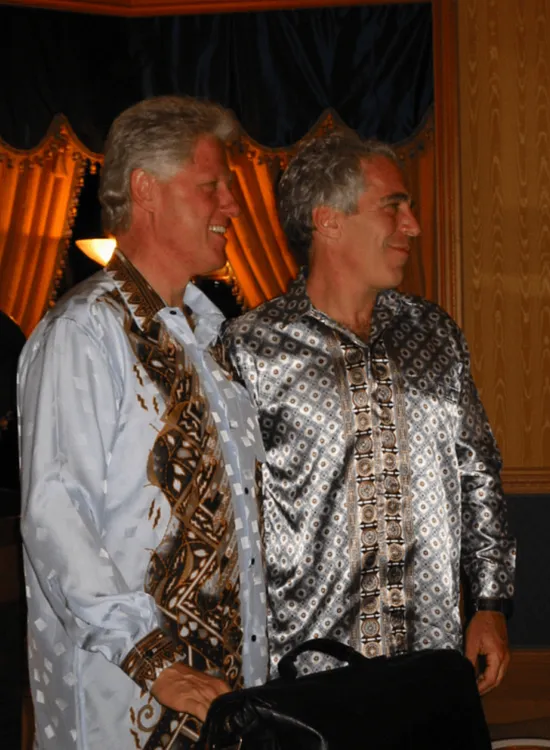
Among the photos the FBI collected in its investigation into Epstein are several of Clinton looking chummy with him, steeped in the high life. One shows Epstein and Clinton beaming in exotic Indonesian silk batik shirts.
There is a photo of Clinton on what appears to be Epstein’s private jet with a blond woman sitting on the arm of his chair. In one photo, Clinton poses with Michael Jackson. In another he is dining with Mick Jagger. Then there is one with him reaching for the shoulders of actor Kevin Spacey, flanked by Secret Service officers. Most damning is a photo of Clinton in a hot tub with a woman whose face is blacked out to protect her privacy. The New York Post featured that one on the cover of its Saturday edition under the headline: “Tubba Bubba.”
snip
Eli Lake is the host of Breaking History, a new history podcast from The Free Press. A veteran journalist with expertise in foreign affairs and national security, Eli has reported for Bloomberg, The Daily Beast, and Newsweek. With Breaking History, he brings his sharp analysis and storytelling skills to uncover the connections between today’s events and pivotal moments in the past.
6
posted on
02/15/2026 2:45:51 AM PST
by
Liz
(Jonathan Swift: Government without the consent of the governed is the very definition of slavery.)
To: sauropod
7
posted on
02/15/2026 5:58:34 AM PST
by
sauropod
To: SeekAndFind
As much as I question Navarro’s position on tariffs he is totally correct on this issue of advising the president. The president needs to hear a variety of alternative ideologies, strategies and tactics. No one should be demaggoged for giving advice.
To: All
9
posted on
02/15/2026 12:15:51 PM PST
by
Liz
(Jonathan Swift: Government without the consent of the governed is the very definition of slavery.)
To: SeekAndFind
10
posted on
02/16/2026 5:26:40 AM PST
by
redinIllinois
(Pro-life, accountant, gun-totin' Grandma - multi issue voter )
Disclaimer:
Opinions posted on Free Republic are those of the individual
posters and do not necessarily represent the opinion of Free Republic or its
management. All materials posted herein are protected by copyright law and the
exemption for fair use of copyrighted works.
FreeRepublic.com is powered by software copyright 2000-2008 John Robinson
