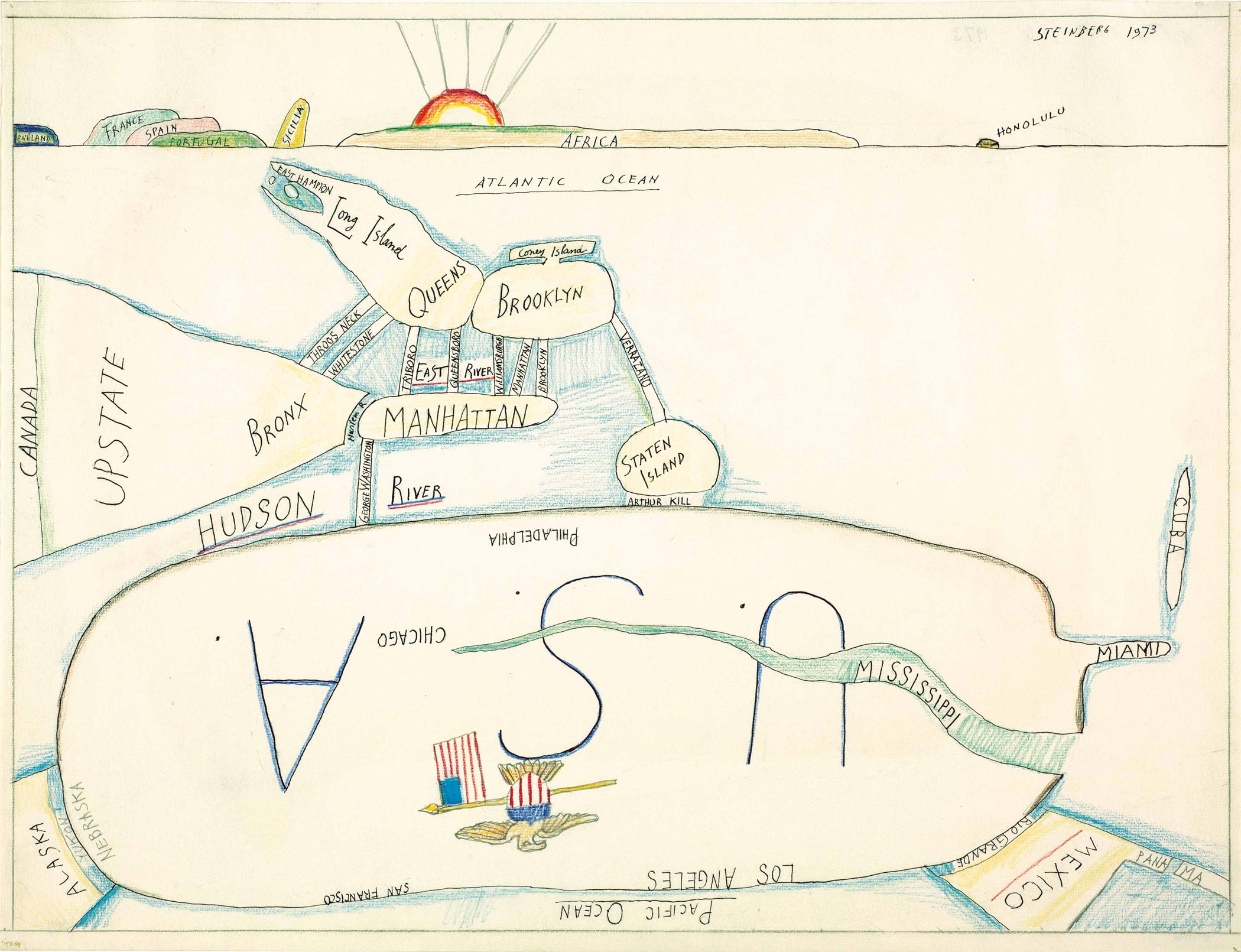
Of course, New York is "all"..... Remember Saul Steinberg?
Posted on 10/02/2025 5:42:16 AM PDT by TigerClaws
The candidates vying to be New Jersey’s next governor are pointing fingers after the Trump administration announced it is freezing billions of dollars in federal funding for two infrastructure projects, including the Hudson Tunnel project to connect New Jersey and New York City.
Democratic Rep. Mikie Sherrill slammed the move Wednesday and called the pause in funding further evidence that her opponent, Republican Jack Ciattarelli, would not stand up to President Donald Trump. Ciattarelli’s campaign placed the blame on Sherrill for opposing the GOP-led government funding measure, which passed the House last month but stalled in the Senate amid Democratic opposition.
The Dem candidate in this race is a 'former' CIA agent.
“Dem candidate in this race is a ‘former’ CIA agent” Nobody could be more sneaky and underhanded then this combination.
President Trump didn't freeze federal funds for this project because of the Schumer Shutdown, he froze them because the quasi-government agency in charge of the project has been violating the law by giving taxpayer money to discriminatory korporations under the guise of "disadvantaged persons businesses".
https://www.cnbc.com/2025/10/01/trump-new-york-funding-infrastructure-vought.html
"The Trump administration has frozen about $18 billion for two major infrastructure projects in New York City pending a review to ensure that funding is not “flowing based on unconstitutional DEI principles,” a top official said Wednesday."
Another tunnel?
If they want to add another throughway, how about making it a bridge? Cheaper yes?
Come to think of it, why hadn't California built that high-speed rail they've been working on for only thirty+ years?
Oh yeah, why did Solyndra some time back and Ivanpah this last week go bankrupt? Oh yeah, no more federal funds.
Maybe, just maybe, it's time for Uncle Sugar Daddy to teach states to fund their own projects?
Such as -- for example -- the two existing vehicular tunnels between Manhattan and New Jersey.
I think it would have been cheaper for California, instead of trying to build the high-speed rail, to give rebates to travelers flying between LA and the Bay Area of the difference between a bus ticket and a plane ticket. If the high-speed rail had been built, it would mostly be those people who would have benefited.
Of course, New York is "all"..... Remember Saul Steinberg?
It’s to supplement the bottleneck of the Northeast Corridor rail line. The two tunnels currently in use are over a hundred years old and leaking. A bridge over the Hudson would make it rather difficult to get the trains into the underground stations.
A freeze lasting a month won’t affect this years over plan and billions over budget project.
EC
“rather difficult to get the trains into the underground stations”
Chicago’s Loop is elevated.
WIKI [Uptown Hudson Tubes - PATH tubes, not Pennsylvania Railroad tubes]
The original plans for the Uptown Hudson Tubes called for a terminal at 33rd Street under the Gimbels department store, now Manhattan Mall. During construction, the plan was changed so the 33rd Street station was directly under Sixth Avenue, providing for a future northward extension. This northward extension, which McAdoo had proposed by 1910, called for the Uptown Hudson Tubes to run under Sixth Avenue to 42nd Street, where they would curve east under the IRT’s 42nd Street Line and terminate at Park Avenue. This would have created an easy connection to Grand Central Terminal, which was under construction at the time. There would be two intermediate stops at 39th Street/Sixth Avenue and 42nd Street/Fifth Avenue.
The proposed extension to Grand Central soon encountered problems. At Grand Central, the H&M platforms would be directly below the 42nd Street Line’s platforms, but above the IRT’s Steinway Tunnel that carried the Flushing Line to Queens. However, the IRT had constructed an unauthorized ventilation shaft between the 42nd Street line and the Steinway Tunnel; this would force the H&M to build its station at a very low depth, making it relatively harder for passengers to access the H&M station. As an alternative, the city’s Utilities Board proposed connecting the Uptown Hudson Tubes to the Steinway Tunnel.
A franchise to extend the Uptown Hudson Tubes to Grand Central was awarded in June 1909, with the expectation that construction would start within six months and that the extension would be operational by January 1911. However, by February 1910, financing had only been secured to complete the 33rd Street terminal, and not for the Grand Central extension. By 1914, the H&M had not started construction of the Grand Central extension, and it requested to delay the start of construction for at least two more months. The Rapid Transit Commissioners had determined that the Ninth Street crosstown spur was unlikely to be built soon, so permission to build the Ninth Street tunnel was denied. By 1920, the H&M had submitted seventeen applications in which they sought to delay construction of the extension to Grand Central; in all seventeen instances, the H&M claimed that it was not an appropriate time to construct the tube. On its seventeenth application, the Rapid Transit Commissioners declined the request for a delay, effectively ending the H&M’s right to build an extension to Grand Central.
https://en.wikipedia.org/wiki/Uptown_Hudson_Tubes
WIKI
The North River Tunnels are a pair of rail tunnels that carry Amtrak and New Jersey Transit passenger lines under the Hudson River between North Bergen, New Jersey, and New York Penn Station in Manhattan, New York City. Built between 1904 and 1908 by the Pennsylvania Railroad (PRR) to allow its trains to reach Manhattan, they opened for service in late 1910.
The tunnels allow a maximum of 24 bidirectional crossings per hour, and operate near capacity during peak hours. The tunnels were damaged by extensive flooding brought on by Hurricane Sandy in 2012, causing frequent delays in train operations. In May 2014, Amtrak then stated that one or both of the tunnels would have to be shut down within the next twenty years.
In May 2021, the U.S. Department of Transportation (USDOT) approved construction of two new tunnels. The new tunnels, dubbed the Gateway Tunnels, are scheduled to open in 2035, while rehabilitation of the old tunnels is set to be completed by 2038.
The original proposal for the PRR and LIRR terminal in Midtown Manhattan, published in June 1901, called for the construction of a bridge across Hudson River between 45th and 50th Streets in Manhattan, as well as two closely spaced terminals for the LIRR and PRR. This would enable passengers to travel between Long Island and New Jersey without changing trains. In December 1901, the plans were modified so that the PRR would construct the North River Tunnels under the Hudson River, instead of building a bridge over it.
The PRR cited costs and land value as a reason for constructing a tunnel rather than a bridge, since the cost of a tunnel would be one-third that of a bridge. The North River Tunnels themselves would consist of between two and four steel tubes with a diameter of 18.5 to 19.5 feet (5.6 to 5.9 m).
https://en.wikipedia.org/wiki/North_River_Tunnels
What might be done is to integrate New Jersey Transit and LIRR passenger service.
Trains would run straight through.
Next stop, Farley.
Next stop, Lexington Avenue.
Next stop, Long Island City
Jack should demand the Dim candidate demand that New York, New Jersey, Amtrak, the MTA, New Jersey Transit and the Port Authority of New York and New Jersey - stakeholders in the tunnel project - insure that DEI will not play any roll in the work or the contracts for the project.
WIKI
The segments of the tube may be constructed in one of two methods. In the United States, the preferred method has been to construct steel or cast iron tubes which are then lined with concrete. This allows use of conventional shipbuilding techniques, with the segments being launched after assembly in dry docks. In Europe, reinforced concrete box tube construction has been the standard; the sections are cast in a basin which is then flooded to allow their removal.
The main advantage of an immersed tube is that they can be considerably more cost effective than alternative options – i.e., a bored tunnel beneath the water being crossed (if indeed this is possible at all due to other factors such as the geology and seismic activity) or a bridge.
The first tunnel constructed with this method was the Shirley Gut Siphon, a six-foot sewer main laid in Boston, Massachusetts in 1893. The first example built to carry traffic was the Michigan Central Railway Tunnel constructed in 1910 under the Detroit River, and the first to carry road traffic is the Posey Tube, linking the cities of Alameda and Oakland, California in 1928. The oldest immersed tube in Europe is the Maastunnel in Rotterdam, which opened in 1942.
The Transbay Tube in San Francisco Bay, completed in 1969, was the world’s deepest and longest immersed tube, at 41 metres (135 ft) below water level and 5.8 kilometres (3.6 mi) long.
https://en.wikipedia.org/wiki/Immersed_tube
WIKI
The Transbay Tube is an underwater rail tunnel that carries Bay Area Rapid Transit’s four transbay lines under San Francisco Bay between the cities of San Francisco and Oakland in California. The tube is 3.6 miles (5.8 km) long, and attaches to twin bored tunnels. The section of rail between the nearest stations (one of which is underground) totals 6 miles (10 km) in length. The tube has a maximum depth of 135 feet (41 m) below sea level.
Built using the immersed tube technique, the Transbay tube was constructed on land in 57 sections, transported to the site, and then submerged and fastened to the bottom – primarily by packing its sides with sand and gravel.
Opened in 1974, the tunnel was the final segment of the original BART system to open.
BART trains can reach their highest speeds in the tube, up to 80 miles per hour (129 km/h), although trains typically operate at 70 miles per hour (113 km/h) unless trying to recover from a delay.
Construction was started on the tube in 1965, and the structure was completed after the final section was lowered on April 3, 1969.
The tunnel is set in a trench 60 feet (18 m) wide with a gravel foundation 2 feet (0.61 m) deep. Lasers were used to guide the dredging of the trench and the laying of the gravel foundation, maintaining route accuracy of within 3 inches (76 mm) for the trench and 1.8 inches (46 mm) for the foundation. Construction of the trench required dredging 5,600,000 cubic yards (4,300,000 m3) of material from the Bay.
The structure is made of 57 individual sections that were built on land at the Bethlehem Steel shipyard on Pier 70 and towed out into the bay by a large catamaran barge. After the steel shell was completed, water-tight bulkheads were fitted and concrete was poured to form the 2.3-foot (0.70 m)-thick interior walls and track bed. They were then floated into place (positioned above where they were to sit), and the barge was tethered to the Bay floor, acting as a temporary tension leg platform. The section was ballasted with 500 short tons (450 t) of gravel before being lowered into a trench packed with soft soil, mud, and gravel for leveling along the Bay’s bottom. Once the section was in place, divers connected the section with the sections that had already been placed underwater, the bulkheads between placed sections were removed and a protective layer of sand and gravel was packed against the sides. Cathodic protection was provided to resist corrosive action from the Bay’s salt water.
The project cost approximately $180 million in 1970 (equivalent to $1.09 billion in 2023), with $90 million of that cost being spent on construction, the remainder going towards laying rails, electrification, ventilation and train control systems.
https://en.wikipedia.org/wiki/Transbay_Tube
The new tunnels (and the existing 115 year old tunnels) are for regular rail service (not subways) that service the existing Penn station. This includes the fairly high speed Acela train from Boston to DC, plus other Amtrak and NJ Transit trains.
Disclaimer: Opinions posted on Free Republic are those of the individual posters and do not necessarily represent the opinion of Free Republic or its management. All materials posted herein are protected by copyright law and the exemption for fair use of copyrighted works.