Posted on 10/02/2010 4:52:11 AM PDT by reaganaut1
*
The Communist Manifesto--1847
The Origin of Species--1859
Das Kapital--1867
The Ascent of Man--1871
oh, here's a recent one:
Coming of Age in Somoa--1928
and hot off the presses:
Silent Spring--1962
These are just off the top of my head. I could list others but their titles don't pack the 'gut punch' quality to make the list. I really hate The New York Times.
http://www.rightgrrl.com/2000/womensstudies.shtml
Why waste time with “DEAD WHITE MEN” when, with little (lotta) elbow grease, you can earn a post graduate degree in queer studies:
Currently reading...
James Madison
Biography by Ralph Ketcham
University of Virginia Press
It's a very good book.
I already read it. Every American should. Great book, important book!
Well - lets make this easy.
Constitution and framers pre-date “Origin of Species” by 70 years.
So no choice required in the timeframe under discussion.
I will point out that MANY (including el Rushbo a few days ago) assign more to Darwin than he actually said.
He was a good scientist, and his observations and logic are in general accurate.
Bible is a better book. I’ve read both.
That one struck me too. She seems to think the idea of Natural Law is some obscure concept rightwing nuts are trying to foist on the Founders.
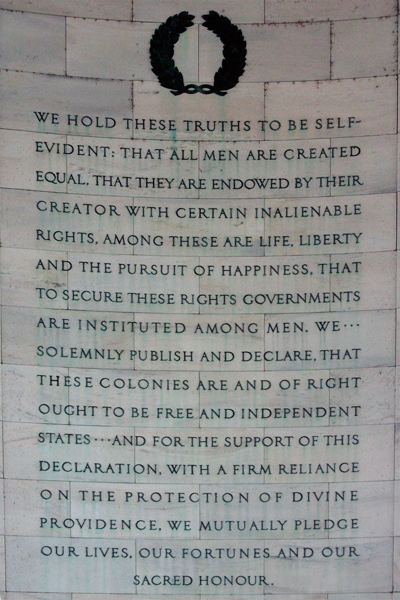
As you point out, they were extremely and explicitly clear they based their ideas on Natural Law. Where in the world does she think the first sentence of the Declaration comes from?
The unfortunate part, of course, is that what constitutes Natural Law is to a considerable extent a matter of opinion, not a matter of fact.
It would be more accurate to say this is "a" Christian world view, not "the" Christian world view.
Historically it is most definitely a minority view among Christians, at least as the Founders chose to apply it. The American Revolution would have horrified Constantine, Augustine, Aquinas, Luther, and most other major figures in Christian history.
However, it is a fact that the idea, with its explosive corrolaries, that "all men are created equal," was developed for the first and only time in Christian nations. The notion never crossed the mind of any previous civilization.
I respectfully disagree. The Law of Nature IS a matter of fact. Vattel's Law of Nations IS the Natural Law for Nations, and consequently, the People.
That's why the Founders repeatedly expounded on the fact the People were 'sovereign'.... just like nations are.
-----
Having given you this general idea and description of the law of nations; need I expatiate on its dignity and importance? The law of nations is the law of sovereigns. In free states, such as ours, the sovereign or supreme power resides in the people. In free states, therefore, such as ours, the law of nations is the law of the people. Let us again beware of being misled by an ambiguity, sometimes, such is the structure of language, unavoidable. When I say that, in free states, the law of nations is the law of the people; I mean not that it is a law made by the people, or by virtue of their delegated authority; as, in free states, all municipal laws are. But when I say that, in free states, the law of nations is the law of the people; I mean that, as the law of nature, in other words, as the will of nature's God, it is indispensably binding upon the people, in whom the sovereign power resides; and who are, consequently, under the most sacred obligations to exercise that power, or to delegate it to such as will exercise it, in a manner agreeable to those rules and maxims, which the law of nature prescribes to every state, for the happiness of each, and for the happiness of all.
Of the Law of Nations, James Wilson, Lectures on Law
---------
There has been a difference of opinion among writers, concerning the foundations of this law. It has been considered by some as a mere system of positive institutions, founded upon consent and usage; while others have insisted that the law of nations was essentially the same as the law of nature, applied to the conduct of nations, in the character of moral persons, susceptible of obligation and laws. We are not to adopt either of these theories as exclusively true. The most useful and practical part of the law of nations is, no doubt, instituted or positive law, founded on usage, consent, and agreement. But it would be improper to separate this law entirely from natural jurisprudence, and not to consider it as deriving much of its force, and dignity, and sanction, from the same principles of right reason, and the same view of the nature and constitution of man, from which the science of morality is deduced. There is a natural and a positive law of nations. By the former, every state, in its relations with other states, is bound to conduct itself with justice, good faith, and benevolence; and this application of the law of nature has been called by Vattel, the necessary law of nations, because nations are bound by the law of nature to observe it; and it is termed by others, the internal law of nations, because it is obligatory upon them in point of conscience.
James Kent, Commentaries Z
-------
What totally terrifies our government, IMHO, is that they have no control over this law. They have no authority to amend it. They have no authority to define it's terminology.
It is what it is and has been since it's inclusion in the Constituion's Article 1, Section 8, Clause 10
After all - if the Founders thought the Law of Nations good enough to define and punish the heinous crimes of Piracies and Felonies committed on the high Seas, why would they NOT have thought it a good enough to use as a guideline for everything else?
Where to start?
Vattel was a man. He had an opinion as to what constitutes Natural Law. He wrote a book about it.
Unless you believe Vattel was divinely inspired, the specifics of the “Natural Law” he believe in is not definitive. His opinion, in and of itself, is of no greater validity than anyone else’s.
I might accept his (or your) arguments because I find them persuasive, but he must persuade us that a principle is Natural Law, not just announce it to be such and have everyone submit.
BTW, Vattel wrote primarily about Natural Law as it applies to relations between States, which was what the reference in the Constitution was about. I do not believe he ever compiled anything resembling a comprehensive code of laws detailing the specifics of Natural Law.
The Founder's thought so.
-----
I find them persuasive, but he must persuade us that a principle is Natural Law, not just announce it to be such and have everyone submit.
Even the most cursory perusal of the Law of Nations would lead a reader to see that it is, in fact, based on the principles of Natural Law. BTW - One of the primary principals is that no nation or person has the right to force anyone to 'submit' to anything.
-----
I do not believe he ever compiled anything resembling a comprehensive code of laws detailing the specifics of Natural Law.
As my previous post illustrated, James Wilson [a Supreme Court Justice as well as a signer of the Constitution] did indeed believe the Law of Nations was applicable to the People.
You may believe as you wish, but the facts are there.
Nonsense. That's what governments do. As one of the Founders, I believe Washington, said, "Government is Force."
That's how it differs from other institutions. If you disobey the laws, they will force you to submit to them.
The question between liberals and conservatives is not one of whether the government should use force, but of which areas of life it should use force in. Conservatives believe government use of force should be limited, liberals believe it should continue expanding till all human problems have been solved. Since that will never happen, liberals are by definition supporting an eventual totalitarian system.
The principle of powers, as designated in the founding documents. are derived from God, not government. This is fundamental to Christianity as far back as you care to go. Any sense of the divine rights of kings does not come between the individual and God. Since Genesis there has been a continuous line of authority for, as you clarified, equality under God and also of life, liberty and the pursuit of happiness derived not from the state but from God.
Perhaps you would care to explain your claim that Christian theologians would have abhored the Revolution. I can agree about the French revolution but not the American revolution or the bloodless revolution of England.
Righto.
But in the Bible, after the time of the judges anyway, and throughout most of the history of the Church, it was assumed God delegated that authority to emperors, princes and kings, individual men who were then responsible to God for how they used that power. That accountability was of course a great deal more in theory than in practice.
Paul and other writers of the Bible made it clear that the duty of a Christian was to obey the laws and their ruler. Not a trace of a notion that it’s okay to rise up and overthrow the King or Emperor if you disagree with his policies. Same is true of the Church Fathers and medieval theologians such as Aquinas. The remedy for bad government was to pray to God for deliverance, not to overthrow it.
Our Revolution was based on the theory that the King had violated a contract between the himself and the people. There is no direct basis in Christian thought for such a notion. As you say, the king’s power derived from God, not from a contract with the people. The idea of the contract, however, derived indirectly from the Christian idea that we are all children of God and therefore in some ultimate sense equals.
As for the English Revolution being bloodless, tell that to those who died in the Civil Wars. The Glorious Revolution was (pretty much) bloodless, but only because the earliers wars had shown the king could not defeat the people by military force.
BTW, even the Glorious Revolution was thoroughly denounced as a violation of Christian duty.
The very notion of “separation” of church and state, much ballyhooed about as justification for removing seasonal Christian displays from government property, (and worse) violates the very wording of the Constitution's protection clause.
All this aside, however, to your main point that the Constitution's divine rights of the people is not a key component of Christian thought I find insidious.
The Bible makes clear that God did not wish Israel to have a King, rather, that matters of social contract be deliberated by judges trained in Talmudic law. It was only the insistence of the people to be ruled by one other than God that led to the selection of a king.
The entire Bible does not ever posit a human authority as inter-posable between God and the individual. That is the essence of our Constitution. The screeching effort to remove religion from the public square and relegate it to the closet is a direct threat to the foundation of our Constitution and of Christian and Jewish religious practices since their inception.
I think we’ll have to agree to disagree. Couple points.
You are discussing what is in the Bible as if that is the whole of Christian thought. I’m sure you are really aware that “Christian thought” has gone far beyond what can be realistically extracted from the Bible, as Christianity as we know it today is really a fusion of Hebrew (Biblical) thought and classical philosophy. Regardless of whether you consider that a good or bad thing, it’s still a fact.
Only a couple of the colonies were founded to provide religious liberty. Most of those with religious reasons were founded to “worship right,” quite a different thing.
Pretty unlikely God wanted the biblical judges to be trained in the Talmud, since that didn’t come along till after Christ. But that’s nit-picking.
Christianity has gone beyond the Bible? Whew. We certainly will disagree. William Foxwell Albright, a family member, was one of the founders of textual criticism. Numerous theologians have gone astray and various agnostics have berated Biblicism. Certainly there has been a plethora of variance from Biblical foundations. To see this as somehow a legitimate and, shall I say, evolutionary development of fundamental teachings is, however, anathema to a fundamental understanding of the Bible.
I sense in this the same argument relative to the Constitution. To maintain coherence you must also believe that Constitutional law has “gone beyond” its foundational work.
Re Talmudic law: The Judges were charged with interpreting Mosaic law. Thanks for catching my error.
Re colony founding principles: All of the colonies were founded under the rubric of religious discipline in one way or another. Religion was the central theme of their establishment.
Disclaimer: Opinions posted on Free Republic are those of the individual posters and do not necessarily represent the opinion of Free Republic or its management. All materials posted herein are protected by copyright law and the exemption for fair use of copyrighted works.