To: VadeRetro
Yes Vade, I remember that thread quite well. I remember my telling you that those
drawings were altered by the author to "show the point" he was trying to make. The man did not use the bones because of course they would not have given the proof he was seeking.
This is one thing about evolutionists, they are very wary of showing the bones on which their statements are based because any normal human being will see that the whole "proof" is not based on anything but the author's imagination. For example, the face of the famous "Lucy" which the evos call our ancestor, is more plaster than bone. It was made in the image the finders wanted, and whether it is anything like what the individual really looked like is indeed very doubtful. In the bones shown in post 87 from the link provided as "proof" by lexcorp you will note that most of the bones are not in any way connected and easily could have been assembled in more than one way, therefore whether they are what the animal looked like, whether they are a composite of different animals, or whether they are the wishful thinking of the paleontologist, no one can say.
To: gore3000
I remember my telling you that those drawings were altered by the author to "show the point" he was trying to make. The man did not use the bones because of course they would not have given the proof he was seeking. A dodge. On the same thread, I researched 70-80 percent of the fossil species in that chart and found skull bones for you and AndrewC. It's silly to pretend that Cuffey could get away with posting deliberately and grossly incorrect drawings of fossil skulls. His fellow professionals would murder him for it.
For example, the face of the famous "Lucy" which the evos call our ancestor, is more plaster than bone.
Lucy isn't famous for her face. Everybody's seen the pictures of the Lucy bone set, so what's the big exposé here?
To: gore3000
In the bones shown in post 87 from the link provided as "proof" by lexcorp you will note that most of the bones are not in any way connected and easily could have been assembled in more than one way, therefore whether they are what the animal looked like, whether they are a composite of different animals, or whether they are the wishful thinking of the paleontologist, no one can say. "No one can say." You're basically the lobbyist for ignorance because you like so little of what we know. You can't handle the truth.
I can see where you might quibble about the order of some of the vertebrae, but I don't see how the overall assembly can be challenged.

What you don't know is whether the bones were found all in a heap or in a context itself suggestive of the reconstruction.
Another point: Pakicetus is a multi-fossil species. For instance, here's a skull in much better shape from another find:
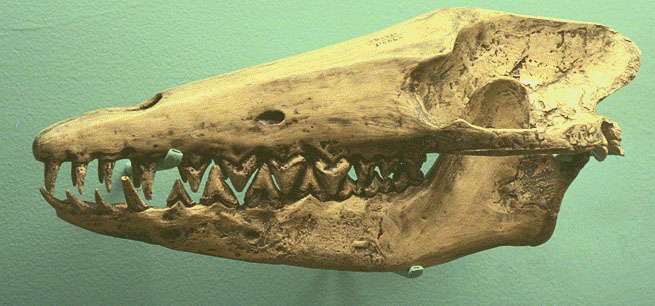
Finding more than one fossil gives you an improved chance of getting the reconstruction right.
So many of your arguments are based upon a (willful?) failure to understand or imagine . . . What's a rational, sentient being to think?
FreeRepublic.com is powered by software copyright 2000-2008 John Robinson