Joining the British army at age 15, Ferguson was a well known marksman and the inventor of a breechloading rifle. The son of a Scottish judge, Ferguson had an affable disposition, a gentle face and was slight of build. Nevertheless, his soldiers named him "Bulldog."
Ferguson distinguished himself early on in his military career. Serving as a cornet in the Royal North British Dragoons, Ferguson was considered by his superiors as a courageous fighter during the wars of Flanders and Germany in the 1760's. In 1768, he joined the Seventieth Regiment of Foot in the West Indies, where British troops engaged in guerilla warfare with the native Carib tribes. Ferguson went for garrison duty at Halifax, Nova Scotia in 1773 but soon became bored.
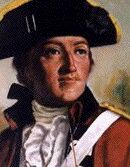
Patrick Ferguson
Ferguson's ability with a rifle was well known. While visiting his family's estate in Scotland before the American Revolution, he began to develop a rifle of his own. After completing the invention, Ferguson displayed the rifle for military leaders and even King George III witnessed one of Ferguson's demonstrations.
During one demonstration, Ferguson fired at a rate of 4-6 shots per minute during pouring rain and high wind. Apparently, Ferguson only missed the target three times while firing from a distance of 200 yards -- this was not possible with the British Brown Bess musket. A patent was issued and a limited number of the breechloading rifles were produced. Ferguson established an elite rifle corps which joined Sir Henry Clinton in America. Their mission: to help stop the rebellion in the colonies.
At the Battle of Brandywine (September 11, 1777), Ferguson was wounded in the arm and his rifle corps was later disbanded. The Ferguson rifles were removed and very few have been seen since. There is no evidence that the Ferguson rifle was used at the Battle of Kings Mountain.
It was at the Battle of Brandywine that Ferguson distinguished himself further though many did not know about it until the 20th century. Scholars believe that Ferguson was the British soldier who had George Washington in his gun sight. Ferguson did not pull the trigger, saying that "it is ungentlemanly to shoot a man in the back of the head."
Ferguson himself mentioned the incident in a letter he dictated a few months later. During the battle, he did not realize the identity of the American officer. While recuperating in the hospital from his arm injury, he discovered that the American officer in question was George Washington. Ferguson wrote that even if he had known, he would not have pulled the trigger. Ferguson's letters are available in the library at Edinburgh University.
Ferguson later fought in the battles of Monmouth and Little Egg Harbor. He was also active in many other battles in the New York and Hudson area. Impressing his superiors with his valor, Ferguson was promoted to Major in 1779.

Late that year, he was selected to command a corps of 300 men, called the American Volunteers. The men were Loyalists, handpicked from units in the New York and New Jersey area. The corps, along with Ferguson, arrived in the South in early February 1780. Ferguson, a persuasive individual, immediately gathered support in Savannah and Augusta before Clinton ordered him to Charleston.
During the invasion of that city, Ferguson worked with the legendary Banastre Tarleton, who had angered many Patriots after his massacre of soldiers trying to surrender to him at Waxhaw. Author Washington Irving later wrote that Ferguson and Tarleton were "equally intrepid and determined but Ferguson is cooler, and more open to the impulses of humanity." In fact, some researchers believe that Ferguson despised Tarleton's methods.
After Charleston fell, Ferguson was appointed to the position of Inspector General of the Militia. Clinton and Cornwallis gave him the mission to organize a volunteer corps of Loyalists troops. Ferguson's men thought highly of him -- he had a natural ability to gain their affection and respect. The Scot was known for spending hours in conversations with the ordinary people around the villages and towns in South Carolina. South Carolina remained a Loyalist stronghold until the end of the war, largely due to his influence.
Additional Sources:
www.americanrevolution.com
www.military.state.ky.us
www.sar.org
www.state.tn.us
www.knowitall.org
www.degrem.com
www.wilkesnc.org
www.tngenweb.org
www.patriotresource.com
jrshelby.com