Skip to comments.
The FReeper Foxhole's TreadHead Tuesday - T-34 Medium Tank - Jan. 27th, 2004
http://www.expage.com/tanksrus2 ^
Posted on 01/27/2004 12:00:32 AM PST by SAMWolf
click here to read article
Navigation: use the links below to view more comments.
first previous 1-20, 21-40, 41-60, 61-80 ... 221-238 next last
To: snippy_about_it
41
posted on
01/27/2004 8:25:18 AM PST
by
stand watie
(Resistance to tyrants is obedience to God. -T. Jefferson)
To: All
|
Air Power
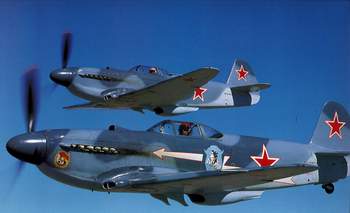
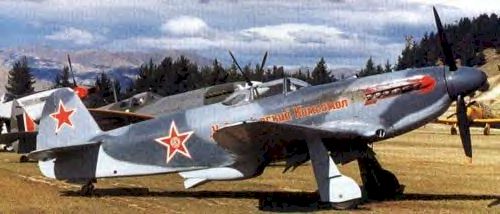
Yakovlev Yak-3
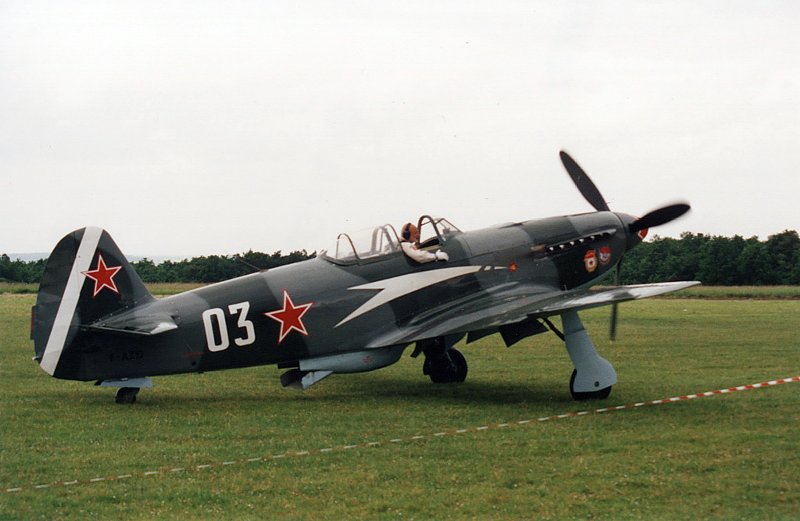 |
As early as 1941 Yakovlev was considering means whereby he could wring the highest possible performance out of the basic Yak-1 design. As there was no immediate prospect of more power, and armament and equipment were already minimal, the only solution seemed to be to cut down the airframe, reduce weight and reduce drag. In the Yak-1M the wing was reduced in size, the oil cooler replaced by twin small coolers in the wing roots, the rear fuselage cut down and a simple clear-view canopy fitted, the coolant radiator duct redesigned and other detail changes made. The result was a fighter even more formidable in close combat than the Yak-1 and Yak-9 families, though it landed faster. The production Yak-3 was further refined by a thick coat of hard-wearing wax polish, and after meeting the new fighter during the mighty Kursk battle in the summer of 1943 the Luftwaffe recognised it had met its match. Indeed by 1944 a general directive had gone out to Luftwaffe units on the Eastern Front to "avoid combat below 5,000 m with Yakovlev fighters lacking an oil cooler under the nose".
To show what the Yak-3 could do when bravely handled, despite its armament - which was trivial compared with that of the German fighters - on 14th July 1944 a force of 18 met 30 Luftwaffe fighters and destroyed 15 for the loss of one Yak-3. Small wonder that, offered all available Soviet, British or American fighters, the famed Normandie-Niemen Group changed from the Yak-9 to the Yak-3 and scored the last 99 of their 273 victories on these machines. It was natural that the more powerful VK-107 engine should have been fitted to the Yak-3, though the designation was not changed. After prolonged trials in early 1944 the Soviet test centre judged the 107-engined craft to be 60-70 mph faster than either a Bf109G or an Fw190, but the re-engined aircraft was just too late to see action in World War II.
As in the case of the Yak-1 and the Yak-9, there were various experimental conversions of the Yak-3: Yak-3/VK-107A: about 100 built, in operation 1945; Yak-3/VK-108: experimental and fastest Yak-3 aircraft with VK-108 engine, first flown 19 December 1944, demonstrated a maximum speed of 463 mph (745 km/h) at 19,685 ft (6,000 m); Yak-3T: anti-tank version built in small numbers with 37-mm N-37 cannon and two 20-mm B-20S cannon; Yak-3T-57: one-off Yak-3T with a 57-mm 0KB-16-57 cannon; Yak-3P: small quantity with three 20-mm B-20 cannon and two 0.5 in (12.7 mm) UBS machine-guns; Yak-3RD (or Yak-3D): experimental adaptation of series aircraft to take Glushko RD-1 rocket unit in tail; Yak-3V: high-altitude variant; Yak-3PD: flown in 1944 with supercharged VK-106 engine; intended to have pressurised cabin; Yak-3U: rebuilt aircraft with ASh-82FN radial engine and twin B-20 cannon - despite heavy engine overall weight, weighed less than standard Yak-3 and during series of test flights started on 12 May 1945 demonstrated a maximum speed of 441 mph (710 km/h) at 20,015 ft (6,100 m); Yak-3TK: VK-107A-powered version tested in 1945 with turbocharger; Yak-3UTI: developed as conversion trainer in late 1945 with ASh-21 radial engine, became eventually Yak-11. Total production of the Yak-3 was 4,848. These fighters may have been smaller and simpler than those of other nations in World War II but they served the Soviet Union well in its hour of great need. They conserved precious material, kept going under almost impossible airfield and maintenance conditions and consistenly out-performed their enemies.
During the final two years of the Second World War, the Yak-3 proved itself a powerful dogfighter. Tough and agile below an altitude of 13,000 feet, the Yak-3 dominated the skies over the battlefields of the Eastern Front during the closing years of the war.
The first attempt to build a fighter called the Yak-3 was shelved in 1941 due to a lack of building materials and an unreliable engine. The second attempt used the Yak-1M, already in production, to maintain the high number of planes being built. The Yak-3 had a new, smaller wing and smaller dimensions then its predecessor. Its light weight gave the Yak-3 more agility. The Yak-3 completed its trials in October 1943 and began equipping the 91st IAP in July of 1944. In August, small numbers of Yak-3s were built with an improved engine generating 1,700-hp, and the aircraft saw limited combat action in 1945. Production continued until 1946, by which time 4,848 had been built.
The story of the Yak-3 did not end with the Second World War. In 1991, the Museum of Flying, in Santa Monica, California, asked Yakovlev to produce a new series of Yak-3s to be built at Orenburg, Russia. The new Yak-3s were built using the plans, tools, dies and fixtures of the original. They were powered by American Allison engines, and given the designation Yak-3UA. These aircraft are now available on the civilian market. [History by David MacGillivray]
Specifications:
Manufacturer: Yakovlev
Variants: Yak-1M and -3
Type: Single-seat fighter
Country of Origin: USSR
First Flight: (Yak-1M) 1942; (Yak-3) Spring 1943
Engine: One 1,300-hp Klimov VK-105PF-2 V-12 piston engine - later models: 1,650 hp VK-107A engine
Number Built: 4,848 (Original 1940s-era models)
Number Still Airworthy: At least 5 newly-manufactured aircraft.
Dimensions:
Weight: Empty 4,641 lbs. - Max Takeoff 5,864 lbs.
Wing Span: 30ft. 2.25in.
Length: 27ft. 10.25in.
Height: 7ft. 11.25in.
Performance :
Maximum Speed: 407 mph later models 447 mph with VK-107 engine
Ceiling: 35,105 ft.
Range: 559 miles
Armaments:
One engine-mounted 20-mm ShVAK cannon
Two 12.7-mm (0.5-inch) UBS machine guns


All information and photos Copyright of their respective websites
42
posted on
01/27/2004 8:25:24 AM PST
by
Johnny Gage
(Why do people make rubber duckies yellow, when real ducks are green, or brown?)
To: Matthew Paul
Morning Matt.
Strange how the Soviets needed to keep sending in their tanks to keep their "Allies" under control, East Germany, Poland, Hungary, Czechoslovakia,etc

Breaking of the Pomperanian Wall by David Pentland
T-34/85 tanks of the Polish Peoples Army "Heroes of the Westerplatte" 1st Armoured Brigade. During the battle to break through the tough German defences of East Prussia.
43
posted on
01/27/2004 8:25:50 AM PST
by
SAMWolf
(Never feed your cat anything that clashes with the carpet!)
To: Valin
1916 Communist party "Spartacus Letters" 1st published in Berlin
I'm Spartacus!!!
44
posted on
01/27/2004 8:29:11 AM PST
by
SAMWolf
(Never feed your cat anything that clashes with the carpet!)
To: SAMWolf
Tanks for the info ping. Finns do have a lot of fun no matter what is going on.
To: snippy_about_it
46
posted on
01/27/2004 8:40:48 AM PST
by
SAMWolf
(Never feed your cat anything that clashes with the carpet!)
To: snippy_about_it
Morning E.G.C. Fog and rain here today
47
posted on
01/27/2004 8:41:15 AM PST
by
SAMWolf
(Never feed your cat anything that clashes with the carpet!)
To: Johnny Gage
Maximum Speed: 407 mph later models 447 mph with VK-107 engine
This sucker can flat out move! No wonder pilots liked it. but then I've never heard of a fighter pilot who thought there was such a thing as too fast.
48
posted on
01/27/2004 8:43:05 AM PST
by
Valin
(Politicians are like diapers. They both need changing regularly and for the same reason.)
To: snippy_about_it
Disabled Soviet tanks in Budapest after the Soviet invasion. You've got to load it first. More fun. Times 43....


49
posted on
01/27/2004 8:45:20 AM PST
by
archy
(Angiloj! Mia kusenveturilo estas plena da angiloj!)
To: SAMWolf
"In addition, many of the technical 'details' of the T-34 proved to be ill-manufactured: the air cleaners were too poor and pushed dirt inside the engine, rapidly wearing it down. 4-speed gear-boxes were prone to breaking down and clutches were weak: maximum teorethical speed was rarely archievable under normal conditions. Tanks required a major engine overhaul after less than (max) 100 hours of use."
From what I have been able to gather from many excellent Russian web sites the above is masterful understatement. Americans are used to a tremendously higher level of performance in these categories than the early T-34 (or the late T-34/85) showed. Americans had 1941 models to examine here in the States and thought them a piece of junk because of drive train design. The Americans were appalled that driving the T-34 into a dust cloud raised by an American vehicle wrecked the T-34 engine because it did not have a real air cleaner and that real skill was needed not to instantly burn out the clutch or very quickly wreck the transmission. The Americans just hopped in and "drove" in the American fashion, expecting all to be well, after all, they were Americans, right? The T-34s immediately broke down very seriously, wrecking engines and transmissions.
The Americans built tanks with toy guns and symbolic, not actual, armor, but were fast, fun to drive, and had highly reliable drive trains. The Russians built the T-34 for war, where twenty hours drive train lifetime was a way longer time than any tank could last in combat.
The Soviet crews did almost all of the maintenance including changing engines and transmissions themselves, track repair (very short track life by American standards), broken Christie springs, gun hydraulics, you name it. No rear echelon maintenance to speak of. In modern times with T-55s and -62s an exercise lasting two hours would be followed by working without a break until the machines were serviceable again, or at least could not be fixed adequately due to lack of parts. Say starting at 4 PM and working until done, taking short naps in rotation. Usually most of the crews could get the job done in 24 hours.
Even T-72s that the Czechs received had their engines and transmissions pulled and every part qualified. Those of you not gear heads will think this is a much easier and smaller job than it is. The Czechs would then reassemble, and start the engine, and on shutdown would find a coffee can full of metal fragments in the oil strainer screens. That is with a first class assembly! Amazing. No wonder a transmission was toast in 500 hours (T-55 for sure) even with repeated removal, disassembly, and part replacement!
50
posted on
01/27/2004 8:46:28 AM PST
by
Iris7
("Duty, Honor, Country". The first of these is Duty, and is known only through His Grace)
To: snippy_about_it
If we die, we want people to accept it. We're in a risky business and we hope if anything happens to us it will not delay the program. Our God given curiosity will force us to go there ourselves because in the final analysis only man can fully evaluate the moon in terms understandable to other men."
Why we need to go to Mars. It's what we do(I wonder what's over the next hill). If America doesn't someone else will.
51
posted on
01/27/2004 8:46:36 AM PST
by
Valin
(Politicians are like diapers. They both need changing regularly and for the same reason.)
To: archy
Soviet tanks were never known for crew comfort.
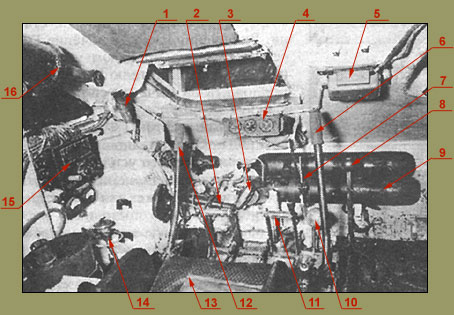
The driver's station.
1. Speedometer and tachometer;
2. The pedal of the main friction clutch;
3. The hand air pump;
4. Control devices;
5. The TPU internal connection;
6. The right steering lever;
7. The holder;
8. The gear shift lever; |
9. The cylinders with compressed air;
10. The fuel injection pedal;
11. The foot-brake pedal;
12. The left steering lever;
13. The driver's seat;
14. The air distributor;
15. The electric dashboard;
16. The balancing mechanism of the hatch. |
52
posted on
01/27/2004 8:46:45 AM PST
by
SAMWolf
(Never feed your cat anything that clashes with the carpet!)
To: Darksheare
I hate gooey roads. :-(
53
posted on
01/27/2004 8:47:19 AM PST
by
SAMWolf
(Never feed your cat anything that clashes with the carpet!)
To: SAMWolf
NO! I'm Spartacus!!! :-)
54
posted on
01/27/2004 8:48:09 AM PST
by
Valin
(Politicians are like diapers. They both need changing regularly and for the same reason.)
To: archy
LOL! It takes a lot of PM to keep a tank running and operational.
55
posted on
01/27/2004 8:48:31 AM PST
by
SAMWolf
(Never feed your cat anything that clashes with the carpet!)
To: snippy_about_it
What? You mean I can't just drive it and shoot things? ;-)Not for long if you don't keep up the maintenance. :-)
56
posted on
01/27/2004 8:50:23 AM PST
by
SAMWolf
(Never feed your cat anything that clashes with the carpet!)
To: Johnny Gage
57
posted on
01/27/2004 8:53:51 AM PST
by
SAMWolf
(Never feed your cat anything that clashes with the carpet!)
To: Johnny Gage
That Yak-3 is shockingly tiny. I had the same reaction when I first saw a T-34/76 at the Patton museum at Fort Knox.
58
posted on
01/27/2004 8:59:55 AM PST
by
Iris7
("Duty, Honor, Country". The first of these is Duty, and is known only through His Grace)
To: SAMWolf
Thanks for the info on the Scaup. Some guys get all the fun. Well, not ALL the Finns running around in T-34s were having such a great time of it.


One of the finest and popular tank designs of WW2 . The T34-series combined good firepower, armor protection, and cross-country mobility. A top speed of 55km/h was considered amazing for a main battle tank (medium) of the period. The tank was considered reliable. At the start of the war with Germany, many of the USSR’s losses were due to simple breakdowns. About 40.000 T34s of all types built (70% of soviet tank production) made it the most numerous tank of WWII (although also USA built over 40.000 vehicles based on M4 Sherman chassis). It stands as a symbol of the Red Army during WWII and was no doubt a war winning-vehicle. The First generation of T34's, were armed with 76mm L/30 and later L/40 guns. After 1943, units came to be armed with the 85mm gun owing to increased protective armor coming into use by the Germans. Units built in 1940-43 had many similar parts as used in KV-series heavy tank. For example, both units used the same motor, but the lighter weight of T34 made it's performance far better than that of KV. Armor was well sloped with a maximum of 75mm (turret) and a minimum of 15mm.
Model types were:
“A” the 1940 production model.
“B” with a rolled-plate turret.
”C” with a larger turret with twin roof hatches in place of the original single hatch.
“D” with hexagonal turret and wider mantlet.
“E” with a cupola on the turret and of all welded construction.
“F” with cast turret.
Finns encountered T34's during the Continuation War from the very start. Two vehicles were captured in Autumn 1941, at the Svir Powerplant, and pressed immediately into service. They were built at the Stalingrad tractorworks and Kharkov train factory. Finns nicknamed the type as “Sotka” (a water bird). Another was captured in Spring 1942, still another in the Summer 1943 bringing the total to four in service. Throughout the war, the Finns put them to considerable use. In summer 1944 Germans promised to send 9 captured/repaired T34/76's for Finns to employ against the Soviets. This never came to pass as relations between the two nations was starting to deteriorate. As it turned out, 3 of the promised delivery were finally received. In June-July 1944 Finnish forces captured two more vehicles. 9 vehicles were in service when hostilities between Finland and the USSR ended. The Finns then turned them on the Germans in the Lapland war. One tank was heavily damaged by a German mine, but later repaired. Not a single T34 was lost during both wars. After war they were considered the most capable tanks available along with the StuGIII and the PzKwIV. The T34 remained in Finland’s active inventory until 1961 when they were retired. Notice the picture far right. This photo shows the "kill" rings on the main gun. Also note the crude finish of the welds and application of the armor. This shot is an excellent example of the hurried work carried on by the Soviets after the German invasion. Photo (to the left) by Mikko Lipponen.
Here's An interesting bit of trivia about the particular Finnish T-34 unit photographed by Mikko Lipponen in the Finnish Armored Museum (picture on the top, left): It was captured in 1943. In July of 1944, a bridge collapsed under it's weight while crossing near Viipuri (Vyborg). The tank was retrieved and was back in battle the very next day.
Specifications
| Crew |
4 |
| Weight (tons) |
26.3 (1940), 28.0 (1941), 28.5 (1942), 30.9 (1943) |
| Engine |
V-12 W-2/34 Diesel, 500hp |
| Length |
5920mm (1940) |
| Width |
3000mm (1940) |
| Height |
2400mm (1940), 2650mm (1943) |
| Performance |
53 km/hr |
| Range |
400 km (1940) 365-465 km (1943) |
| Armament |
(1940 model) 7.62cm L/11, 2-3 x 7.62MG type 1939, (1943 model) 7.62cm F-34, 2 x 7.62MG type 1942 |
| Armor |
15 - 45mm (1940), 15 - 75mm (1943) |
  The Soviet T-34/85 The upgraded model of the T34. The T34/85 three-man turret which mounted a capable 85mm AT-gun developed from an AA-weapon. With the new gun Armor was increased to 110mm maximum at front and 75mm at sides. They were used by the Soviets in Karelia in summer 1944. Although Finnish troops were in retreat, they were able to capture nine T34/85 tanks. Most of them when the attack had ceased and lines in some form established. Finns pressed seven of them in service immediately. The remaining two were repaired and ready for action when war ended. After the Continuation War it was planned to change the 85mm gun to a 75mm AT-gun (used in StuGs) due to ammunition supply, and the good performance of the German weapon. The Gun was changed for experiments in one tank, but later (winter 1944-45) 85mm gun was re-mounted and all tanks retained their original armament. All nine survived both the Continuation and Lapland Wars. Afterwards they were used until early 60's like T34/76s. The tank proved popular with it's crews and remained in Finnish inventory until 1962. The far right picture is by Mikko Lipponen.
Specifications
| Crew |
5 |
| Weight |
32 tons |
| Length |
? |
| Width |
? |
| Height |
? |
| Engine |
V-2-34 V-12 diesel (500hp) |
| Transmission |
? |
| Performance |
55 km/hr |
| Range |
180 - 300 km |
| Armament |
85mm at-gun, 2 x 7.62mm MG |
| Armor |
30 - 110mm |
|
59
posted on
01/27/2004 9:03:09 AM PST
by
archy
(Angiloj! Mia kusenveturilo estas plena da angiloj!)
To: stand watie
!!!!!
60
posted on
01/27/2004 9:03:56 AM PST
by
snippy_about_it
(Fall in --> The FReeper Foxhole. America's History. America's Soul.)
Navigation: use the links below to view more comments.
first previous 1-20, 21-40, 41-60, 61-80 ... 221-238 next last
Disclaimer:
Opinions posted on Free Republic are those of the individual
posters and do not necessarily represent the opinion of Free Republic or its
management. All materials posted herein are protected by copyright law and the
exemption for fair use of copyrighted works.
FreeRepublic.com is powered by software copyright 2000-2008 John Robinson