Skip to comments.
Dollar's Drop And Oil Fears Cause Gold Rush
The Guardian (UK) ^
| 9-26-2003
| Larry Elliott
Posted on 09/25/2003 7:25:46 PM PDT by blam
Dollar's drop and oil fears cause gold rush
Bullion price hits seven year high
Larry Elliott
Friday September 26, 2003
The Guardian (UK)
Fears of a prolonged slump in the value of the dollar sent gold prices to their highest level in seven years yesterday as investors sought a haven from the turbulence of the foreign exchanges. The price of gold rose by $5 to just over $390 an ounce in London trading amid speculation that the $400 barrier could be breached in the coming weeks.
With the financial markets unsettled by the sharp drop in the dollar and by the surprise cut in oil production by Opec, traders said the precious metal was back in fashion.
"The technical chart looks very strong still - so from that point of view we could see further speculative buying into gold. The next target is $401," said Ingrid Sternby of Barclays Capital.
An initial fall in share prices on Wall Street added to gold's appeal but that later eased on profit taking and the Dow Jones index recouped its early losses.
Bullion has risen 14% since July as the dollar has weakened, making gold more affordable for buyers using other currencies, while doubt about a recovery in the US economy has lit up the precious metal on the radar screens of less traditional investors. This was underlined yesterday by data showing an unexpected 0.9% drop in US durable orders in August.
Traders said the oil supply news was supportive for gold as a hedge against inflation because Opec's decision was seen as feeding through into higher prices at the pumps over the coming months.
Concern that central banks might intervene on the foreign exchanges to limit the dollar's fall against the Japanese yen spared the US currency from further widespread decline yesterday, but dealers said it remained weak.
In late morning trading in New York the dollar was down 0.21% at 111.55 yen, while the euro shrugged off German economic data to push up 0.3% against the dollar to $1.1526. Sterling was up 0.22% at $1.6624.
In its fourth fall in five trading days, London's FTSE 100 index of blue chip shares closed 34.2 points lower at 4202.2.
With the markets in a jittery mood, the Bank of England will say today that much of the recent increase in the ratio of household debt to income has resulted from more people owning homes rather than from an increase in the amount of debt per household.
The Bank remains concerned, however, that some borrowers have not taken on board the fact that interest rates at a 48-year low may not last for ever and, if an adverse factor came along, individuals who had taken on too much debt might be forced to cut consumption sharply.
TOPICS: Business/Economy; News/Current Events
KEYWORDS: buyhighselllow; dollars; drop; fears; gold; goldbuggery; goldmineshaft; isellgold; oil; rush
1
posted on
09/25/2003 7:25:47 PM PDT
by
blam
To: blam
Gold took it on the chin today. But as this article notes, only after hitting a new seven-year high. The bull market in gold is now a couple of years old, although not too many have noticed yet.
Some people conjecture that the European and Asian central bankers may not be as eager as they used to be to sell gold to prop up the dollar every time Greenspan says "jump."
2
posted on
09/25/2003 7:38:08 PM PDT
by
Cicero
(Marcus Tullius)
To: Cicero
LOL. My $402.00 Kruggerands look a little better today.
3
posted on
09/25/2003 7:46:46 PM PDT
by
blam
To: blam
Gold Rush?? Not quite!
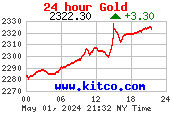
Well...it did peak a bit there for a while. THis looks like intentional price jacking to me. There has been a lot of manipulation on some stocks lately. Big price increases for 2 days, then ON-SIGNAL a massive all at once sell-off within 5 minutes?
Hard to imagine 22 million shares independently being sold within 5 minutes --- especially for a company that only has 33 million outstanding.
4
posted on
09/25/2003 7:47:04 PM PDT
by
steplock
(www.FOCUS.GOHOTSPRINGS.com)
To: blam
The United States federal budget deficit is $480 billion a year, the United States balance of trade deficit is $40 billion a month.
Thats a combined total of a trillion dollars a year.
Continued annual deficits of a trillion dollars a year is going to substantially increase the interest costs, esp when interest rates rise again, as sooner or later they will. The cost just to service the federal debt will in itself be a trillion dollars a year very shortly.
With the loss of manufacturing and high tech in the United States, witht the United States producing nothing, and with nothing to export and fewer people paying income taxes, gold is going much higher.
Disclaimer:
Opinions posted on Free Republic are those of the individual
posters and do not necessarily represent the opinion of Free Republic or its
management. All materials posted herein are protected by copyright law and the
exemption for fair use of copyrighted works.
FreeRepublic.com is powered by software copyright 2000-2008 John Robinson