The Love Unlimited Orchestra
20th Century 2069
Barry White was born in Galveston, Texas, but grew up in Los Angeles, where he began singing in the church choir at the age of eight. By the time he was ten, he was playing church organ, and helping to serve as choir director. Over the next few years, his musical interest led to the mastery of several instruments.
At sixteen, Barry joined a local group called the Upfronts, and gained experience as a singer and pianist in small R&B clubs. He also started to write and produce records, working with such artists as Bob and Earle ("The Harlem Shuffle"), Jackie Lee ("The Duck"), and Felice Taylor ("It May Be Winter Outside").
|
THE TOP FIVE Week of February 9, 1974 1. Love's Theme Love Unlimited Orchestra 2. The Way We Were Barbra Streisand 3. You're Sixteen Ringo Starr 4. Americans Byron MacGregor 5. Until You Come Back to Me (That's What I'm Gonna Do) Aretha Franklin |
In 1968, Barry met three young black girls, Diane Taylor and Linda and (future wife) Glodean James, who aspired to professional acceptance as a singing trio. Barry devoted the next few years to grooming this group, which he called Love Unlimited. In 1972, their first single, "Walkin' in the Rain with the One I Love," turned out to be a million-seller. On their record, Barry was heard very briefly as a voice on the telephone.
The next year, Barry launched his own singing career, with "I'm Gonna Love You Just a Little More Baby." It was a startlingly different sound, lushly orchestrated, with bedroom lyrics that were half-spoken and half-sung. Barry called his pillow-talk style "'sensual soul,' and a few months later, we were to call it disco." Oddly enough, Barry always viewed that genre of music with disdain, even though he was clearly one of its founding fathers.
Barry had a second hit in the same style in the fall of 1973: "Never Never Gonna Give You Up." He then returned to his proteges, writing and producing their album, Under the Influence of Love Unlimited. To help pad out the album, he threw together a filler instrumental, "Love's Theme," which he cut with his forty-piece orchestra. The track worked so well that he decided to release it as a single, credited to the "Love Unlimited Orchestra."
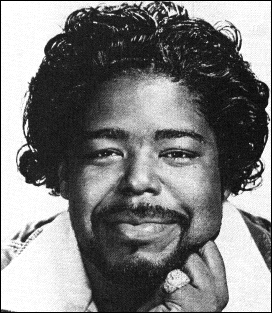 "I conduct the Love Unlimited Orchestra," said Barry. "I also arrange and play many of the instruments. That's the backing I've used on every one of the 57 gold records I've won, worldwide. That's a lot of records. I didn't go on trips. I didn't get high. I went into the studio and made music. That's the only reason I have so many gold records. I didn't go in there loaded, talking about 'Let's dream up this.' I knew what I wanted when I went in there. I went in, got it, and I left."
"Love's Theme" took off early in December 1973, reaching number one in February 1974. It hung around for five months, becoming one of the top-selling singles of the year. Afterward, Barry had four more major pop vocal hits: "Can't Get Enough of Your Love Babe" (1974), "You're the First, the Last, My Everything" (1974), "What Am I Gonna Do with You" (1975), and "It's Ecstasy When You Lay Down Next to Me" (1977). Subsequent R&B hit singles included "Playing Your Game Baby," and "Your Sweetness Is My Weakness."
By the late seventies, Barry's appeal had begun to cool, though he had minor hits with a cover of Billy Joel's "Just the Way You Are" and in 1982 with the title track from Change. In the late eighties White experienced something of a resurgence, with "Sho' You Right" and "For Your Love (I'll Do Most Anything)", followed by "The Secret Garden (Sweet Seduction Suite)." Later hits included "I Wanna Do It Good to You," "When Will I See You Again," and "Put Me in Your Mix." In late 1994 Barry returned to the top of the charts with a #18 pop hit, "Practice What You Preach," from his platinum album The Icon Is Love.
"The hardest kind of superstar to be is a black one," said Barry. "I can't make black music. I have to make worldwide music -- music that appeals to everybody, not just black, white, Puerto Rican, Italian, Jewish, African, Australian -- for the world. The supreme gift that I have is rhythm, and everybody has that, whether they know how to dance, sing, compose or not."