Posted on 03/07/2003 4:30:17 PM PST by Brett66
by Sibing He
Kailua-Kona - Mar 07, 2003
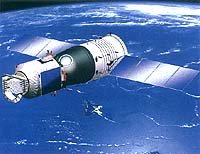
The Shenzhou spacecraft carries equipment for military surveillance, said Zhang Houying, human spaceflight application system commander at the Chinese Academy of Sciences, in a lecture on China's human spaceflight technology application delivered 15 February at the China Science and Technology Museum in Beijing, according to an article by the 21st Century Global Report posted 25 February on Xinhuanet, a website run by the state media Xinhua (new China) news agency.
The Shenzhou-5 will carry a CCD camera capable of obtaining imagery with ground resolution up to 1.6 meters mainly for military surveillance, according to Zhang. The Shenzhou-4, whose orbital module is still operating in orbit, he indicated, is also equipped with devices for conducting signals intelligence through interception of radars and telecommunications traffic signals.
An article in PLA Daily also reveals SZ-4 carries multiple model microwave remote sensors capable of penetrating cloud as well as soil and vegetative covers to obtain data about targeted areas on Earth, which could doubtlessly be used for gathering information for military purposes.
The ground facilities in Miyun on the suburb of Beijing receive the data sent back by the SZ-4 during a period of ten minutes each time when the orbital module passes the area above.
In the lecture, Zhang displayed several photos taken by the Shenzhou showing Bohai (an arm of the Yellow Sea), and the landscapes of Taiwan, Tokyo area and the Japanese islands. "The newest American space cameras can get imagery with ground resolution of 10 centimeters. They watch us from space all the time. We can view them from above too now," he said.
The US space policy toward China is carefully designed to block any channel of cooperation fearing the Chinese would acquire U.S. space technology through such contacts, he told the audience.
Personnel from the China Aerospace Science and Technology Cooperation and the Department of General Armament were generally denied visas to visit the United States although some space scientists from the Chinese Academy of Sciences were allow to travel to America, according to Zhang.
The Chinese delegation led by China National Space Administration (CNSA) chief Luan Enjie was not able to obtain visas to attend the World Space Congress in Houston last October. (For this episode, see also Craig Covault, "U.S. snubs China at Space Congress." Aviation Week & Space Technology, 19 October 2002).
In another case in November 2001, which was not mentioned in Zhang's lecture, the Chinese delegation could not acquire visas to attend the 9th International Space Conference of Pacific Basin Societies held in Pasadena, California although the Chinese Society of Astronautics was one of the three organizations that sponsored the event (other two were: the American Astronautical Society and the Japanese Rocket Society).
Zhang used his personal experience to exemplify American visa officers' tactics regarding visa application by Chinese space scientists. According to his account, when he was applying for a visa to attend a conference in the United States last year, the visa officers told him upon his inquiries that his application was in process. But he was not finally notified until the conference was concluded that his invitation to the meeting was expired.
"The Americans say that whoever control space stations, whoever control the Earth. Currently, the United States and Russia are space technology powers. If China will not develop its space technology independently, they will never give us a place in space. By developing a human spaceflight program, China can aggrandize its national prestige as well as military prowess," Zhang said.
Although astronauts from twenty nations have visited "America's International Space Station," no Chinese has been allowed to be there so far, he said. He also complained that he tried to order eight containers used for holding science experiments in spacecraft, but he could not get any from the United States.
It was unusual that a Chinese space official stressed the military functions of the Shenzhou missions and criticized the US space policy at the same time in a public lecture, although observers in the West have long speculated the dual purpose of China's human spaceflight program. His rhetorics parallel with recent remarks by US officials concerning Washington's intention to expand its civilian space agency's role in defense.
Dana Rohrabacher, chair of the House Space and Aeronautics Subcommittee, is pushing for more cooperation between NASA and the Defense Department. "Any fundamental research that we're doing that will help us either in civilian or commercial space should have a dual use with the military, and we shouldn't shy away from that. We're getting more bang for our buck," Rohrabacher said.
Peter B. Teets, undersecretary of the Air Force and the Defense Department's executive agent for space, also has pushed to work more closely with NASA. "Clearly, space is the high ground, and we need to capture that high ground and exploit it," he said. (see Patty Reinert, "NASA's defense role could expand," Houston Chronicle, 22 Feb 2003)
In the lecture Zhang said the launch date of the SZ-5 is a state secret. However, he speculated it would take place in November or December this year. This is consistent with the report in the10 January issue of Science Times, an official publication of the Chinese Academy of Sciences, in which an official in charge of the spacecraft application system predicted the mission around November.
To allow the astronaut to have more room inside the Shenzhou spacecraft, no science experiment will be carried on the upcoming mission, Zhang revealed. Based on the information unveiled by Zhang, an expert at the China Science and Technology Museum speculated that the SZ-5 would carry only one astronaut to travel in space for one day because the purpose of this mission is simply to demonstrate the nation's ability to send a human into space. The simpler design for the mission, the higher change it would succeed.
Zhang also announced that a space lab would be placed in orbit in 2007, which could be attended by two to three astronauts periodically. Two to three expedition crews are to be sent to the lab each year and each crew would stay there for 30-40 days. However, the life support system for the lab has not been successfully developed yet, he admitted.
The Shenzhou-5 spacecraft to be launched this fall, he revealed, will carry a docking system for docking with the space lab under development. Chinese space scientists have stated earlier that the Shenzhou spacecraft is designed to be able to dock with the ISS. The space lab's docking system, therefore, should be compatible with that of the ISS.
China will develop a permanent space station, Zhang affirmed. But it will be a long-term goal, according to China National Aerospace Science and Technology Corporation general manager Zhang Qingwei's remarks made soon after the return of the SZ-4 reentry module last January.
After the Shenzhou missions, China will focus on the Moon, as indicated in CNSA administrator Luan Enjie's announcement on 1 March, which affirmed the three-stage lunar exploration plan first outlined at a conference on deep space exploration held in Qingdao last August.
Luan, who has been appointed as commander-in-chief of the Moon project, declared the project will officially start this year. The first orbiting mission could be launched within three years upon the final approval by the government.
The project has been named after Chang'e, a fairy who flew to the Moon with her pet rabbit in a Chinese legend (a low-cost small lunar orbiter project being developed by the China Aerospace Science and Industry Corporation is called Moon Rabbit).
Principal lunar scientist Ouyang Ziyuan revealed it would take more than ten years to complete the three-step plan, which includes orbiting missions, robotic soft-landing missions, and sample return missions.
Human missions are not the nation's short-term goals although Ouyang envisioned an international human base on the Moon in 2030. His remarks dismissed any speculation by Western observers that China had planned crewed lunar flyby or human landing missions.
AFP reported 16 Feb that rocket scientist Huang Chunping believes "China has the full capability to send astronauts to the Moon." A check of the original report in the Chinese language by China News Service found that his remarks were mistranslated.
What he meant is that China is able to land robots on the Moon. China's next generation rockets capable of launching human and sample return missions to the Moon will not be available until the end of this decade.
China is expected to continue to follow its self-reliance principle to develop its space program. Meanwhile, it would vigorously explore new opportunities to expand the existing cooperation with Russia and European nations to counteract US containment.
The challenge from Beijing must prod the U.S. to maintain its superiority in space, if only for military reasons. The militarization of space could only be avoided through international cooperation rather than competition.
Does the Federal government do anything for other than military reasons?
The Americans would be able to take out your satellites, too, had it not been for Clinton and the perfidious Democrats.
--Boris
Um, food stamp programs? Surplus cheese sales? Department of (mis)Education? HUD? Farm subsidies? Studies of cockroach cuticles? Intense study of global non-warming? "Health", "Education" and "Welfare"? Anti-gun laws? The Legal Services Corporation? Amtrak? War on Drugs? Suing Microsoft? Outlawing tobacco advertising?...
--Boris
Disclaimer: Opinions posted on Free Republic are those of the individual posters and do not necessarily represent the opinion of Free Republic or its management. All materials posted herein are protected by copyright law and the exemption for fair use of copyrighted works.