Skip to comments.
Destroyers, a Century of Greatness
Navy News ^
| 11/27/2002
| Journalist Third Class (SW/AW) Jennifer Zingalie,
Posted on 11/27/2002 12:03:09 PM PST by SAMWolf
NORFOLK, Va. (NNS) -- One hundred years ago, on Nov. 24, a new class of ship was “born” into the fleet of the U.S. Navy.
This ship, USS Bainbridge (DD 1), along with eight sister ships, leaders of the class, were built to destroy powered torpedo boats (German U-boats).
Throughout the years, destroyers have been fast, alert, lethal and resourceful. They have been involved in almost every naval conflict and continue to be essential to the Navy’s warfighting strategy.
“Destroyermen -- a powerful term that includes so many generations, so many experiences -– peacetime and war, both men and women,” said Vice Adm. J. Cutler Dawson, Commander 2nd Fleet, who served as guest speaker at last spring’s Destroyermens' Ball.
Although the birth date of this class of ship has been celebrated for the entire year, the actual birthday of the destroyer is in the month of November and is remembered by those to whom its birth means the most, the men and women who serve aboard them.
“On a destroyer, the crew is small, so being capable and versatile in your job and as a Sailor is very important. We are mission-ready. Intense training to build these traits in each other is of utmost importance,” said Sonar Technician (Surface) Seaman James M. Hughes of USS Oscar Austin (DDG 79).
Today, there are two types of destroyers; Arleigh Burke-class and Spruance-class. Armed to respond with power and precision, the Spruance-class is used mainly for antisubmarine warfare, and the Arleigh Burke-class has a variety of combat capabilities. However, both serve in the protection of other ships in a battle group.
“Destroyers are ships that, when out to sea, constantly train. These exercises prepare us for any contingency, because we are ready for action at a moment’s notice,” said Mess Management Specialist 3rd Class James W. Towne of Oscar Austin.
The Navy continues to explore new and better ways to improve the fleet and is working to develop the 21st century’s next-generation destroyer, known as the DD(X). These ships are being designed for multimissions in dealing with small boats, diesel submarines and mines in coastal waters. Like their predecessors, they will also fulfill the need of the Navy in combat and precision.
“I believe that destroyers have held high standards for the ships and Sailors alike since they were first commissioned, and always will,” said Hughes. “We as destroyermen have jobs to do, which can be dangerous and hard. We put ‘warheads on foreheads.’ Everything we do is built around fighting our ships. I think we have to uphold high standards.”
Adm. Arleigh A. Burke, one of the Navy’s greatest destroyermen, said in 1964: “…the already great strength of the Navy will be increased even more, and through it, we will respond more effectively to the challenges which confront our country,”
TOPICS: Miscellaneous; News/Current Events
KEYWORDS: destroyers; navy; tincans
Navigation: use the links below to view more comments.
first 1-20, 21-40, 41 next last

Sep. 13, 2001 -- USS Winston S. Churchill makes a high-speed run in the English Channel. The destroyer, based in Norfolk, Va., is making its first deployment to the United Kingdom and Norway. The Churchill is the only U.S. Navy vessel in active service named after a foreign dignitary. The ship is named in honor of Sir Winston Spencer Leonard Churchill (1874-1965), best known for his courageous leadership as the British Prime Minister during World War II. U.S. Navy photo by Photographer’s Mate 2nd Class Shane T. McCoy. (RELEASED)

USS Carney fires her five-inch gun during a gun exercise in the Northern Arabian Gulf. Carney is deployed to the North Arabian Gulf in support of Operation Enduring Freedom and Operation Southern Watch. U.S. Navy photo by Chief Journalist John F. Williams. (RELEASED)
1
posted on
11/27/2002 12:03:09 PM PST
by
SAMWolf
To: souris; AntiJen; Victoria Delsoul; MistyCA; SpookBrat; SassyMom; bluesagewoman; GatorGirl; ...

A Standard Missile Two (SM-2), Block IVA is fired from the guided missile destroyer during a live missile fire exercise. Higgins is part of the USS Constellation (CV 64) Battle Group, which is conducting operations in support of a Joint Task Force Exercise (JTFEX) prior to its scheduled six-month deployment. Live fire operations gives the ship’s crew the experience of launching operational weapons and honing their war-fighting skills. U.S. Navy photo by Photographer’s Mate Airman Apprentice Rebecca J. Moat. (RELEASED)

Operations Specialist 1st Class Michael B. Hoch gives a status report to Commander John P. Cordle, Commanding Officer, while standing watch as Aircraft Interceptor Controller monitoring a no fly zone around the USS Harry S. Truman (CVN 75) Battle Group. Oscar Austin is underway with the USS Harry S. Truman (CVN 75) conducting missions in support of a Joint Task Force Exercise (JTFEX). U.S. Navy photo by Photographer's Mate 1st Class Michael W. Pendergrass. (RELEASED)

— As viewed from the deck of the guided missile frigate USS Ingraham, a full moon illuminates the nuclear aircraft carrier USS Carl Vinson while conducting night flight operations. Carl Vinson is currently underway off the southern coast of California conducting training in preparation for their next scheduled deployment. U.S. Navy photo by Electronics Warfare Technician 2nd Class Christopher Ware
2
posted on
11/27/2002 12:05:41 PM PST
by
SAMWolf
To: SAMWolf
Son-of-a-destroyer-sailor BUMP!
They are, in the words of Kipling...
"...the CHOOSERS OF THE SLAIN!"
3
posted on
11/27/2002 12:07:16 PM PST
by
Poohbah
To: Poohbah
The history of the destroyer is the story of rugged Sailors and their gallant ships in foaming seas making haste to go in harm’s way. But the story isn’t just about these “Greyhounds of the Sea,” it’s also about the “Tin Can” Sailors who have manned destroyers for a hundred years.
“Throughout the years, destroyermen have been a proud breed,” said retired Adm. Arleigh Burke in the 1962 book "Destroyer -– 60 Years." “They have achieved distinction and the respect of their fellow Sailors through their performance and their ability to do anything asked of them. No task has been too difficult for them to tackle. They have plunged into each new requirement with the zest of an arduous and dedicated advocate. Through a combination of such advocacy, enthusiasm, hard work, and ability, destroyermen have carried on the tradition of seafaring men that has been a characteristic of Americans since the inception of this great nation.”
Burke, who passed away in 1996, was Chief of Naval Operations, but he is probably better known as the commodore of the “Little Beavers,” the eight ships of Destroyer Squadron (DESRON) 23, which “fought their tails off” in the Solomons campaign during World War II.
In November 1943, from the bridge of his flagship USS Charles Ausburne (DD 570), Burke led several successful attacks against many Japanese warships. During that one month, the ships of DESRON 23 sank one enemy cruiser, nine destroyers, one submarine and several small vessels, and shot down 30 planes. For nine months they battled their way up the Solomons leaving a trail of destruction.
Achievements like this fill the U.S. Navy’s destroyer history books, a history that began in 1902 with the commissioning of 11 torpedo boat destroyers. The first of these ships to be commissioned was USS Decatur (Torpedo-Boat Destroyer No. 5), on May 19, but the honor of being the first American destroyer is usually given to USS Bainbridge (Torpedo-Boat Destroyer No. 1), which the Navy commissioned on Nov. 24. By the end of 1911 there were 36 destroyers in the fleet, and by World War I there would be many more.
Within a month after the U.S. entered World War I, six destroyers rushed from Boston to Queenstown, Ireland, to help the British stop the German U-boats (submarines). They arrived on May 4, 1917, and immediately Vice Adm. Sir Lewis Bayly of the Royal Navy, thinking the Americans may need days or even weeks in which to train or perhaps put their ships through overhaul, asked the dreaded question, “How soon will you be ready to go out on patrol?”
The commander of the U.S. destroyers, Cmdr. J.K. Taussig, gave the historic reply, “We are ready now, sir!”
The six destroyers immediately went on patrol, and before the war ended, the U.S. destroyer force in European waters expanded to 80 ships. They did an outstanding job, tangling with U-boats in 250 actions while only losing one destroyer, USS Jacob Jones (DD 61), and 64 members of the ship’s crew. Destroyers also guarded the transatlantic crossings of two million men, without the loss of a single life or a single transport ship.
4
posted on
11/27/2002 12:12:01 PM PST
by
SAMWolf
To: SAMWolf
Good article, but an error right off the bat. Destroyers were indeed built to counter torpedo boats (the original full name was "torpedo boat destroyer") but torpedo boats were surface craft. U-boats were submarines. The ASW role for destroyers came later, and it was not the reason they were developed. I believe I'm correct in saying the first destroyers were built by the British navy some time around 1890, and thus predate operational modern submarines by at least ten years.
5
posted on
11/27/2002 12:13:11 PM PST
by
kms61
To: All
World War II and beyond
The next world war resulted in the loss of many more destroyers, 71 according to the 1996 book "Blood on the Sea" by Robert Parkin. But the Navy lost more then just ships, as Tin Can crew members made up a good portion of the 37,000 American Sailors who made the ultimate sacrifice during World War II.
Most of those Sailors and ships were lost to suicidal plane attacks called kamikazes. During the U.S. invasion of Okinawa in 1945, 150 destroyers and destroyer escorts (DEs) stationed themselves in a vast ring around the island, a picket line to protect Americans from the attacking Japanese air strength. On April 6, “the full mad hurricane force of the ‘divine wind’ broke over the destroyer ring like flame and rock bursting from the crater of an erupting volcano,” said Capt. William Schofield, author of "Destroyers -– 60 Years."
By the time the U.S. finished taking the island in late June, the inferno of Japanese kamikazes, mines, submarines and shellfire sent 13 DDs and two DEs to the bottom of the sea and damaged 118 others, including USS Kidd (DD 661). A member of the crew, Joseph Mahoney, remembered the kamikaze attack.
“It is probably the most eerie and unnerving form of warfare mankind has ever inflicted on itself,” Mahoney told the Louisiana Naval War Memorial in Baton Rouge, where Kidd now sits as a memorial ship. “...You hear droning from the loudspeaker, ‘Air attack is imminent,’ and then, ‘Bogies sighted 35 miles north and closing.’ Next, the waiting and the thinking, ‘Thirty-five miles is a long way off. Don't kid yourself; it's only minutes away -- perhaps the last minutes of your life. I'm not ready, too much I haven't done yet.’ ... ‘(loudspeaker) Target sighted, position four o'clock low on water. Prepare to fire. Mark!’ Then explosions! Fire! Deafening noise! Acrid odors! Commands screamed! ‘How long can this go on? I can't breathe! Teeth hurt from grinding; fingers ache from gripping!’ And then it is over -- for this time. ‘Ah, I am alive; I am untouched. This is not me; I am not here. This is not happening to me!’”
The destroyers did hold their line under these attacks of incredible fury, protecting U.S. Marines and soldiers on Okinawa. At the high cost of men and ships, they came through with glory; they won their victory. Destroyer victories in the Pacific during World War II greatly outnumber the losses, but the victories didn’t come easy for the Sailors manning those ships.
“We have been up at GQ [general quarters] six nights out of the past week,” wrote Donald Vick in his diary on Oct. 3, 1943. “The only sleep I get is about three or four hours in the day.”
Vick, a Radioman Third Class aboard Burke’s Charles Ausburne, manned one of the 20mm antiaircraft guns during GQ. On Nov. 4 he wrote: “We got two near bomb hits that threw shrapnel on our fantail and dented the bulkheads. Two full nights of murderous hell with no sleep, very little food, but who gives a damn, eight men were hit on our fantail.”
Vick passed away in 1998. His daughter, Nancy Faulk, shared her feelings about her father and those he served with.
“I feel proud,” said Faulk. “I feel humble. I feel astonished by what they did and how they did it. I feel thankful for the freedom they secured.”
Not only did destroyers fight for freedom in the Pacific, they also made a difference in the Atlantic, especially during D-Day on June 6, 1944. Late morning found the U.S. Army pinned down on Omaha beach with more than 1,000 casualties. Seeing this, Navy destroyers moved in close to the beach. Dodging return fire, and sometimes scraping bottom, these ships blasted one German position after another and enabled the American soldiers to move inland.
In testament to these Navy destroyers, Maj. Gen. L.T. Gerow, the U.S. commander on Omaha Beach, sent a message to the operation’s commander, Gen. Omar Bradley, stating, "Thank God for the United States Navy.”
6
posted on
11/27/2002 12:13:11 PM PST
by
SAMWolf
To: All
Destroyers in The Korean War, Vietnam and today
There’s hardly any comparison between World War II and the Korean War for the U.S. Navy and its destroyers. In the entire conflict, the Navy only lost five ships, none of them destroyers. Coastal gunfire and mines did damage 73 ships, including 48 DDs and DEs, mostly minor damage in gunfire duels with shore batteries.
While handling these types of threats, destroyers carried out critical missions during the Korean War. They assisted in minesweeping operations, shore bombardment actions, amphibious landings and evacuations. They screened carriers and rescued downed Navy pilots. And they demolished countless shore targets, including gun emplacements, tank columns, troop concentrations, bridges, highways, railroads and trains. Destroyers also did a lot of the same kind of work during the Vietnam War.
“We spent most of our time in the Tonkin Gulf at Yankee Station and all along the Vietnam coast north of Dan Nang,” said Rick Broadhead, a former USS Bausell (DD 845) Fire Control Technician. “Our missions included shelling enemy positions, plane guard duty with the carriers and rescue ship station far to the north in the Tonkin Gulf. Our days and nights were spent interdicting coastal shipping and destroying enemy supply vessels. Our northern operations included refueling Sea King ‘choppers’ sent on rescue missions for downed pilots in the vicinity of Hanoi and disrupting VC [Vietcong] supply routes to the south. Most patrols involved well over 30 days on station nonstop and this 'Greyhound of the fleet' had some holes put in her by hostile gunfire.”
Edwin Finney also served in the Vietnam War, as an officer aboard USS Waldron (DD 699) from 1967 to 1969. He’s not the first destroyerman in his family; his father commanded USS Harlan R. Dickson (DD 708) from 1951 to 1953.
“I certainly feel proud to have been a destroyerman and be a ‘card carrying member’ of Tin Can Sailors,” said Finney, who works in the photographic section of the Naval Historical Center in Washington, D.C. “I think this came about quite naturally growing up in a Navy family with my father, my uncle Earl and my grandfather all having been surface line officers.... It may sound silly, but in high school I kept an eight by 10 black and white glossy photo of DD 708 steaming at high speed with ‘a bone in her teeth’ taped up in my locker. I got what I wanted -- service in an old but good destroyer!”
Old and new destroyers have been in a number of actions since the Vietnam War. In the 80s, four destroyers took out a pair of Iranian command and control platforms in the Arabian Gulf after Iran attacked a reflagged Kuwait supertanker. During Operation Desert Storm, they launched Tomahawk land-attack cruise missiles into Iraq, and destroyers did the same into Yugoslavia and Afghanistan in more recent actions.
Today, Tin Can Sailors search merchant ships for military contraband, help to enforce the “no fly” zone over Iraq, evacuate American citizens from dangerous situations abroad and provide humanitarian aid to nations that have endured natural disasters. Also, today's Tin Can Sailors are both male and female.
“Growing up I heard a lot about Tin Can Sailors from my dad who was a World War II Sailor,” said Senior Chief Boatswain's Mate (SW) Juanita Rozar of USS Bulkeley (DDG 84). “When I first came in the Navy in 1981 I was told by the ‘salty old boatswain’s mates’ there was no way women would ever be allowed to sail [aboard] destroyers.”
In 1995 the Navy opened up destroyers to women, and the day after the message came out Rozar asked her detailer for a billet. The Navy put her into the “Women at Sea” program and she became one of the first women to serve aboard a destroyer.
“I checked aboard USS Barry (DDG 52) on April 5, 1996, said Rozar. “It’s one of the proudest days of my career. The second proudest day was the commissioning of Bulkeley.... Both ships have been the highlight of my career and both carry my fondest memories....”
Bulkeley is one of 54 destroyers currently in the Navy’s active fleet, much less than its high of 377 Tin Cans in 1945. More than 1,000 destroyers have sailed the world’s oceans and seas in the vessel’s century-long history.
“It is important to remember the history of the destroyer because of all the long days, blood, sweat and tears spent on the work horse of the fleet,” said Lt.j.g. Dwight Davis of USS Hopper (DDG 70). “Many destroyers have been spent defending the constitution of the United States, and especially on the 100th anniversary of the destroyer, we should take time to remember the dedicated service of the ship and even more, the crews who served on them.”
“Earning the title ‘destroyerman’ is accompanied with a long history of strength and stability as the name itself sounds,” said Fire Controlman Second Class (SW) Kenneth Ryan of USS O’Brien (DD 975). “The opportunity to be directly associated with this history is an honor.... Destroyers have engraved their signatures in history books and continue to be an ever-present asset in creating history. Remembering their toll in history is important, but I feel equal or more impressive feats are still yet to come.”
“Destroyermen have established enviable records of achievement,” stated Burke. “And they are still steaming toward unknown horizons where developments of the future wait for discovery.”
7
posted on
11/27/2002 12:13:59 PM PST
by
SAMWolf
To: SAMWolf; Pookie Me
Tin-can sailor BUMP
8
posted on
11/27/2002 12:14:49 PM PST
by
NorCoGOP
To: SAMWolf; mhking; rdb3; hchutch; general_re; Cultural Jihad
A brief literary break suited for this thread: The Destroyers by Rudyard Kipling - 1898
The strength of twice three thousand horse
  That seeks the single goal;
The line that holds the rending course,
  The hate that swings the whole;
The stripped hulls, slinking through the gloom,
  At gaze and gone again --
The Brides of Death that wait the groom --
  The Choosers of the Slain!

Offshore where sea and skyline blend
  In rain, the daylight dies;
The sullen, shouldering sweels attend
  Night and our sacrifice.
Adown the stricken capes no flare --
  No mark on spit or bar, --
Birdled and desperate we dare
  The blindfold game of war.

Nearer the up-flung beams that spell
  The council of our foes;
Clearer the barking guns that tell
  Their scattered flank to close.
Sheer to the trap they crowd their way
  From ports for this unbarred.
Quiet, and count our laden prey,
  The convoy and her guard!

On shoal with carce a foot below,
  Where rock and islet throng,
Hidden and hushed we watch them throw
  Their anxious lights along.
Not here, not here your danger lies --
  (Stare hard, O hooded eyne!)
Save were the dazed rock-pigeons rise
  The lit cliffs give no sign.

Therefore -- to break the rest ye seek,
  The Narrow Seas to clear --
Hark to the siren's whimpering shriek --
  The driven death is here!
Look to your van a league away, --
  What midnight terror stays
The bulk that checks against the spray
  Her crackling tops ablaze?

Hit, and hard hit! The blow went home,
  The muffled, knocking stroke --
The steam that overruns the foam --
  The foam that thins to smoke --
The smoke that clokes the deep aboil --
  The deep that chokes her throes
Till, streaked with ash and sleeked with oil,
  The lukewarm whirlpools close!

A shadow down the sickened wave
  Long since her slayer fled:
But hear their chattering quick-fires rave
  Astern, abeam, ahead!
Panic that shells the drifting spar --
  Loud waste with none to check --
Mad fear that rakes a scornful star
  Or sweeps a consort's deck.

Now, while their silly smoke hangs thick,
  Now ere their wits they find,
Lay in and lance them to the quick --
  Our gallied whales are blind!
Good luck to those that see end end,
  Good-bye to those that drown --
For each his chance as chance shall send --
  And God for all! Shut down!

The strength of twice three thousand horse
  That serve the one command;
The hand that heaves the headlong force,
  The hate that backs the hand:
The doom-bolt in the darkness freed,
  The mine that splits the main;
The white-hot wake, the 'wildering speed --
  The Choosers of the Slain!
9
posted on
11/27/2002 12:15:14 PM PST
by
Poohbah
To: SAMWolf
USS Dennis J Buckley DD 808 vet 1971-1972
To: kms61
Correct. The article does jump around but it states that in 1902 Destroyers were built to counter torpedo boats and then mentions later that they were used in WWI in an Anti-submarine role.
11
posted on
11/27/2002 12:18:17 PM PST
by
SAMWolf
To: Poohbah
Thanks for the Kipling Poem. That's one I was unfamiliar with.
12
posted on
11/27/2002 12:19:59 PM PST
by
SAMWolf
To: SAMWolf
SAM
These are fabulous pictures!! The last one is especially beautiful!
To: Poohbah
Fine ships.
Very fine ships.
Probably my favorite destroyer moment is the Battle off Samar Island. Damned if the Wolves and Little Wolves didn't pull off a miracle.
14
posted on
11/27/2002 12:26:27 PM PST
by
hchutch
To: SAMWolf
Bump
To: hchutch
I've always had a soft spot for the Fletcher class.

16
posted on
11/27/2002 12:36:35 PM PST
by
SAMWolf
To: Fiddlstix
USS Luce DDG-38 1985-1986 Mayport Fla.
Patrolled the Persian gulf for six months.
Six months of watching sea snakes and a few days liberty in Bahrain.
Btw the wildest thing for me was when we refueled from the carrier America in the North Atlantic in rough seas. Amazing. The bow of the carrier hit the water and a wave rolled across the flight deck. And we were about a football field away from it when it happened.
17
posted on
11/27/2002 12:39:26 PM PST
by
venturin
To: venturin
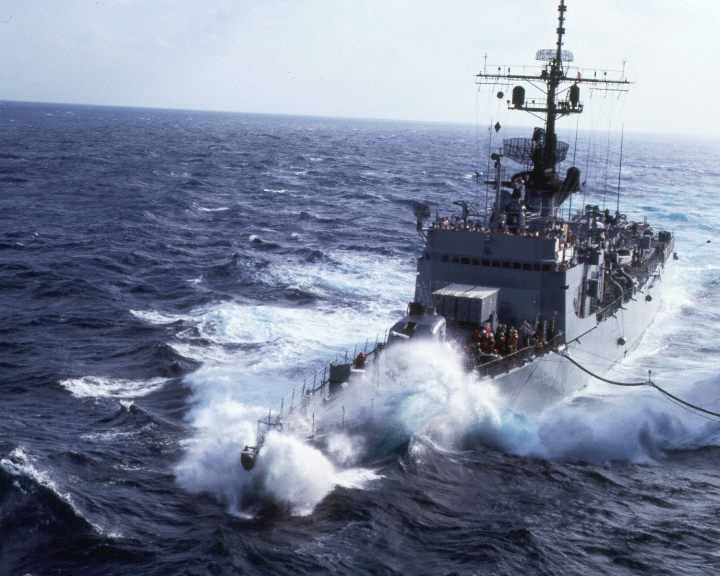
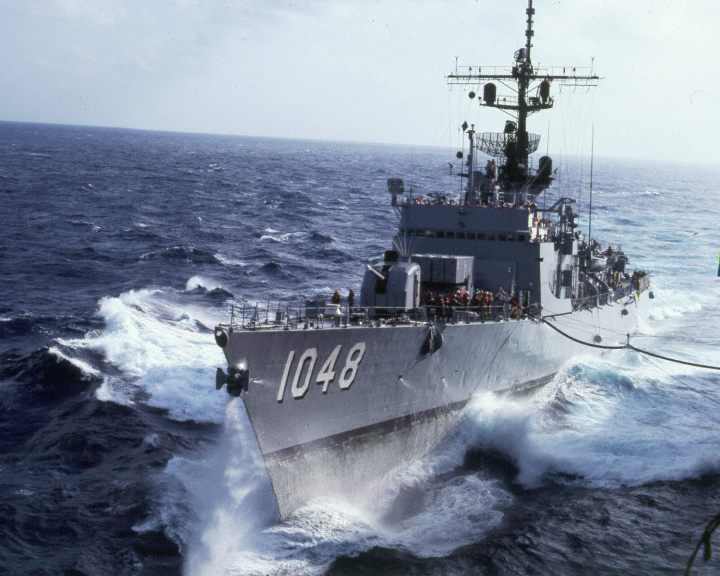
Thes photos show how a destroyer handles the waves while refueling next to the aircraft carrier USS Kitty Hawk. Notice the fuel lines coming from the carrier to the Navy Destroyer, USS Sample DE-1048
18
posted on
11/27/2002 12:46:16 PM PST
by
SAMWolf
To: kms61
Good article, but an error right off the bat. Destroyers were indeed built to counter torpedo boats (the original full name was "torpedo boat destroyer") but torpedo boats were surface craft.I caught that also and was scanning to see if anyone had corrected it before I posted. Well done.
To: HoustonCurmudgeon
IIRC, German torpedo boats were called "E-boats" but damfino what the "E" stood for.
Navigation: use the links below to view more comments.
first 1-20, 21-40, 41 next last
Disclaimer:
Opinions posted on Free Republic are those of the individual
posters and do not necessarily represent the opinion of Free Republic or its
management. All materials posted herein are protected by copyright law and the
exemption for fair use of copyrighted works.
FreeRepublic.com is powered by software copyright 2000-2008 John Robinson