Skip to comments.
Cormorant colonies take toll on forests
the Register Guard ^
| 15 Oct 02
| By Larry Bacon
Posted on 10/15/2002 4:20:09 PM PDT by Glutton
REEDSPORT - It's not a pretty sight, unless you're a cormorant.
Dead and dying trees mar a huge hunk of wooded hillside on the Umpqua River estuary that's visible downstream to northbound traffic from the Highway 101 bridge. What used to be a scenic piece of forest in the little-used Tideways State Park began changing in the late '80s when cormorants started building nests in the trees.
Locals say the number of long-necked, gangly black birds has increased in recent years, with cormorant-caused devastation becoming much more noticeable. During cormorant nesting season, which runs from March through August, the hillside becomes thick with the birds, whose droppings turn trees, plants and the ground white. The onslaught is so great that many of the trees and plants die.
The hillside is part of the shoreland of Bolon Island between the Umpqua and Smith rivers. About 500 feet of shoreline on the 150-foot hillside has been decimated by the birds.
Roy Lowe, a U.S. Fish & Wildlife Department biologist at Newport, estimates the hillside supports 200 to 300 nests in the summer, and said the colony's population may peak at more than 800 birds.
Lee Allen, a state parks ranger who does trail maintenance work in the park, said the trees are "black with birds" during nesting season - and that the noise they make sounds like a stadium full of people talking excitedly and all at once.
Cormorant excrement is pretty potent stuff, according to Lowe. The guano, which has been harvested as fertilizer in some parts of the world, is super-rich in nitrogen.
"It's so hot it burns the vegetation," Lowe said.
The trees and plants die, he said, because the foliage gets showered by the caustic droppings, and the soil in which they grow becomes saturated with nitrogen.
It's upsetting to longtime residents such as Eric Boe, a tugboat operator who liked the hillside much better when it was lush and green with second growth Douglas Fir and spruce.
"It's a nice piece of public real estate and it's being ruined by an excessive number of cormorants," he said.
Like seals, the cormorants have never been popular with fishermen because they feed on juvenile salmon and other fish. Boe remembers the days when locals liked to use them for crab bait. But since the mid-1970s the birds have been protected under federal law enacted for the benefit of migratory birds.
Former Reedsport Mayor Tom Tymchuk calls the cormorant damage "visible pollution" and said it concerns a lot of people in the Reedsport-Gardiner area.
Gary Ferguson, manager of the idle International Paper Co. paper mill property at Gardiner and a member of the Lower Umpqua Economic Development Forum, said that group has talked about trying to get something done about the bird blight.
It's sad to see, he said, at a time when just to the north of the bird colony the American Bridge Co. is building a new steel fabrication plant that has become a source of community pride for the lower Umpqua River area.
No one has proposed hurting the birds or trying to scare them. Lowe said anything that would harm the eggs or young birds would be illegal.
But both Boe and Ferguson have talked to state parks officials about how to deal with the problem. Maybe cutting out the dead snags would improve the looks of the hillside and eventually persuade the birds to move, Ferguson said.
But Lowe doesn't see what the fuss is all about. Eventually, the colony will probably move, he said.
"Yeah, they've killed some trees," he said. "But in the grand scheme of things, that's not a lot of trees."
A better approach, he said, might be to set up an interpretive area and some spotting scopes across the river so the public can appreciate what's happening and get a good look at the nesting activity.
He said the birds in question are double-crested cormorants, one of three species along the Oregon Coast and the only ones that nest in both saltwater and fresh water areas. Found all across the United States, they nest in rocks, cliffs and bulrushes as well as trees. The two other cormorant varieties stay close to the sea and mainly nest in offshore rocks and cliffs.
Along the coast, Lowe knows of only four cormorant tree-nesting colonies. Two are on the Umpqua River, one on the Siuslaw and another near Cape Arago in Coos County.
You won't find a sign identifying the 11-acre Tideways park. There's a pullout and a historical marker telling about a nearby Indian massacre of most of a party of 17 trappers headed by explorer Jedediah Smith in 1828. Behind the sign, a half-mile trail heads out through timber to a fork with one branch going to a scenic point and the other into woods with the cormorant colony.
Near the trailhead stands a small stone marker commemorating the donation of "Tide Ways Island Memorial Park" to the state in 1934 by William and Jennie Chamberlain in memory of their five children.
The park and the trail, which provide some sweeping views of the Umpqua River estuary, have always been a favorite with locals, said Dennis Davidson, an assistant area state parks manager at Florence, who oversees management of the Bolon Island property.
But few others even know about the park, he said, because the department hasn't had the resources to put up a sign or provide such minimal development as benches or picnic tables.
Even now, the trail is blocked by fallen trees remaining from a windstorm last February. Davidson said the trail will be cleared this winter, and there has been talk about asking American Bridge to help with benches, tables or an interpretive sign about the cormorants.
Davidson said he doesn't see much that can be done, short of cutting down some dead trees.
"But if we fell the dead ones, the birds will just move into the live ones and kill more, which they probably are going to do anyway," Davidson said. "It's a challenge, and I don't know the right answer."
TOPICS: News/Current Events
KEYWORDS: birds; foresthealth; invasivespecies
1
posted on
10/15/2002 4:20:09 PM PDT
by
Glutton
To: farmfriend; blackie; Jolly Rodgers; Grampa Dave; AuntB; nunya bidness
ping
2
posted on
10/15/2002 4:21:28 PM PDT
by
Glutton
To: Glutton
Why not put a couple of endangered whatevers, toads, lizards, etc., near the trees and then call the eco-whackos responsible for that species. They'll come over to protect their turf and wind up shotgunning all the non-endangered cormorants. Got to pit one group of eco-whackos against another before they take over everything.
3
posted on
10/15/2002 4:34:30 PM PDT
by
Tacis
To: Glutton
Stop the attacks on our Freedoms by the wacko, extreme left-wing, lunatic fringe, dirt worshipping Green Jihadist, enviro-nazis terrorist's and their toadies in the media !!
Stop Rural Cleansing !!
Freedom Is Worth Fighting For !!
Molon Labe !!
Fighting Irresponsible Radical Environmentalism !!
FIRE !!
4
posted on
10/15/2002 5:07:26 PM PDT
by
blackie
To: Glutton
"He said the birds in question are double-crested cormorants, one of three species along the Oregon Coast and the only ones that nest in both saltwater and fresh water areas."
So this is a native species,as opposed to an invasive one?
5
posted on
10/15/2002 8:17:31 PM PDT
by
Rocksalt
To: Glutton; Carry_Okie
Thanks for the ping. Passing it on.
To: farmfriend
We have 3 or 4 cormorants that have been returning for at least the 6 years we've been here. Locals tell us they have actually been returning for about 10 years.
We call them flying pigs.....due to the sound they make.
7
posted on
10/15/2002 11:03:36 PM PDT
by
justshe
To: Glutton
During cormorant nesting season, which runs from March through August, the hillside becomes thick with the birds, whose droppings turn trees, plants and the ground white. The onslaught is so great that many of the trees and plants die. What do you bet that they blame farmers for nitrates in the water but they'll prevent the harvesting of natural guano for farming?
To: Rocksalt
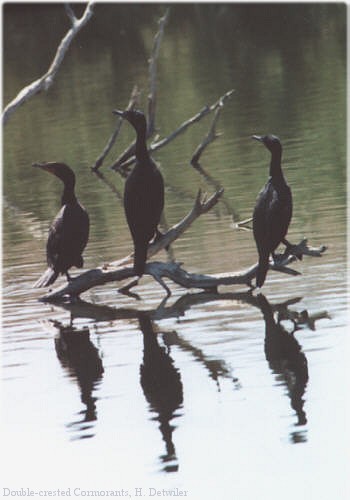
Q. Where do they live?
A. Double-crested cormorants can be found in many locations throughout North America. They nest along the coast from southwest Alaska to Mexico, and on lakes from central Alberta, James Bay and Newfoundland, south along the coast to the Gulf of Mexico. Along the Pacific coast and the southern Atlantic coast, populations are resident year-round. Cormorants spread from the interior of North America into the Great Lakes between 1913 and the early 1930s. The Great Lakes basin population migrates along the Atlantic coast and Mississippi River drainage, to overwinter in the southeastern Gulf states and Gulf of Mexico, returning north in April.
9
posted on
10/16/2002 12:28:39 AM PDT
by
ALS
To: Carry_Okie
Leave it to you to cut to the chase.
To: ALS
Are cormorants an introduced species from Asia?
To: ALS
Check that, my field guides indicate that they are native. Cormorants appear to be a globally distributed genus. It was your description of their propagation led me to ask the question.
To: Glutton
SH!T happens.
13
posted on
10/16/2002 7:56:44 AM PDT
by
Illwind
To: ALS
This article and the info you posted says they are quite migratory.Maybe they will just move on on their own in time.That would be convienent.
14
posted on
10/16/2002 10:11:01 AM PDT
by
Rocksalt
To: Rocksalt
Good point. One could call this a displaced species if this behavior is due to that. It sure isn't an invasive species such as English ivy or Scotch broom is by virtue of invading the area from another continent.
15
posted on
10/16/2002 4:51:28 PM PDT
by
Glutton
To: Carry_Okie
Cormorants are beautiful birds. They have oiled feathers and dive for food. They're really cool when they get on a tree branch and extend to full wingspan to dry out after they've eaten their full.
Problem with cormorants is they're nowhere near endangered. In fact they an infestation that are causing many problems, they are not endangered or threatened in any way whatsoever.
You know how that goes. Us nature lovers are not allowed to trespass in the eviros political rhealm.

16
posted on
10/16/2002 5:01:31 PM PDT
by
AAABEST
To: AAABEST
Cormorants are beautiful birds. They have oiled feathers and dive for food. They're really cool when they get on a tree branch and extend to full wingspan to dry out after they've eaten their full. I lived on a boat on San Francisco Bay for nine years. I've seen thousands of them.
To: Carry_Okie
I've seen thousands of them. So have the envirals "biologists". Yet they insist on turning certain species into a pestilence, like the filthy liars they are.
18
posted on
10/16/2002 6:19:37 PM PDT
by
AAABEST
To: Glutton
From the pictures that were posted they look like fairly large birds. I'm suprised some enterprising person has not already made an effort to collect the guano,and capitalize on it.Would that be legal? If it's anything like bat guano it might be worth a few shillings a pound.
19
posted on
10/16/2002 6:33:16 PM PDT
by
Rocksalt
To: ALS
I'm assuming the numbers of these birds are pretty high.They are pretty good looking,they remind me of an black Egret.Hopefully they will decide to migrate on their own.
20
posted on
10/16/2002 6:52:07 PM PDT
by
Rocksalt
Disclaimer:
Opinions posted on Free Republic are those of the individual
posters and do not necessarily represent the opinion of Free Republic or its
management. All materials posted herein are protected by copyright law and the
exemption for fair use of copyrighted works.
FreeRepublic.com is powered by software copyright 2000-2008 John Robinson