Skip to comments.
Bug Invasion.
http://www.journalism.ryerson.ca/online/krazy/over/wseccombe.htm ^
| 2002
| Will Seccombe
Posted on 09/30/2002 2:44:39 PM PDT by Rightone
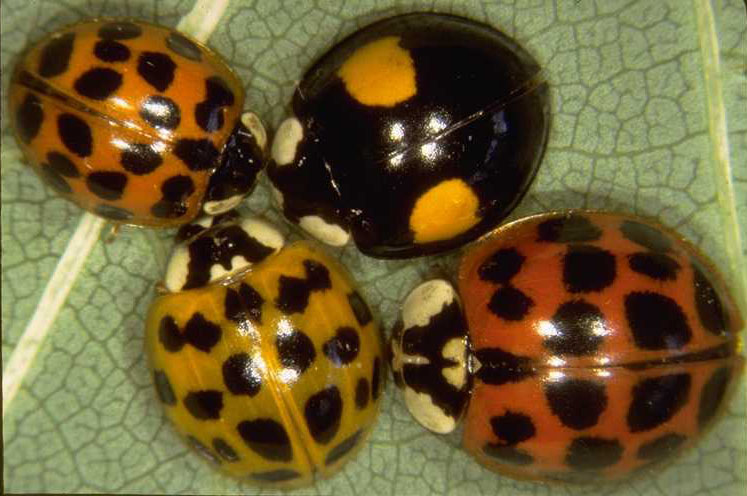
| It's a bird. It's a plane. No, it's a ladybug. In fact, it's millions of ladybugs swarming all over Ontario. "Why are we being invaded by ladybugs?" "Why are some of them biting us?" "What do they want?" This fall there have been record numbers of ladybugs in Ontario, and these are not the ladybugs people are used to. "They are not red any more," reads a comment on the Great Lakes Gardening Forum. "Their colour is orange. What's happened to our old ladybugs? These new ones are everywhere. A real invasion. Are they coming from the Middle East?" Actually, these ladybugs are from Asia. According to entomologists at the University of California Riverside (UCR), the Asian Lady Beetle (or Harmonia Axyridis, if you want to get fancy) was introduced to the U.S. intentionally by the Department of Agriculture to help control aphid populations. However, it worked better than expected and in the early 90's the species, which has no natural enemy in North America, established itself. It is now reaching epidemic proportions. For Ontarians, Asian Lady Beetles (see photo) are both friend and foe. They are our friends because they eat aphids, and no one likes aphids. In August, an Asian aphid was reported in Canada for the first time, says Chris Darling, curator of insects for the Royal Ontario Museum. The species was introduced in the mid-west of the U.S. about four or five years ago, and since then has been slowly expanding to suitable habitats. This past summer, they flew in on the wind and landed in the soybean fields to the west of Toronto. The little green suckers started feasting on the crops and quickly reached huge numbers in the fields and surrounding areas. The loss to soybean farmers has been estimated at about $100 million, a number that could have been much higher had the Asian Lady Beetle not flown to the rescue. And for the city folk, their days of wading through seas of aphids on the streets of Toronto soon ended.
For now, the aphids are out and the ladybugs are in - in people's houses and biting them in some cases. The Asian Lady Beetle (more info) can be quite a nuisance to homeowners, especially in October, as they flock together in large groups to seek out a warm place to spend the winter in hibernation. Naturally, they do this in caves or crevices that are exposed to the sun during the day. But a house will do just fine too. Many Ontarians are finding them gathered in piles on their windowsills. They vacuum them up only to find more the very next day. The UCR Department of Entomology says, "If you want to toss them outside for the winter, then go right ahead - but there are no repellents to keep them away, so until the weather turns too cold for them to keep flying (ladybugs can't fly when the temperature drops below 13 C), you'll probably have more sneaking into your house." Killing them is another option, according to UCR entomologists. "Ecologically speaking, there is no reason not to; even if you could kill 50,000 of them it wouldn't make a dent in their numbers." Just remember that these ladybugs secrete a smelly yellow fluid as a defense mechanism that will stain your squishing surface. In the past, the thought of killing a cute little harmless ladybug may have outraged some ladybug lovers. But now there are reports that these ladybugs are not as harmless as people might think. They can bite. Experts say that the insects occasionally mistake supple human skin for the soft green aphids that are their favourite food. This phenomenon has some people ticked off. A posting on the Great Lakes Gardening Forum reads: "Hey! These bugs are not ladies anymore! They are landing on people and immediately biting! Never had that happen before. Fifty bites in one day." Another person writes: "I hope these will not crowd out our lovely benign red ladies. I don't mind if they want to eat aphids, but I don't want them eating me!"
Although people do not welcome litters of ladybugs in the house, let alone chomps on the arm or leg by the confused critters, the biggest threat that these alien lady beetles present is the extinction of our native species. According to Darling, there are good records in museum collections, such as the ROM, that examine the collection of lady beetle fauna pre-introduction and post-introduction of the Asian Lady Beetle and show dramatic changes in the abundance of local species. He says there is a conservation issue associated with this. The Asian ladybug now accounts for 99 per cent of the ladybugs in Ontario. There is a good chance that they will help push along some of our local species to extinction, because they're voracious feeders and they're out competing with some of the native species for resources. Our native species also have natural predators to contend with, whereas the biggest threat to the Asian ladybug is the "Dustbuster." Darling says that the initial introduction of the Asian Lady Beetle into North America as an anti-aphid measure raises the general question of humans playing God and "mucking with systems that they don't understand." He says, in many cases, people end-up affecting the delicate balance of the earth's ecosystems and producing problems down the road that weren't easily identifiable from the start. Ontarians should take a moment to consider life from the perspective of the indigenous ladybugs. Theirs is a life of strife, and uncertainty. They may not be around much longer. Asian Lady Beetles, on the other hand, are something we're all going to have to get used to. There's no stopping them now. They are here to stay. |
TOPICS: Culture/Society; Government; Miscellaneous; News/Current Events
KEYWORDS: asian; bugs; homeinvasion; ladybugs; smelly
Navigation: use the links below to view more comments.
first 1-20, 21-26 next last
These bugs are all over the Mid-Western states now and even farther west. I posted this Ontario article as it show how far north they have spread, too. They truly are pests and they are getting worse each year. My house is covered with these awful things as I type this. My wife and I woke up this morning in our bedroom and there were 100's of them crawling all over the ceiling and walls. Our house newly built, rock solid and tight, too.
1
posted on
09/30/2002 2:44:40 PM PDT
by
Rightone
To: Rightone
Let's home none of them gets bitten by a west-nile carrying mosquito!
To: Larry Lucido
Enviromentalists brought these awful pests in to supposely control amphids so less pesticides would be used???
Now our natural and loved ladybugs are being choked out by this species and it is also invading our homes and generally making life miserable for many people, particularly in rural areas.
3
posted on
09/30/2002 2:52:27 PM PDT
by
Rightone
To: Rightone
These bugs land over our house every fall.
In the spring they emerge from their hibernation....some inside, some outside.
If they get into your house now, you need to do some serious caulking.....heat escapes out the vents that they find to enter the house.
They are a myriad of colors, like the fall foliage.
My 83 year old mom says they are good luck.
To: Rightone
Check your neighborhood for any Tulip Trees. These trees are like Mecca to the little bastards. We've got them out here in Washington by the millions too - and we had them really bad until we got rid of that Tulip Tree. (I used to just incinerate them with a weedburning torch. It stunk, but it worked.)
5
posted on
09/30/2002 2:53:50 PM PDT
by
11B3
To: Rightone
many years ago camping in one of California's forests, we got invaded by ladybugs...everywhere! It was an awesome sight, but a little disconcerting crunching bugs underfoot.
6
posted on
09/30/2002 2:55:00 PM PDT
by
goodieD
To: Rightone
You can't stop these little buggers either. I have a friend who spend two weeks sealing up every possible place they could enter his house. Last winter he had even more.
7
posted on
09/30/2002 2:58:04 PM PDT
by
itzmygun
To: Rightone
We had them in the SE Wisconsin area last fall. Nasty little biters. No sign of them this year
8
posted on
09/30/2002 3:06:46 PM PDT
by
UB355
To: UB355
We had temps that dipped to 30 degrees last week and then it jumped back into the low 80s this week. That is what seems to have really riled them up again. I don't know how they are getting into the house, but they are. They are also getting between closed screens and closed windows that the smallest knats can't get into. This Asian beetle is nasty.
They do bite, too, as mentioned in the article, and they stink when you get them mad by swatting at them.
9
posted on
09/30/2002 3:10:59 PM PDT
by
Rightone
To: Rightone
We have had a few mild winters around the great lakes region, and they horded in homes in our state, and virtually lived all winter. They bite, stink, stain, and serve no useful purpose. They swarm on anything light colored - including people and clothing. The only way to get rid of them is to vaccum them, bag them, and trash them.
Around the first of April we had couple of weeks of a warm snap and the Asian Lady Beetles swarmed outside to feed on the new life coming onto the trees. Then, after being 70 degrees for a few days, the temperature dropped down to 20 the next, it snowed six inches, and and was cold for the next two weeks. This is the first time in three years I haven't seen any of them in the house or yard. It seems that God was the only answer at my house. For awhile it looked a lot like something Hitchcock would write about.
It amazes me that the Fed Ag Experts brought this thing into our country from China, and released it knowing that it had no preditor. Who was manning customs when they brought this in? Isn't infestation a terrorist attack?
10
posted on
09/30/2002 3:21:06 PM PDT
by
tomball
To: tomball
And, it's also amazing there is so little talk of this.
Living in Iowa, I did a search on this pest, and researchers at the University of Iowa were actually *asking* for samples of the Asian Ladybug Beetle back in 1996. Bet they don't need any more samples now! There are literally billions of them now all over the state and in every county. Heck, there are billions just outside my window trying to get inside. One just flew by my head and tried to land on the keyboard.
11
posted on
09/30/2002 3:45:21 PM PDT
by
Rightone
To: Rightone
This nast lady bug, has ousted our friendly beneficial one, they have done the same in the EU, but it happened there years ago, don't think there is any turning back the clock.
To: CROSSHIGHWAYMAN
My 83 year old mom says they are good luck.That was the little friendly one. :-}
To: 11B3
Check your neighborhood for any Tulip Trees. These trees are like Mecca to the little bastards. Where as the old fashion lady bug will lay their eggs near the roots of Alderberry bushes, thinking if planting one again, just to give them a headstart.
To: Rightone
Wow. I thought this thread was going to be about the Harkin campaign operation.
To: Rightone
Not nearly as bad in Mich. this year compared to last. Maybe due to a late spring\dry-hot summer???
To: Rightone
Why couldn't they have worked on increasing the population of our native ladybugs? Do the Asian ones multiply faster?
17
posted on
09/30/2002 4:33:17 PM PDT
by
Aliska
To: Aliska
The Asian ladybug is so aggressive that the native ladybugs no longer have a food supply because the Asian bug is eating everything. And, yes, the Asian bug is hardy, aggressive, and multiplies like crazy. If you haven't seen it yet where you live, you will in time.
18
posted on
09/30/2002 4:38:09 PM PDT
by
Rightone
To: Rightone
Oh yes, I've seen them. They were a nuisance last year but I haven't seen any yet this fall.
19
posted on
09/30/2002 4:40:42 PM PDT
by
Aliska
To: Aliska
It likely depends on weather factors. We had them very bad for a couple of years starting about 1999. Every year seems to be getting worse here in my part of NW Iowa.
In other parts of the country, perhaps they will go away for awhile, but that will probably be temporary. I did some research on this, and these bugs will come back strong depending on the local conditions. I hope I'm wrong, but everything I've read on this says they will be back and eventually will find their way into your house and become a pest.
20
posted on
09/30/2002 4:46:01 PM PDT
by
Rightone
Navigation: use the links below to view more comments.
first 1-20, 21-26 next last
Disclaimer:
Opinions posted on Free Republic are those of the individual
posters and do not necessarily represent the opinion of Free Republic or its
management. All materials posted herein are protected by copyright law and the
exemption for fair use of copyrighted works.
FreeRepublic.com is powered by software copyright 2000-2008 John Robinson