Posted on 07/02/2002 1:06:01 PM PDT by rface
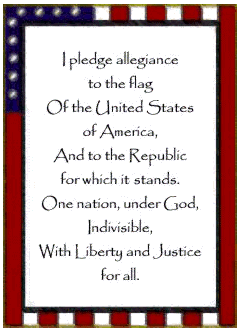
An unbelievable furor erupted last week about an addendum to the Pledge of Allegiance after a federal judge ruled that making schoolchildren recite the words "under God" was an unconstitutional breach of the wall that separates church and state.
The plaintiff, an emergency room physician in California, had sued on the grounds that his young daughter was, for all intents and purposes, forced to utter the phrase even though her family does not acknowledge the existence of the deity.
The plaintiff’s daughter is now in hiding because of death threats from the God-loving. The U.S. Senate immediately denounced the decision by a vote of 99-0, and the judge who issued it lost no time in effectively quashing his own ruling.
Now, I love a good dust-up as much as anyone - more, in fact. This one, however, is at bottom meaningless. The decision applied only to a portion of the country, and it is bound to be overturned anyway.
More to the point, the pledge itself holds little meaning for the millions of schoolchildren who recite it dutifully each day. The Pledge of Allegiance is a rote exercise. Kids are drilled in it as soon as they are old enough to chew their food, and they perform both tasks with an equal amount of thought and reverence.
A parent I know tells me his 3-year-old daughter has the pledge memorized, but only phonetically. "It means about as much to her as ‘eeny-meeny-miney-moe’ and a lot less than ‘twinkle, twinkle, little star,’ " he said.
As an experiment, I posed a question to three 12-year-old boys: What is the meaning of the word, "indivisible?" The answers were: 1. Something that can’t be divided; 2. Something that can’t be seen; 3. Something in the national anthem.
I didn’t ask them to define "under God," or "liberty" or "justice." Those are words that even distinguished federal jurists often struggle with, not to mention the rest of us patriotic citizens.
The pledge was penned in 1892, and the nettlesome "under God" phrase was added in 1954 at the behest of the Knights of Columbus, presumably to differentiate us from the godless communism we were fighting in those days.
Now, the Knights of Columbus is a fine organization, and they really know how to run a bingo hall. But they aren’t exactly the Continental Congress, either.
Nevertheless, there is a furious debate about whether the United States was or was not founded as a theistic nation. The political consensus seems to be that our nation’s founders were devout believers to a man, that they considered this to be a Christian nation but wisely provided that the law not promote any particular sect. Did not Thomas Jefferson write, in the document we celebrate this week, of a "Creator" who endowed humankind with certain inalienable rights?
No doubt the founders were predominantly Christian, and strictly Protestant Christians, for the most part. They erected that famous wall of separation primarily to prevent the Catholic-Protestant quarrels that had plagued Europe for centuries, and still do, in places.
But I think they had a larger idea in mind: In this country you can say anything you want to say, and no one can make you say anything you don’t want to say.
That and that alone is what makes the United States unique among nations.
Surveys show that about 8 percent of the U.S. population is non-believing, a figure that fluctuates according to natural disasters, the jobless rate and other factors. The atheistic element probably was proportionately smaller in 1776 than it is now, but a few freethinkers like Ben Franklin were lurking about even then. Tom Paine, author of "The Rights of Man," was a secular humanist 200 years before that unfortunate term was coined. I can’t believe that Jefferson would have denied them the right to hold their damnably dangerous opinions.
That is what freedom is all about. Freedom has nothing to do with flags and fireworks, which are found in every dictatorship in the world.
Celebrate Independence Day. Say whatever you want to.
-------------------------------------------------------------------------------- Forrest Rose is a Tribune columnist. You can reach him via e-mail at editor@tribmail.com.
Ashland, Missouri
I did pick up on something I would like to comment on specifically. He says:
But I think they had a larger idea in mind: In this country you can say anything you want to say, and no one can make you say anything you don’t want to say.
That and that alone is what makes the United States unique among nations.
What clap trap. Our division of powers under a written constitution is probably the obvious item that originally made us unique. Every socialist in Sweden or throughout the EU can speak about whatever they want and they do so.
A moral sensibility with equal justice before the law and no man bowing to others is what de Touqeville noticed as I recall. This guy is a really deeeeep commentator if this is all he can come up with.
The government isn't supposed to establish a religion, but it isn't supposed to establish atheism, either.Make you a deal. You homeschool your daughter, or send her to Atheist University preschool. You get a voucher or a tuition tax credit, your daughter is educated your way, my granddaughter is raised her parent's way, and we're even. That's my final offer.
...she was not forced to pledge, with any intent or purpose ...she has not received any threats (the father has though) From what I have learned, the Mother and Daughter are Christian, and it is the Mother that has custody. The Mother says that "Under God" should remain in the pledge, and the Daughter enjoys saying the pledge. This lawsuit may have been built on deception and fraud.
For one thing, this tired little canard:
They erected that famous wall of separation
Liberals never get tired of repeating this lie, but it's still a lie. The "famous wall of separation" was the personal opinion expressed in a letter by Jefferson, and nothing more. It wasn't until many years later that the courts took this opinion and decided to incorporate it into the Establishment Clause. The notion that the Establishment Clause forbids even the mentioning of God was certainly not shared by most of the Founding Fathers, and it's not shared by most Americans today.
Let's look at what Mr. Paine wrote:
From Common Sense:
In short, monarchy and succession have laid (not this or that kingdom only) but the world in blood and ashes. 'Tis a form of government which the word of God bears testimony against, and blood will attend it.
Of more worth is one honest man to society and in the sight of God, than all the crowned ruffians that every lived.
But where says some is the King of America? I'll tell you Friend, he reigns above, and doth not make havoc of mankind like the Royal Brute of Britain.
From The Rights of Man:
and consequently every child born into the world must be considered as deriving its existence from God.
The duty of man is not a wilderness of turnpike gates, through which he is to pass by tickets from one to the other. It is plain and simple, and consists but of two points. His duty to God, which every man must feel; and with respect to his neighbor, to do as he would be done by. If those to whom power is delegated do well, they will be respected: if not, they will be despised; and with regard to those to whom no power is delegated, but who assume it, the rational world can know nothing of them.
The illuminating and divine principle of the equal rights of man (for it has its origin from the Maker of man) relates, not only to the living individuals, but to generations of men succeeding each other.
Though I mean not to touch upon any sectarian principle of religion, yet it may be worth observing, that the genealogy of Christ is traced to Adam. Why then not trace the rights of man to the creation of man? I will answer the question. Because there have been upstart governments, thrusting themselves between, and presumptuously working to un-make man.
From The Existence of God
Where will infidelity, where will atheism, find cause for this astonishing velocity of motion, never ceasing, never varying, and which is the preservation of the earth in its orbit? It is not by reasoning from an acorn to an oak, from an egg to a bird, or from any change in the state of matter on the surface of the earth, that this can be accounted for. Its cause is not to be found in matter, nor in any thing we call nature. The atheist who affects to reason, and the fanatic who rejects reason, plunge themselves alike into inextricable difficulties. The one perverts the sublime and enlightening study of natural philosophy into a deformity of absurdities by not reasoning to the end. The other loses himself in the obscurity of metaphysical theories, and dishonours the Creator, by treating the study of his works with contempt. The one is a half-rational of whom there is some hope, the other a visionary to whom we must be charitable.
I have said in the course of this discourse, that the study of natural philosophy is a divine study, because it is the study of the works of God in the creation. If we consider theology upon this ground, what an extensive field of improvement in things both divine and human opens itself before us! All the principles of science are of divine origin. It was not man that invented the principles on which astronomy, and every branch of mathematics, are founded and studied. It was not man that gave properties to the circle and the triangle. Those principles are eternal and immutable. We see in them the unchangeable nature of the Divinity. We see in them immortality, an immortality existing after the material figures that express those properties are dissolved in dust.
If we unite to the present instruction a series of lectures on the ground I have mentioned, we shall, in the first place, render theology the most delightful and entertaining of all studies. In the next place we shall give scientific instruction to those who could not otherwise obtain it. The mechanic of every profession will there be taught the mathematical principles necessary to render him a proficient in his art; the cultivator will there see developed the principles of vegetation; while, at the same time, they will be led to see the hand of God in all these things.
If you read the First Amendment's clauses in reverse order, you find that:
You have the right to get together with likeminded people and complain publicly about what the government is doing.The trouble with divorcing the government entirely from religion is that, perforce, the government needs oaths. Officials and even soldiers and jurors and witnesses take oaths. And in truth currecy and coin are oaths as well--pledges that the tokens you are holding are produced by the government rather than a counterfeiter, and are not being produced in inflationary quantity.You have the right to speak or print your opinion of the government.
Your political rights do not depend on whether you are a Protestant, Catholic, or other/no religion.
And as the Bible points out in Hebrews Chapter 6, oaths are sworn by the higher. God cannot swear by anything higher, so He swore "by myself." Once reject the authority of God, and the government is in the position of swearing "by myself". What a place to put, of all people, x42!!!
January 1, 1802
Gentlemen,
The affectionate sentiments of esteem and approbation which you are so good as to express towards me, on behalf of the Danbury Baptist Association, give me the highest satisfaction. My duties dictate a faithful and zealous pursuit of the interests of my constituents, and in proportion as they are persuaded of my fidelity to those duties, the discharge of them becomes more and more pleasing.
Believing with you that religion is a matter which lies solely between man and his God, that he owes account to none other for his faith or his worship, that the legislative powers of government reach actions only, and not opinions, I contemplate with sovereign reverence that act of the whole American people which declared that their legislature should "make no law respecting an establishment of religion, or prohibiting the free exercise thereof," thus building a wall of separation between church and State. Adhering to this expression of the supreme will of the nation in behalf of the rights of conscience, I shall see with sincere satisfaction the progress of those sentiments which tend to restore to man all his natural rights, convinced he has no natural right in opposition to his social duties.
I reciprocate your kind prayers for the protection and blessing of the common Father and Creator of man, and tender you for yourselves and your religious association, assurances of my high respect and esteem.
Last paragraph says alot.
Liberal socialists can speak its Conservatives who are banned for hate speech.
Disclaimer: Opinions posted on Free Republic are those of the individual posters and do not necessarily represent the opinion of Free Republic or its management. All materials posted herein are protected by copyright law and the exemption for fair use of copyrighted works.