
You're welcome.
Posted on 06/28/2002 6:18:11 PM PDT by Pokey78
The US nuclear attack on Hiroshima paved the way for September 11 and its aftermath
Now that the number of innocent civilian victims killed collaterally in Afghanistan by the US bombardments is equal to the number killed in the attack on the Twin Towers, we can perhaps place the events in a larger, but not less tragic perspective, and face a new question: is it more evil or reprehensible to kill deliberately than to systematically kill blindly? (Systematically because the same logic of US armed strategy began with the Gulf war.) I don't know the answer to the question. On the ground, among the cluster bombs dropped by B52s or the stifling smoke in Church Street, Manhattan, perhaps ethical judgments cannot be comparative.
When on September 11 I watched the videos on television, I was instantly reminded of August 6 1945. We in Europe heard the news of the bombing of Hiroshima on the evening of the same day. The immediate correspondences between the two events include a fireball descending without warning from a clear sky, both attacks being timed to coincide with the civilians of the targeted city going to work in the morning, with the shops opening, with children in school preparing their lessons. A similar reduction to ashes, with bodies, flung through the air, becoming debris. A comparable incredulity and chaos provoked by a new weapon of destruction being used for the first time - the A-bomb 60 years ago, and a civil airliner last autumn. Everywhere at the epicentre, on everything and everybody, a thick pall of dust.
The differences of context and scale are of course enormous. In Manhattan the dust was not radioactive. In 1945 the United States had been waging a full-scale, three-year-old war with Japan. Both attacks, however, were planned as announcements. Watching either, one knew that the world would never again be the same; the risks everywhere, to which life was heir, had been changed on the morning of a new unclouded day.
The bombs dropped on Hiroshima and Nagasaki announced that the US was henceforth the supreme armed power in the world. The attack of September 11 announced that this power was no longer guaranteed invulnerability on its home ground. The two events mark the beginning and end of a certain historical period.
Concerning President Bush's riposte to September 11 - his so-called war against terrorism, which was first baptised Infinite Justice, and then renamed Enduring Freedom - the most trenchant and anguished comments and analyses I have come across, during the last six months, have been made and written by US citizens. The accusation of "anti-Americanism" against those of us who adamantly oppose the present decision-makers in Washington is as short-sighted as the policies in question. There are countless "anti-American" US citizens, with whom we are in solidarity.
There are also many US citizens who support these policies, including the 60 intellectuals (Francis Fukuyama and Samuel Huntingdon among them) who recently signed a statement which set out to define what is a "just" war in general, and why in particular the operation Enduring Freedom in Afghanistan, and the ongoing war against terrorism, are justified. The statement was widely published in the US and appeared in Le Monde and other European papers.
They argued that the moral justification for a just war is when its purpose is to defend the innocent against evil. They quoted St Augustine. They added that such a war must respect as far as possible the immunity of non-combatants.
If their text is read innocently (and of course it was not written either spontaneously or innocently), it suggests a patient gathering of erudite, quietly-spoken experts, with access to a great library (and perhaps, between sessions, a swimming pool) who have the time and quiet to reflect, to discuss their hesitations, and finally to come to an agreement and offer their judgment. And it suggests that this meeting took place somewhere in a mythic six-star hotel (access only by helicopter) in its own spacious grounds, surrounded by high walls with guards and checkpoints. No contact whatsoever between thinkers and the local populations. No chance meetings. As a result, what really happened in history and what is happening today beyond the walls of the hotel is unadmitted and unknown. Isolated De Luxe Tourist Ethics.
Return to the summer of 1945. Sixty-six of Japan's largest cities had been burned down by napalm bombing. In Tokyo a million civilians were homeless and 100,000 people had died. They had been, according to Major General Curtis Lemay, who was in charge of the fire bombing operations, "scorched and boiled and baked to death". President Franklin Roosevelt's son and confidant said that the bombing should continue "until we have destroyed about half the Japanese civilian population." On July 18 the Japanese emperor telegraphed President Truman, who had succeeded Roosevelt, and once again asked for peace. The message was ignored.
A few days before the bombing of Hiroshima, Vice Admiral Radford boasted that "Japan will eventually be a nation without cities - a nomadic people". The bomb, exploding above a hospital in the centre of the city, killed 100,000 people instantly, 95% of them civilians. Another 100,000 died slowly from burns and effects of radiation.
"Sixteen hours ago," President Truman announced, "an American airplane dropped one bomb on Hiroshima, an important Japanese army base." One month later the first uncensored report - by the intrepid Australian journalist Wilfred Burchett - described the cataclysmic suffering he encountered after visiting a makeshift hospital in the city.
General Groves, who was the military director of the Manhattan Project for planning and manufacturing the bomb, hastily reassured congressmen that radiation caused no "undue suffering" and that "in fact, they say it is a very pleasant way to die". In 1946 the US strategic bombing survey came to the conclusion that "Japan would have surrendered even if atomic bombs had not been dropped".
To describe a course of events as briefly as I have is, of course, to over-simplify. The Manhattan Project was started in 1942 when Hitler was triumphant and there was the risk that researchers in Germany might manufacture atomic weapons first. The US decision, when this risk no longer existed, to drop two atomic bombs on Japan, needs to be considered in the shadow of the atrocities committed by Japanese armed forces across south-east Asia, and the surprise attack on Pearl Harbour in December 1941. There were US commanders and certain scientists working on the Manhattan Project who did their best to delay or argue against Truman's fateful decision.
Yet finally, when all was said and done, the unconditional surrender of Japan on August 14 could not have been, and was certainly not, celebrated as the longed-for victory. There was an anguish at the centre of it, and a blindness which blinded.
I tell this story to show how far even from the reality of their own history were the 60 American thinkers in their six-star mythic hotel. I tell it also as a reminder of how the period of US armed supremacy, which opened in 1945, began for all those outside the US orbit with a blinding demonstration of a remote and ignorant ruthlessness. When President Bush asks himself "why do they hate us", he might ponder this - except that he is one of the directors of the six-star hotel and never leaves it.
· John Berger is a writer and critic; his books include Ways of Seeing, G and, most recently, The Shape of a Pocket
You're welcome.
*snicker* You keep on thinking that, bloke. We have SO LONG AGO ceased to care about why they hate us, or why you hate us. They are going to be destroyed, and you are irrelevant. Meaningless. And I mean that literally. If you end up as collateral damage in WWIII, America will not even notice. You are dust in the wind. Get used to it.
1. Who started WWII?
(a) Europeans
(b) North Americans
2. Who created the conditions that led to the Hiroshima bombing?
(a) Eropeans and Japanese
(b) North Americans
3. Who stopped WWII?
(a) Europeans
(b) North Americans
Who rebuilt Europe and Japan after WWII?
(a) Europeans and Japanese
(b) North Americans
It never ceases to amaze me how the Euros can start a major war every two generations then call us barbarians after we've cleaned up the messes they made.
Exactly. The Euro's seem to have short memories.
Expletive deleted.
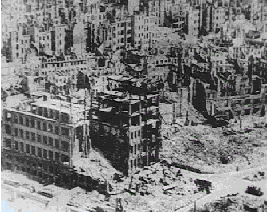
February 13, 1945. 130,000 dead in Dresden.
But hey, I guess that was different...somehow.
Whaat a peculiar analogy. As if the Japanese were at peace when the bombs were dropped, as were New York and DC.
By that date, mass firebombings were so...1943.

A perfect example of why the Kingdom has gone down so far in the esteem of the world.
Only if it is more reprehensible to kill combatants than to kill innocents.
Let's even grant that 3,000 innocent Afghans died as collateral damage in the war. In spite of that, tens of thousands of Afghans have voted with their feet and have gone back to Afghanistan. Would they have done that if death from Americans was such an evil or such a threat? I haven't heard a word about starvation in Afghanistan since November. Now with the Islamaic fanatics out of power and transportation restored inside Afghanistan, the threat to 5 million Afghan by starvation is gone. Easily more than 3,000 lives have been saved.
Of course, every innocent life lost is a tragedy. I bet John Berger didn't give a sh*t when the Taliban and Al Qaeda were slaughtering people on purpose and creating famine. Only accidental, unintentional death due to Americans is evil.
I say Berger is evil and he's a creep.
 His name became known amongst other foreign correspondents as "Wellfed Bullshit". Burchett was an agent of influence for Directorate A during the cold war.
 Just another Communist stooge.
Be Seeing You,
Chris
Disclaimer: Opinions posted on Free Republic are those of the individual posters and do not necessarily represent the opinion of Free Republic or its management. All materials posted herein are protected by copyright law and the exemption for fair use of copyrighted works.