Skip to comments.
The Crusader Crusade: Behind the controversy.
National Review Online ^
| June 19, 2002
| James S. Robbins
Posted on 06/19/2002 10:10:29 AM PDT by xsysmgr
This week the White House issued a veto threat over the antiterrorism bill currently wending its way through Congress. At issue is the new $11 billion Crusader artillery system, which Secretary of Defense Rumsfeld has determined to be "no longer relevant to our future requirements." However, some influential members of Congress disagree, as do some Army officers, and, of course, Crusader's team of contractors. The Senate is going to consider whether to go along with language in the House version of the bill that would advise the Secretary of Defense not to take any action to stop work on Crusader, which prompted the presidential warning.
The issue is not over whether Crusader is a good artillery piece. As far as I have heard it is probably the best cannon ever made. The larger argument is about "defense transformation," a much discussed but not as widely understood concept. Many confuse transformation with acquiring advanced technology, the wonder weapons of the future that will change the face of war. This is why every weapons developer in the country wants to call his system "transformational," and Crusader is a case in point. But transformation is not simply getting newer, sexier pieces of gear, it is a means of reconceptualizing threat assessment and balancing risks with resources in a rapidly changing global-security environment. In the transformational age, that mere fact that a weapon is good isn't good enough. The system has to be balanced against the type of threat it is meant to deal with and the resources required producing it.
This is the objection to Crusader, which is probably the deadliest conventional artillery piece ever designed. It would be invaluable in a massed, Fulda Gap style, symmetrical, force-on-force struggle, busting tanks and breaking assaults — but few defense planners see that particular battle taking place in the Crusader's operational lifetime, which would have begun in 2008. What the DOD now wants are more precise, more rapidly deployable systems that can better be integrated and networked with other weapons. This revolution is just around the corner, so why use scarce resources to buy a weapon which, if it isn't obsolete on arrival, won't have an enemy to fight?
In some ways the Crusaders is analogous to another controversial weapon, the B-36 "Peacemaker" bomber, a variant of which was coincidentally also called the Crusader. The B-36 was conceptualized shortly before World War II as a successor to the B-29 Superfortress (best remembered as the aircraft that dropped the A-bombs on Japan), which was then just entering its testing phase. It was intended to be able to hit European targets from the United States in case Britain fell to the Nazis. The first test version was flown in 1946, and the aircraft became operational in 1948. The B-36 was an extremely well-designed aircraft; the engineers had to overcome a number of challenges to fulfill the aircraft's demanding mission requirements. The B-36 incorporated all of the hard-learned lessons of the strategic-bombing campaigns of the Second World War. The bomber's long-range flight capability made it potentially useful for its Cold War mission of nuclear deterrence against the Soviet Union. However, the Peacemaker was slow and unwieldy — the jet age had arrived, and the B-36 was propeller driven. It would have difficulty penetrating the Soviet Union and evading interceptor jets. Various attempts were made to stave off obsolescence, from mounting jets at the ends of the wings, to producing a supersonic mini-bomber (the XB-58, which later became the B-58 Hustler) that would deploy from the vastly larger B-36 after being hauled close to the target. But the writing had been on the wall from the beginning. The B-47 Stratojet made its initial test flight in 1947, six months before the B-36 became operational. You didn't need Nostradamus to see the future belonged to the jets.
This was the background to a vicious political fight between the Air Force and the Navy in the summer of 1949, known as the "Revolt of the Admirals." President Truman's defense cuts had forced some tough choices, and one of them was to cancel the Navy's planned supercarrier, the U.S.S. United States. The Navy saw the B-36 as the main adversary; in their view, it was a soon-to-be outmoded budget buster foisted on the country by the newly independent and influential Air Force at the expense of the other services. A series of congressional hearings were held, both sides played dirty, careers were ended, but the B-36 survived. It was a fight that makes the current controversy seem tame.
It was also unnecessary. A year later the Korean War and the recognition of the Soviet military threat rendered such debates passé. Between 1950 and 1955 the defense budget tripled in real terms, which temporarily settled the issue of resource scarcity. The Air Force could afford to field a variety of expensive and short-lived aircraft. The B-52 is a notable exception — it first flew in 1952, and was operational by 1955 — itself originally intended to be an interim system, it has become the most adaptable, longest-lived operational bomber platform in history. The Navy got both nuclear powered aircraft carriers and the nuclear submarine fleet. Meanwhile the neglected 1950s Army was reorganized into something called the Pentomic force and only barely managed to prevent its helicopters from becoming Air Force assets.
Today the United States does not have the luxury of a soaring defense budget or a clearly definable future threat. The defense dollars are under strain, and had been even before September 11 necessitated the Pentagon go on a war footing. The Senate is considering language to delay until next spring ending the Crusader program at a cost of $300 million — that is, an additional $300 million just to stop it. Maybe this is the cost of doing business in Washington. However, not all weapons programs are eternal. The Navy had long anticipated the advent of the DD-21 class of destroyers, but last November redirected its program towards the DD(X), which will not be a type of ship so much as a new family of advanced vessels, a test bed for experimentation. The decision was not a question of the Navy not wanting or needing a new ship, but a matter of priorities. Munitions, readiness, and missile defense need attention immediately, and it was decided that the present destroyer fleet could last a bit longer. DD(X) is an opportunity to move to a more "transformational" platform, perhaps of a kind not yet conceptualized. The Navy thinks it is a good gamble; there was no political ruckus; and the program is ten times the size of Crusader.
Note that we are not talking about an artillery piece that would be available tomorrow to go head to head with al Qaeda (even if it could). Crusader was planned to be deployed in 2008. Given the pace of innovation in wartime it is reasonable to assume that one or more of the possible successors (Excalibur, GMLRS, HIMARS, or Netfires) could be accelerated to meet the same time frame, thus successfully skipping a generation of technology. This in fact is the plan, should Crusader funding be reallocated. Of course, there are no crystal balls, no one can be certain what the future holds. But risk is a part of every business decision, and this "risk balancing" approach is central to the transformational mindset Secretary Rumsfeld seeks to inculcate in the DOD. On the other hand, maybe Congress will force the issue, and the United States will possess the most lethal artillery system the Soviet Union will ever face.
— James S. Robbins is a national-security analyst & NRO contributor.
TOPICS: Foreign Affairs
KEYWORDS:
1
posted on
06/19/2002 10:10:29 AM PDT
by
xsysmgr
To: xsysmgr
Crusader NEEDS to go away, as it has been completely surpassed by
MetalStorm (think 1 million rounds fired PER SECOND).
It does not surprise me that the dunces in Clowngress don't get this....
:) ttt
2
posted on
06/19/2002 10:17:55 AM PDT
by
detsaoT
To: detsaoT
OK, explain how a piece of field artillery capable firing all sorts of rounds (high explosive, smoke, guided munitions, etc.) as needed, is replaced by what looks to be a stack of prepackaged munitions, which may or may not have the right mix. Not to mention which is still way early in development.
Better idea, Bush actually proposes a real defence budget, with large dollar amounts, so we can deploy both the Crusader and thorougly check out the alternates.
To: detsaoT
Crusader NEEDS to go away, as it has been completely surpassed by MetalStorm (think 1 million rounds fired PER SECOND). Funny the Russians didn't get the word and deploy a *metalstormsky* copy for their counterinsurgency campaign in Chechnya. Instead, they found one of their most useful tools to be the 2S19 152mm self-propelled artillery piece, mounted on the T72 tank chassis.

I'll be much more impressed with Metalstorm after working models have fired more than two or three rounds in live-fire tests, at which time that yet-unproven technology may become practical as a barrage-fire replacement for such things as the US Navy CIWS anti-missile defensive systems aboard ships, or for such equipment as the US M55 quad-.50 AA weapon, modified and used by the Israelis as the TC-120 AA system with twin 20mm cannons. Possibilities for defensive area coverage, as was formerly provided by land mines may also become a near-future use.

In the meantime, the Russians and their former Soviet clients already have their 2S19 *Crusaderrski* in service, now combat-proven in Chechnya, and have plenty of obsolete T72 tank chassis from which many more could be assembled- while in Afghanistan, our F16s are killing Canadians.
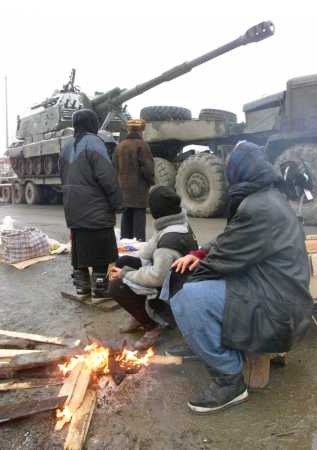
2S19 152-mm SELF-PROPELLED ARTILLERY SYSTEM
The 2S19 is based on a full tracked MBT chassis with the driver at the front, fully enclosed turret in the center and powerpack at the rear and in many respects is similar to the French 155-mm GCT self-propelled artillery system based on an AMX-30 MBT chassis. The hull and turret is of all-welded steel armor construction which provides protection from small arms fire, shell splinters and mines. The 2S19 self-propelled artillery system is based on the chassis of the T-80 MBT but with automotive components of the T-72 MBT as the 2S19 has a distinct exhaust outlet on the left side that is not on the T-80 which is powered by a gas-turbine engine. Mounted under the nose of the vehicle, in a similar manner to that of the T-72/T-80 MBT's, is a dozer blade that can be used to prepare fire positions or clear obstacles. The suspension is of the torsion bar type with six road wheels, idler at the front, drive sprocket at the rear and track-return rollers with the upper part of the track being covered by a skirt. The vehicle commander is seated on the right and operates the roof-mounted 12.7-mm machine gun that can be operated by remote-control and the searchlight. The 12.7-mm machine gun can be used to engage both ground and air targets. Mounted externally on the right side of the turret are boxes of 12.7-mm machine gun ammunition for ready use. Main armament comprises a long-barreled 152-mm gun fitted with a fume extractor and a muzzle brake. When the 2S19 is traveling the ordnance is held in position by a traveling lock mounted on the glacis plate. The 152-mm gun fires an HE-FRAG (high explosive fragmentation) projectile to a maximum range of 24700 m, although using an extended-range projectile its range is probably 36000 m. Other types of projectile can also be fired including illuminating, incendiary, smoke and tactical nuclear. Automation of the loading process enables a maximum rate of fire of 8 rds/min to be achieved using onboard ammunition and 6 to 7 rds/min using projectiles and charges from the ground. This selects and then places the fused projectile into the breech with the charges being loaded semi-automatically. In addition to selecting the projectile from the magazine, the automatic loading mechanism controls the number of rounds to be fired and has built-in test equipment. Laying in elevation is automatic with laying in traverse being semi-automatic. A total of 50 projectiles and charges is carried. Spades are not required on the 2S19 as it is very stable when in the firing position. If required the 2S19 can be reloaded through the turret rear while the system is firing. This enables the system to move off to its next fire position with a full load of ammunition on board. Three smoke dischargers are mounted either side of the turret. A 16 kW autonomous gas-turbine auxiliary power unit (APU) is provided in the turret and this provides power within 30 to 60 seconds of being switched on. This allows the system to be fully operational at temperatures ranging from -50 to +50°C with the main diesel engine being switched off to conserve fuel supplies. Standard equipment includes an NBC system and night vision equipment for the driver.

4
posted on
06/19/2002 10:50:30 AM PDT
by
archy
To: ExpandNATO
OK, explain how a piece of field artillery capable firing all sorts of rounds (high explosive, smoke, guided munitions, etc.) as needed, is replaced by what looks to be a stack of prepackaged munitions, which may or may not have the right mix. Not to mention which is still way early in development. Easy. You have the preplanned mix available, and if something different is needed for a conventional fire mission, can either quickle run an ammo swap with a different preload from one of the ammunition support vehicles on hand, after which that vehicle replaces the original prepoad *cassette* and leaves for a resupply pack. Alternately, in those locations where a semipermanent fire base may be set up, multiple packs of preloaded ammunition can be stowed for different on-call missions [including nighttime illimination, which you left out, as well as nuclear, the let's-hope-it-doesn't-come-to-that choice....] If all else fails, the Crusaders can be loaded up by hand, from a less-capable support vehicle or 5-ton 6x6 truck, just as a M109A5 155mm Paladin is now. Similarly, those preloaded ammunition packages can sometimes be brought to a dispursed Crusader position if the unit is not on the move via helicopter, if the air assets are available at such critical times. But it's the capability of that CSV to reload and refuel the Crusaders and keep them on the move, hopefully clear of counterbattery fire or air strikes, that really makes the Crusader a major advance in SP artillery.
Of course, if the idea is to weaken the US military and hand it over to the UN as a peacekeeping force before the US flag is hauled down, then Crusader is the wrong system to go for. We can use more wheeled armored cars for the Internal Security Police if that's to be the case.
5
posted on
06/19/2002 11:03:25 AM PDT
by
archy
To: archy
In the future we won't rely on the ground pounders. Everything will be GPS or laser guided. If we see a terrorist via satellite he will be exterminated via precision guided munitions. If he is in a cave or camouflaged he is out of the game anyway.
No need to worry about him. We will send over a few drones to find him and blam. Warfare will be so simple when we get modernized. Somehow, I find the BS and propaganda a little too thick to swallow.
6
posted on
06/19/2002 11:14:37 AM PDT
by
meenie
To: archy
I guess I was not clear enough. I was asking the Metalstorm proponent to explain how a Crusader could be replaced by a prepackaged set of munitions.
Disclaimer:
Opinions posted on Free Republic are those of the individual
posters and do not necessarily represent the opinion of Free Republic or its
management. All materials posted herein are protected by copyright law and the
exemption for fair use of copyrighted works.
FreeRepublic.com is powered by software copyright 2000-2008 John Robinson