Posted on 11/09/2026 8:46:33 PM PST by lasereye
The fast-congealing conventional wisdom is that the GOP attempt to re-redistrict didn’t just fail but also backfired on them. In other words, they drew “dummymanders” and ended up worse off than they would have if they’d stuck with the old maps. The reasoning is pretty straightforward: By spreading their voters too thin, Republicans set up a situation in North Carolina where it looks as though the map will produce a 10-4 Democratic edge. The re-redistricting in Texas netted a seat loss, while precipitating a redraw in California that looks as though it will net the Democrats five seats.
I’m not sure that’s correct. I know this sounds crazy, but hear me out.
Let’s first be up front, though: Unraveling these counterfactuals is difficult. There’s an argument that the Supreme Court’s decision cutting back the reach of the Voting Rights Act spurred Black participation in some states, changing the makeup of the districts. There’s also an argument that putting these Representatives in front of new voters weakened their incumbency advantages. We can’t know that the incumbents would have drawn the same type of challenger in their old districts. Some of this is a two-way street (maybe incumbents who won would have drawn even stronger challengers), but regardless, let’s work with what we actually have.
First things first: Alabama, Tennessee, and Florida aren’t dummymanders (their genesis is a bit more complicated than a simple political gerrymandering story as well). Republicans are no worse off than they would have been under the old maps (as of this writing). In fact, Republicans might have lost Florida districts 13 and 15 under the old maps, which ended up more Republican under the new lines.
In Tennessee, it looks as though Scott DesJarlais will lose; he almost surely would have won under the old lines. But Republicans would not have picked up the ninth district under the old lines, so the map is a wash. They will likely pick up a seat in Louisiana after the runoffs.
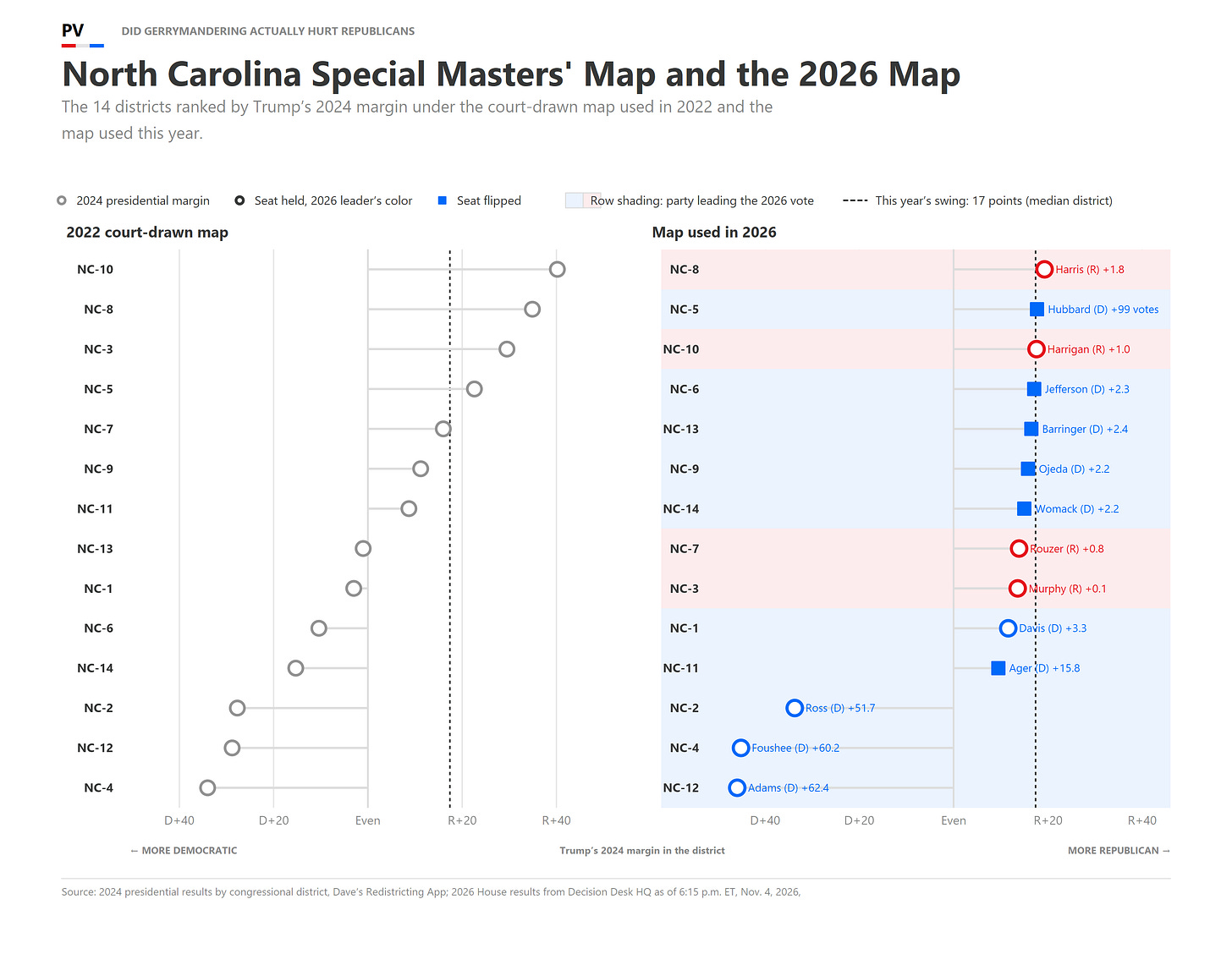
Let’s look at the strongest case for a dummymander. The Supreme Court of North Carolina struck down North Carolina’s initial 2021 map as an unconstitutional partisan gerrymander in 2022. It then imposed one of its own, drawn by a team of special masters. The Supreme Court of North Carolina then reversed itself, declared gerrymandering a non-justiciable issue, and allowed North Carolina to redraw its map. The state did so, producing a 10-4 Republican map. It then redrew again for the 2026 cycle, producing a map that was supposed to be 11-3 Republican.
This is not what happened! Democratic Rep. Don Davis held on by a surprisingly narrow margin. But the rest of the map was a bloodbath for Republicans. As of this writing, six Republicans are trailing their opponents in Republican districts, producing a 10-4 Democratic map (as of this writing).
But this doesn’t answer the question: What would have happened under the old map? Some of those districts would never have been occupied by Republicans in the first place; the delegation was split 7-7 after the 2022 elections. In a wave year like 2026, some of the seats that the special masters drew would have flipped anyway.
So, let’s take a look at this. On the right panel, we explore the map that was used in 2026. I’ve ordered the districts from most to least Republican, and drawn a circle or square at the district’s presidential vote margin (on the x-axis). A red circle means a Republican won it, a blue circle means a Democrat won it, and a blue square shows districts that flipped. I’ve also included the margins. I then compared the margins to the district’s presidential performance in 2024. I then calculated the median swing. In North Carolina, that was around 17.4 points. Note that if a district is to the left of the line but didn’t flip, it’s because the incumbent generated a large enough personal margin that it overcame the general swing in the state as applied to their district, either through persuasion or turnout.
If you then apply that swing to the old map you end up with (drum roll) a 10-4 Democratic map. Again, it is an imperfect method, but as a rough heuristic it is fine.
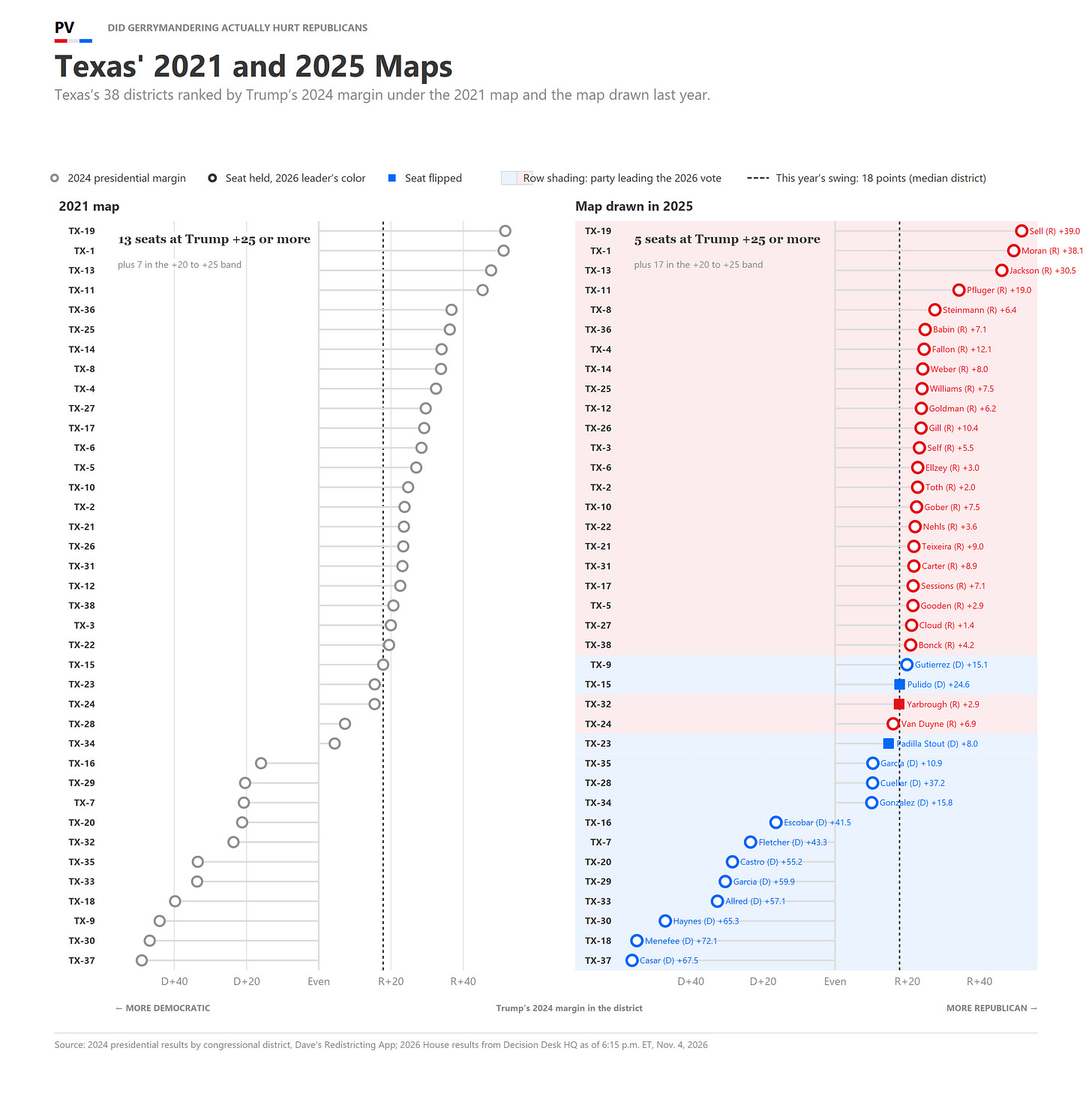
OK, what about Texas? Republicans hoped to add five districts here. Only one of those seats performed, the 32nd. At the same time, Republicans lost the 23rd and 15th districts, for a net loss in the state. But again, the state was a disaster for Republicans, from the top of the ticket to the bottom. The statewide ticket was wiped out, and the state House map failed spectacularly.
Let’s apply the same approach here. As you can see, under the old map, Democrats would have still (obviously) held districts 9, 28, 34 and 35, in addition to 32 (which flipped). But this is the key: Districts 15 and 23 weren’t made weaker due to redistricting. Even without accounting for the margins by which they flipped, those Republicans were probably doomed under the old map as well. The map didn’t perform as well as Republicans had hoped, but it probably didn’t cost them any seats either. (Van Duyne’s actual nine-point margin probably would have saved her either way).
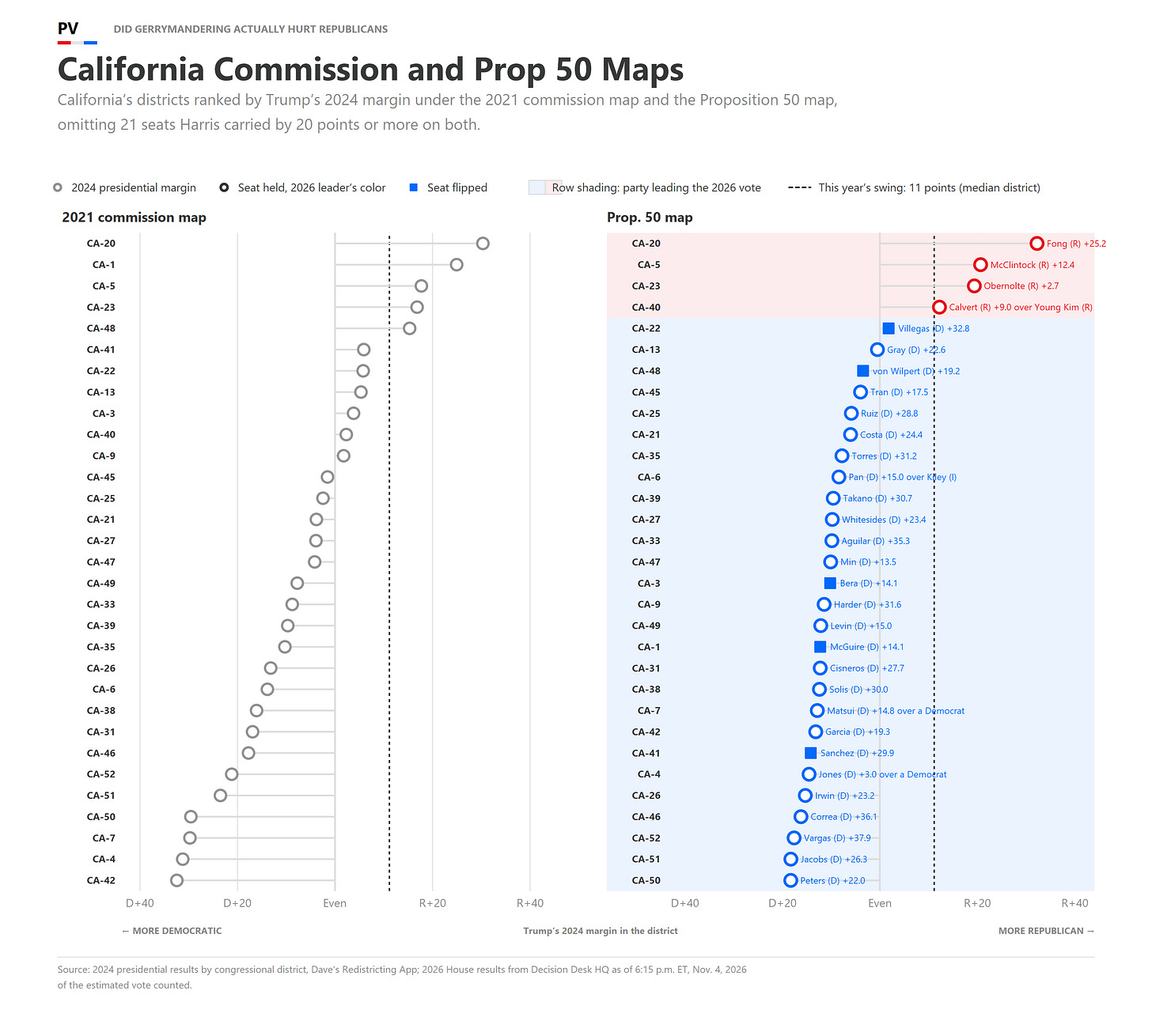
What about California? This is a little harder to unpack, but the state was likely to be a killing field for Republicans regardless of the remap. A simple swing cuts the Republican delegation to five seats under the old Commission map; given von Wilpert’s massive margin of victory, the Republicans could have been reduced to four seats even without the redraw. Given Obernolte’s slim lead, he probably would have lost in the old, less Republican district the Commision gave him, before Prop 50 packed Republicans into it. Redistricting him ironically might have saved Republicans a seat.
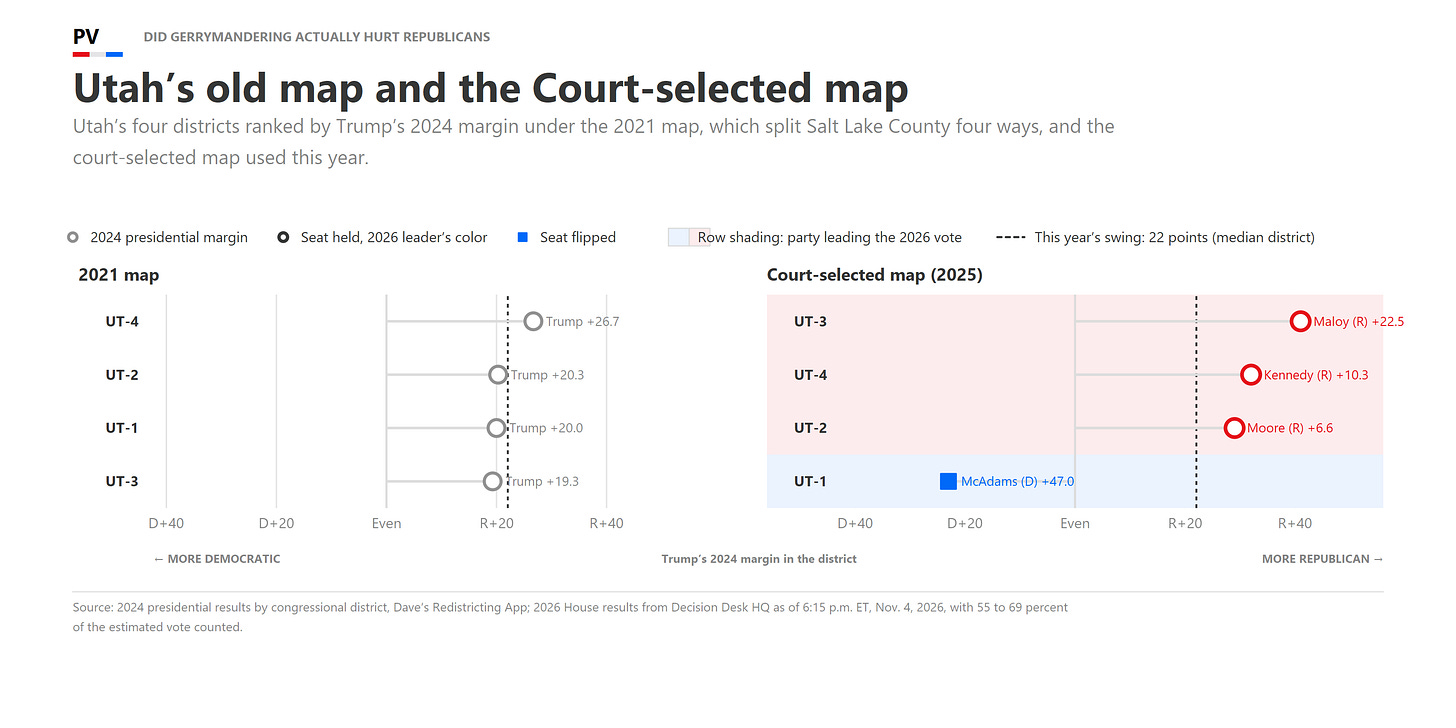
Finally, a reverse case. In Utah, a trial court judge struck down the state’s old map as violating the state’s anti-gerrymandering law. It then imposed a map that packed the Democrats in Salt Lake City into a single district, guaranteeing a Democratic pickup. It also resulted in three hyper-Republican districts in the rest of the state. Utah swung massively against Republicans; even in districts Trump won by well over 20 points, Republicans were winning by relatively narrow margins. What if you applied that result to the old map? It suggests that three Republicans could have lost.
Now, you can fairly object that even taking this analysis at face value, it doesn’t prove that these maps didn’t hurt Republicans. Maybe North Carolina should have drawn a safer version of the old 10-4 map, or even dropped to 9-5. Maybe Texas should have focused more on incumbent protection. That’s fair enough. But these aren’t one-cycle maps, either. Either 2028 or 2030 is likely to be an unfavorable Democratic climate, and under those circumstances, these maps seem likely to perform.
Regardless, this isn’t a definitive analysis; it isn’t meant to answer the question finally (after all, we haven’t even counted all of the votes). It’s just meant to point out that the answer is more complicated than a simple counting of seats would have suggested. The old maps would have performed under wave conditions as well, and it’s not clear they would have held up any worse.
|
Click here: to donate by Credit Card Or here: to donate by PayPal Or by mail to: Free Republic, LLC - PO Box 9771 - Fresno, CA 93794 Thank you very much and God bless you. |
The reason for the unexpected results is that gerrymandering assumes that a geographic area, such as a certain town or county, will vote about the same as they usually do. That didn't happen in this nightmare of an election.
Note that in one of the four states, California, Democrats did the the re-redistricting. He thinks the newly drawn districts may have inadvertently helped save one seat for the GOP in that state. Their gerrymandering made a few heavily Republican districts more heavily Republican. Because it was a wave election, the previously Republican districts that flipped would have also flipped under the old map. Whereas one district that was already heavily Republican (and made more heavily Republican in the new map) might have flipped blue as well if they hadn't messed with it.
When we have a more normal political year (whenever that is) the redistricting will help the GOP, according to Trende.
Yes. And Republicans can’t sustain a future if they keep being viewed as the racist party. And that is what re-districting was framed as.
It was big and it was beautiful, baby. We are going to get 50 new seats.
But the seats were in the overflow room in the tent outside.
Good speaker system to hear the Dems and Socialists in the Capitol really well, though. Dolby Atmos. And the lemon squares are tasty out there.
You may be onto something. When Judge Augustus B. Woodward laid out the streets in 1806 after the Detroit fire in the form of a spoked wheel for the new city of Detroit there is a rumor (unverified) that he was drunk much of the time.

That doesn’t prove that no Republicans switched sides or that the Democrats found millions of new voters. Harris got 75M votes in 2024.
It doesn't prove that Republicans did switch sides or that the RATS didn't fraudulently create all those new voters.
"Harris got 75M votes in 2024."
So why didn't she get 81 million like Joe did in 2020?
Disclaimer: Opinions posted on Free Republic are those of the individual posters and do not necessarily represent the opinion of Free Republic or its management. All materials posted herein are protected by copyright law and the exemption for fair use of copyrighted works.