Posted on 07/13/2026 6:36:53 AM PDT by UMCRevMom@aol.com
CCTV captures civilians taking cover during Russian strike on Sumy in Ukraine
CCTV footage from the Ukrainian city of Sumy captured the moment visitors at a local coffee shop scrambled for cover during a Russian air strike.
The video shows customers rushing toward a safe place after the explosion of a Russian guided glide bomb shatters.
(Excerpt) Read more at apnews.com ...
VIDEO CLIPS
1. 4 Russian Fronts Ordered a RETREAT — Then THIS Happened
Don Khan
Jul 10, 2026
https://www.youtube.com/watch?v=YzVKwvv78E0
Russian commanders may have revealed more through their battlefield orders than Moscow has admitted publicly.
In this military analysis, we examine reports of Russian withdrawal orders across multiple sectors of the Eastern Front and what those decisions could mean for the wider direction of the war in Ukraine.
The key issue is not simply that territory may have changed hands. It is why commanders reportedly chose to pull forces back, abandon prepared positions, reduce defensive perimeters, and shift from offensive staging areas into weaker fallback lines.
This video breaks down the possible pressure points behind those decisions, including manpower shortages, ammunition consumption, vulnerable logistics, encirclement risks, unprepared secondary defenses, and the growing cost of holding exposed positions.
We also explore why an ordered retreat carries such deep institutional meaning inside the Russian military, how battlefield setbacks are often reframed as tactical repositioning, and why soldiers on the ground may understand the reality very differently from the public narrative.
The analysis covers:
Russian withdrawal orders across four sectors
• The difference between retreat and tactical repositioning
• Why fallback positions may be weaker than abandoned defenses
• How retreating forces can surrender valuable trenches and fortifications
• The impact on morale, trust, and command cohesion
• Why multiple independent withdrawals may signal a systemic problem.
• What this could mean for the future of the Eastern Front
This is not only a story about kilometers on a map. It is a story about military judgment, institutional pressure, and the gap between official claims and operational reality.
Battlefield information during wartime can be incomplete, delayed, or disputed. Claims discussed in this video should be compared with independently verified reports and official sources.
2. Trump grants Ukraine license to produce Patriot missiles amid ongoing war
Journal Editorial Report
July 11, 2026
6:43
https://www.foxnews.com/video/6400900028112
Trump grants Ukraine license to produce Patriot missiles amid ongoing war
Paul Gigot discusses Trump’s decision to grant Ukraine a license for Patriot missile production. Seth Jones analyzes the move’s impact on Ukraine’s defense, current battlefield challenges and potential Russian escalation against NATO.
Thanks, Mom.
It’s automatic and a habit with the Russians. Killing civilians is what they do best. And Putin loves it.
Russia probably has the missile and drone sites set on automatic to launch on a daily basis. NO need for troops to do the dirty deeds. Blame the killings on the missiles and drones.
You are more than welcome!
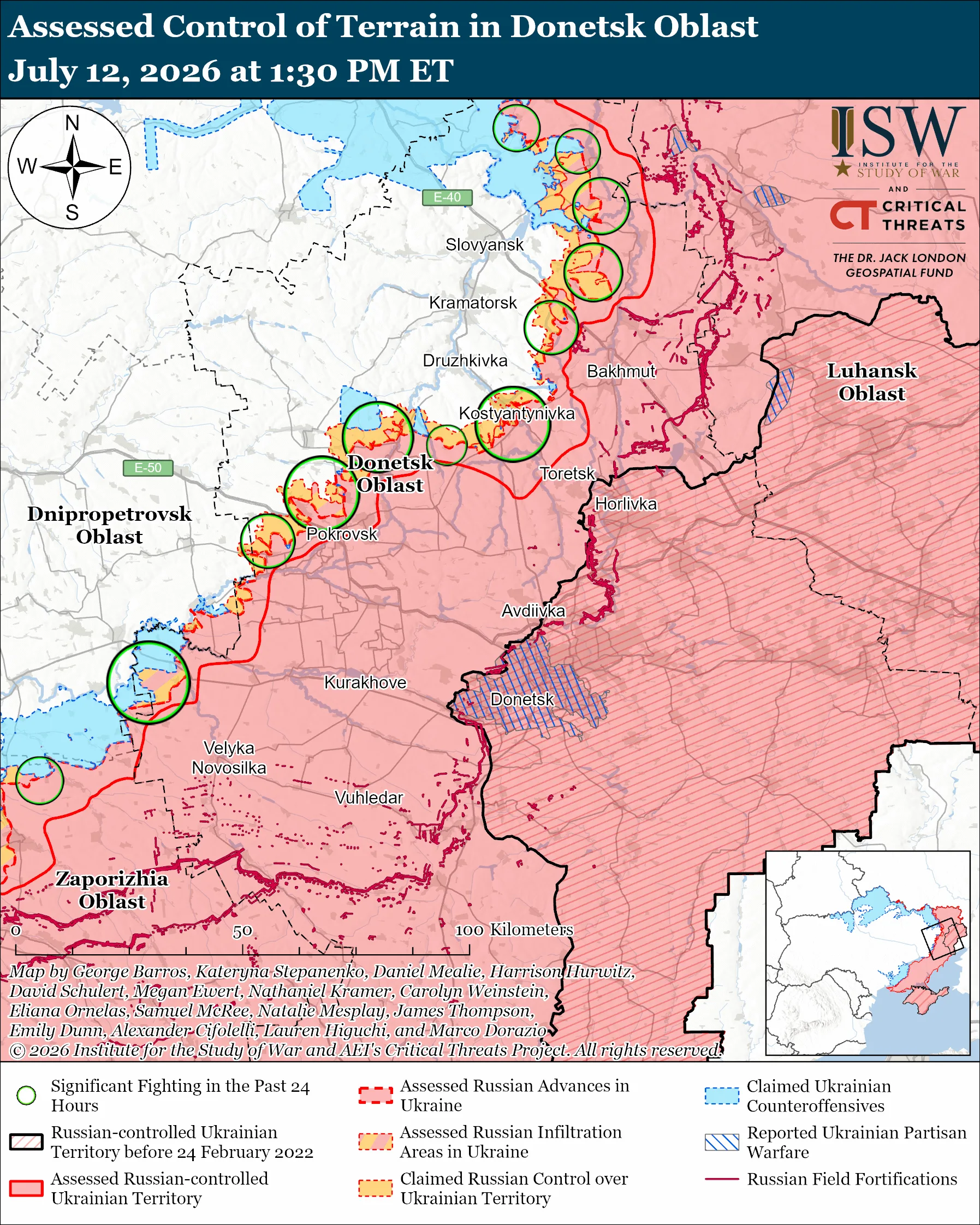
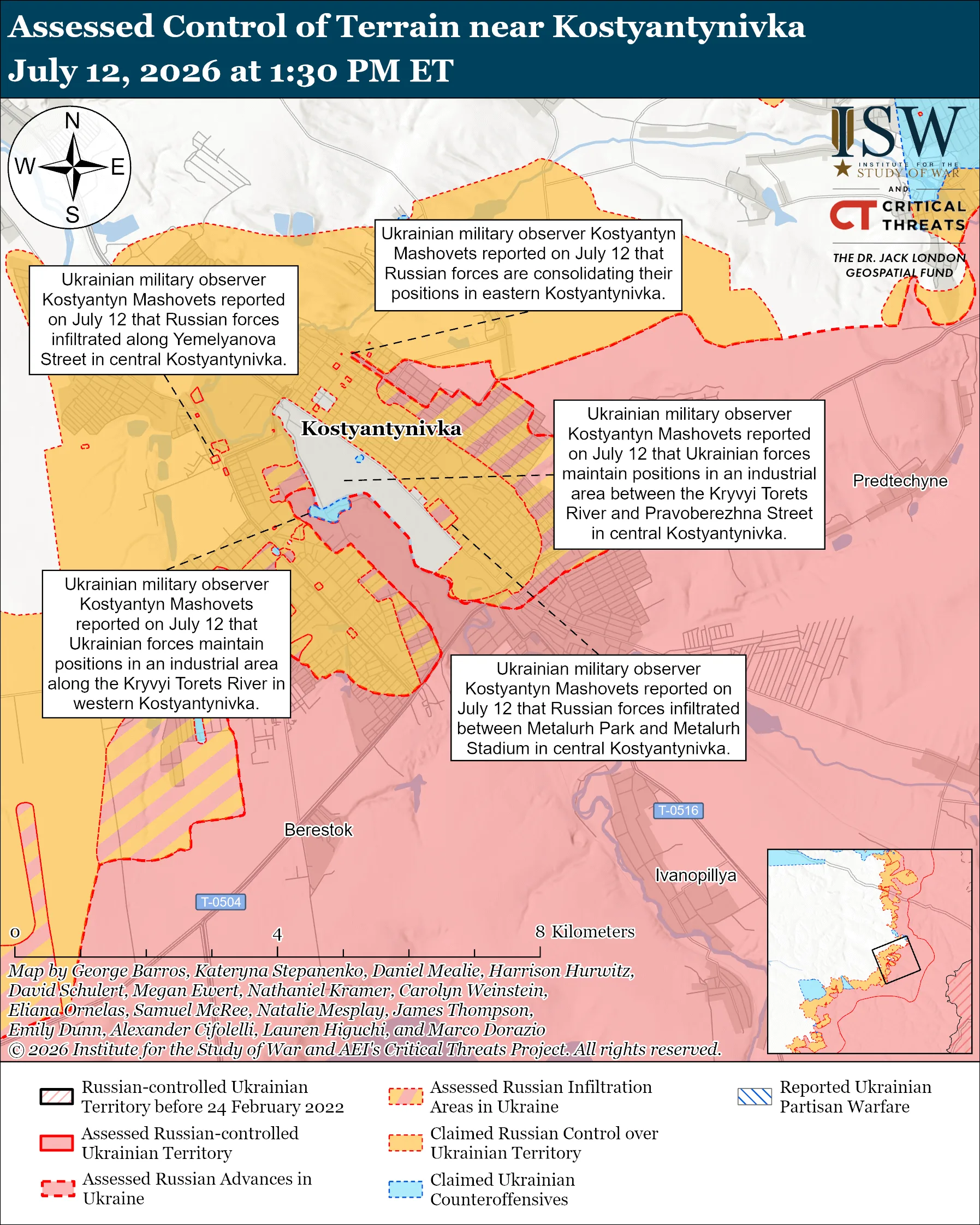
If you've seen like maps before, you know what they show.
VIDEOS
RFU News — Strategic Geopolitics
Transcripts available
🔴 Our Interactive News Map: https://www.rfunews.com/map
⚠️ Watch RFU in 20 languages:
1. Ukrainian F-16s lure a Russian Su-35 jet into a trap in an insane operation
RFU News — Strategic Geopolitics
7-13-2026 1:05 p.m.
Length 5:53 minutes
https://www.rfunews.com/articles/ukrainian-f-16s-lure-a-russian-su-35-jet-into-a-trap-in-an-insane-operation
2. What were they even thinking?
Footage: 101 Russian ships burning in the middle of the sea
RFU News — Strategic Geopolitics
Jul 12, 2026
Length 4:52
https://www.youtube.com/watch?v=y7-OsRchFiA
“In this video, we will analyze how Ukraine destroyed one-hundred-one Russian ships in six days.
Here, Russia thought it could quietly deploy its Shadow fleet to supply Crimea, placing the ships well within Ukrainian striking range while only adding a few machine-gun emplacements to keep them safe. However, this didn’t stop Ukraine from unleashing its most devastating strike on the Russian ships, and in just under six days, the Sea of Azov was filled with more than one hundred burning wrecks.
In total, Ukraine disabled one-hundred-one ships in the Sea of Azov in just six days, including ninety shadow fleet tankers, which were assigned to carry fuel for Crimea. Ukrainian drones first made a fly-by to confirm the targets, then turned around to engage them after they were identified. Ukrainian drone operators aimed for the bridge of the ship because this way the ship loses its navigation systems, making follow-up strikes easier, and forcing the crew to evacuate. As a result of the strikes, the fuel tankers were seriously damaged and were observed to be burning at sea uncontrollably. Ukraine also targeted a ferry and a dry cargo ship, which were carrying supplies to Crimea, and demonstrated that the Sea of Azov is not a safe rear route, which is why it is strange that Russia concentrated so many valuable vessels there.
This high concentration of ships in the Sea of Azov is explained by the fact that Ukraine has already significantly reduced Russia’s ability to supply Crimea by land with strikes on bridges and rail connections. Because of the need for fuel, Russia reassigned its shadow fleet tankers to supply Crimea. These tankers are no longer used for exports as they once were, depriving Russia of export revenue and further reducing Russia’s available tanker fleet. However, this shift in priorities only relocated Russia’s logistical vulnerability from land to sea, and predictably exposed it as concentrated tankers operating in the Sea of Azov remained within the range of Ukrainian drones.
Russia recklessly concentrated valuable tankers in the Sea of Azov without air-defense protection, which is well within the range of FP-Two drones. This allows Ukraine to use its long-range kamikaze drones to strike tankers and ships while they are waiting in a port or on the move because they are slow and large. As Russia’s shore-based air defense systems proved to be ineffective at covering the Sea of Azov, Russia had to come up with an on-board solution. Notably, some of the tankers were carrying a platoon of machine gunners while they were en route to Crimea. Their task was to protect the vessels with small arms against Ukrainian drones, whose speed can reach two hundred kilometers per hour, making them extremely difficult to shoot down.
However, the improvised defense failed in the exact scenario it was supposed to handle, as both tankers were struck by FP-Two drones. The attack happened during the night, which significantly reduced the soldiers’ time to react and their ability to see the incoming threat, making the entire concept of manually shooting drones from a tanker look desperate. This was proven by the drone footage released by the Ukrainians, in which the soldiers can be seen looking in the wrong direction when the drone hit the ship right behind them. These machine-gun platoons were not a serious defense plan, but a sign that Russia had no better protection left, which is why even Russian analysts called the deployment wasteful.
As a result of Russia sending defenseless and slow assets into Ukrainian drone range, the Russian military analysts were outraged because of the lack of protection. They said that the use of these tankers is catastrophic because they are defenseless, even with designated machine gunners, who cannot solve the problem of fast-moving nighttime drone attacks. They stressed that even the Black Sea Fleet had to be withdrawn, and if they could not survive, then civilian tankers with machine guns and without a fleet to cover them had no realistic chance. Russia also cannot replace these tankers because they have no shipbuilding industry capable of building tankers. Because of this, Russia is losing the same ships it now needs for Crimea because its land routes are under pressure.
Overall, the destruction of one-hundred-one ships in just six days demonstrates that Ukraine destroyed six times more Russian tankers than Western partners seized in six months. Russia’s reliance on machine-gun crews aboard civilian vessels highlights that Russia is compensating with desperate measures because it lacks layered maritime protection in the Sea of Azov. Unless Russia develops an effective way to protect the Sea of Azov, Crimea will receive less fuel, and Russia will recklessly burn through vessels with no hope of easily replacing them.”
3. Russian politicians now BEG Putin to stop the war! Russia cannot sustain it for much longer...
Jul 11, 2026
Length 5:59
“In this video, we will analyze why politicians in Russia started begging to end the war.
Here, Russia’s economy can barely sustain the cost of the war for much longer, which is a looming disaster as pressure from the elite is rising and state control is weakening. Now, even Russian politicians are aware of the severity of the problem, begging Putin to stop the war before it breaks Russia.
Recently, a Russian State Duma deputy, Renat Suleymanov, said that the war needs to end now because Russia’s economy cannot sustain the current tempo. He also stressed that forty percent of the federal budget already goes to defense and security, which is crowding out normal spending. Defense spending is also driving inflation, which is officially five percent, and forcing cuts in civilian spending. Suleymanov warned that even after the war ends, Russia will face problems reintegrating hundreds of thousands of returning troops who experienced extreme violence, and that Russia will still carry these costs after peace.
Because of the combined budget, manpower, and infrastructure problems, the Russian economy can barely sustain the war at this intensity. Notably, Russian losses have exceeded one point four million casualties in the war, including dead and wounded, according to the Ukrainian general staff. This is critical because this year, Russia was unable to recruit as many soldiers as it lost from month to month, which means that the size of its army is now decreasing. At the home front, Russia’s layered air defense system can no longer defend all critical infrastructure, because from the start of this year, Russia has lost almost two hundred air defense systems. This leaves Russia’s refineries and export infrastructure undefended against Ukrainian strikes. Ukraine exploited this and reduced Russia’s export capacity and even forced it to import finished oil products. Because of these strikes, Russia’s oil revenue is collapsing, which is why Russian officials are warning that the current tempo is unsustainable.
Against this backdrop, Zelensky sent an open letter to Putin, but the message was aimed at the war weary Russian elite, who have money, networks, and institutional access, making them dangerous for Putin. The proposal for a meeting was part of Kyiv’s attempt to highlight Moscow’s economic weaknesses and prove that Russia is not invincible, as also shown by the emergence of harsh criticism from Russian officials. The letter was intended to draw the attention of Russia’s elite to the fact that they are losing billions of dollars because of asset seizures and sanctions and to make them see the war as a personal financial threat, not just a national burden.
As a result of the economic and war related problems, Putin is slowly losing his control over the narrative and the expectations of the elite, not necessarily control over the state. Officials and business leaders are increasingly seeing events unfolding independently of Putin’s decisions, which suggests that the Kremlin has lost its control over defining the country’s future and that pressure is growing among the elites. This shift is being driven by the mounting costs of a war that was originally planned as a quick victory but has become impossible to ignore for the Russians. Russia’s business elite are demanding greater predictability because Western sanctions forced them to bring their assets back to Russia, and they had to watch five trillion rubles worth of private assets be confiscated over the past three years. Because of this, they increasingly want clear rules, stronger property rights, and confidence in the country’s economic future, which is deteriorating because of the war. At the same time, the informal social contract between the Russian state and society has collapsed because, previously, the government largely stayed out of citizens’ private lives in exchange for political passivity. Today, that arrangement has been replaced by expanding repression, mobilization, and increasing state control, with widespread internet restrictions serving as one of the clearest examples. As a result, the Kremlin finds itself in a self-defeating cycle, and the current system can endure only as long as Putin remains in power, yet every measure he takes to preserve and strengthen it ultimately accelerates its long term decline.
Overall, the pressures facing Russia are no longer confined to the battlefield but have expanded to the home front as well. The economic decline, combined with increasing elite dissatisfaction, is reinforcing itself, making the problem even worse for Putin. The longer Putin continues the war, the more the war itself becomes the force weakening Russia from within.”
4. Russians beg Ukrainians to stop shooting at them as their dead pile up around them
RFU News — Strategic Geopolitics
7-11-2026
Length 6:09 minutes
https://www.youtube.com/watch?v=UhGG5jNBwpw
“In this video, we will analyze how false Russian claims ended in the biggest disaster of the year.
Here, Russia is claiming the city of Kostiantynivka has been captured, and the Ukrainian defense has been overrun. However, piles of Russian bodies and Russians begging Ukraine for a ceasefire suggest something else is happening, as Ukraine found a devastating way to answer Russian claims.
High-ranking Russian officials claimed up to ninety-six percent of Kostiantynivka is under Russian control, presenting staged flag-raising videos in the northern districts as proof that Ukrainian units holding the area have collapsed. Yet Ukrainian footage shows something completely different, as geolocated videos demonstrate Ukrainian troops operating across northern, central, and southern parts of the city, while active fighting continues throughout the town. Still, official Russian sources continue to insist that only isolated Ukrainian holdouts remain in basements and peripheral districts, with their clearance being only a matter of time. Despite these claims, even Russian military analysts now compare the announcement about Kostiantynivka capture to the fake capture claim of Kupiansk in November of last year. These doubts are confirmed by Russia’s own artillery footage showing active shelling of Ukrainian positions in areas that the Russian military claims is under full Russian control.
This goes further than just the public backlash from their own side, as in response to the Russian claims, Ukrainians massively intensified their shelling of Russian positions as punishment. Geolocated footage shows a Ukrainian Mig Twenty-nine is destroying a building used as a Russian drone base, while a Ukrainian Mirage Two-thousand struck a substation where Russian infantry was massing for further assaults. Ukrainian artillery has been continuously buildings used as infiltration hideouts, while heavy bomber drones, FPV, and reconnaissance drones monitor every approach and attack every movement.
As a result, Russia’s premature victory claim has made the disaster worse, as the Russian command was forced to sending new infiltrators forward in large numbers. Just like what happened around Kupiansk, Russian commanders now face immense pressure to make reality match their false symbolic claims, as soldiers are sent forward to hold on to the claim that the city is under Russian control. Instead, Ukrainian drones, artillery, and aircraft hunt them while they move between ruins, attempt to reinforce positions, or wait for orders.
The clearest evidence about how things really are on the ground comes from the Russians themselves, as footage filmed by a Russian assault soldier shows him moving along what has effectively become a path of death. Dozens of Russian bodies lie within meters of each other, piled along both sides of the route into Kostiantynivka. The approaches and the streets are becoming a graveyard in which the infiltrating Russians have nowhere to hide from the Ukrainian drone strikes.
The losses have become so severe that the Russian Defense Ministry has now begged Ukraine to halt its shelling of the city. Russians claim they want to stop Ukrainians shooting, so that they can supposedly evacuate civilians and recover bodies. However, the real reason is that a ceasefire would silence precisely the Ukrainian strike-and-search system that prevents Russia from gaining control of Kostiantynivka. The humanitarian pretext is an excuse to indirectly beg Ukrainians to stop shooting at their overwhelmed soldiers, as such significant losses are causing footholds to slip out of their control.
This is particularly distrustful, as Russia did not demand a ceasefire while its bombs and drones were destroying Kostiantynivka as the siege began. It was Ukraine that conducted the civilian evacuations, dedicating sparse armored vehicles under great risk to move residents out of the town. It was Ukrainian soldiers who had to clear Russian drones laying in ambush on the evacuation roads out of Kostiantynivka, while Russian operators attacked any movement regardless of whether vehicles carried soldiers or civilians. Only when Russian bodies began piling up did their commanders begin begging Ukraine for a pause to the fighting.
Overall, the Russian capture claim serves a political purpose, strengthening Russia’s position before the world audience. But the Russian command has repeatedly shown that after announcing imaginary victories, it will sacrifice thousands of soldiers trying to make them real, and Kostiantynivka is becoming the next example. Russia declared victory, intensified infiltrations, and watched its troops die faster, then effectively started asking Ukraine to stop firing long enough for them to advance...”
5. It has started: Russian men are ambushed and loaded onto buses, sent to the army
7-9-2026
Length 6:29 minutes
https://www.youtube.com/watch?v=eG5-qJ6AVew
“In this video, we will analyze why Russia is on the brink of launching full mobilization.
Here, the Kremlin is running into a growing manpower problem, as recruitment slows, battlefield losses keep rising, and the one advantage Russia still depends on starts to weaken. As that pressure builds, Russia is moving closer to the point where paying men to join is no longer enough, and taking them by force becomes unavoidable.
Footage from Russia already shows how forced mobilization is conducted in the open, as men in Penza were taken off the streets and loaded into a minibus outside a military enlistment office. Mothers and wives surrounded the vehicle and tried to block it from leaving, as one woman became ill from stress and another cried that they had not even given her five minutes to say goodbye to her husband. Additional reports from the area also describe security forces stopping cars and public transportation, taking men to enlistment offices, and forcing them to sign contracts to be sent to the front lines. This shows that the authorities are no longer relying only on incentives and formal recruitment channels, but are beginning to pull manpower more directly from the population.
Those scenes become even more significant as the administrative side of this mobilization process had been moving at a breakneck speed in the weeks prior. In the Volgograd region, Russian officials from across the Southern Federal District were recorded gathering for a conference to discuss how best to implement forced mass-conscription into the army, updating and preparing the necessary procedures and staff. So-called realistic exercises were part of these preparations as well, including the handling of citizens already pre-selected for mobilization, the dispatch of draft notices, the transfer of vehicles and equipment, and how to conduct targeted mobilization inside major enterprises.
The reason this mobilization effort is now taking shape is because a superiority in manpower is the only major advantage Russia still has left over Ukraine. In most other areas, Ukraine now has a sound lead over the invading Russian forces. Ukraine’s drone industry produced four and a half million drones last year, and that scale is now giving Ukrainian forces a denser and more persistent presence in the air along the front. That allows them to keep Russian movement under closer surveillance, conduct more FPV strikes, and shift more supply work onto unmanned systems instead of exposing their own soldiers to constant attrition. At the same time, Ukrainian forces place far greater emphasis on preserving manpower, so operations are approached more carefully and evacuation efforts are pushed further, which helps Ukraine keep more soldiers alive and prevent avoidable losses after the fighting. As a result, Ukraine is losing fewer of its own soldiers while steadily driving Russian losses higher, leaving manpower as the one major advantage Russia still has left to lean on.
That is why Russia now needs mobilization to preserve the one advantage it still has left, because it is no longer bringing in enough men through so called voluntary recruitment alone. A new report shows that Russia is now recruiting only around eight hundred soldiers per day, down from roughly one thousand to one thousand two hundred per day the year before. At the same time, Ukraine is dealing around one-thousand-two-hundred Russian casualties per day, which means it is now inflicting losses faster than Russians can replace them. What makes this even more telling is that the slowdown comes despite already absurdly high enlistment bonuses, which in some cases have reached around thirty thousand euros, or roughly thirty-four thousand dollars. The Kremlin has even had to add debt relief for recruits and their families in an effort to make enlistment more attractive. That shows Russia has already spent heavily to avoid broader mobilization, and is still failing to generate enough manpower through incentives alone.
Those mounting casualties are steadily bringing mass mobilization back to the center of the war. As Ukraine drives Russian losses higher, it becomes harder for the Kremlin to keep weakened units filled through contracts and cash alone, especially as recruitment slows despite record high incentives. With losses now outpacing replacement, a broader draft stops looking like a political risk Moscow can keep postponing and starts looking like the only way to keep the front from thinning out under its own weight.
Overall, Russia is moving toward a stage of the war where preserving manpower will require steadily deeper coercion inside the country itself. That will make any new wave of mobilization more destabilizing, because the Kremlin will be drawing more directly from a population that has been shielded from the full burden of the war. At the same time, sending larger numbers of men INSIGHTAinto the army will not solve the deeper weaknesses in logistics, equipment, and battlefield effectiveness that are already reducing the value of Russia’s numerical advantage.
That means every new draft wave may hold the front together in the short term while leaving Russia weaker over time as the war drains more men and places a heavier burden on the Russian society itself.”
You could reduce the size of the post (a lot) to make it more readable.
FUNNY VIDEO!
https://www.youtube.com/watch?v=U9PlUmMNnGo
A Russian military training exercise nearly ended in disaster after an improvised anti-drone weapon system violently spun out of control while firing.
The viral footage shows soldiers testing a YakB-12.7 four-barrel rotary machine gun originally designed for the Mi-24 Hind attack helicopter. The powerful aircraft weapon had been mounted on an improvised ground platform for use against drones.
But seconds after the gunner opened fire, the extreme recoil and torque caused the entire weapon mount to rotate uncontrollably.
The gunner was thrown around as the weapon sprayed rounds across a wide area, forcing nearby soldiers to duck for cover in a terrifying near-miss.
The YakB-12.7 can reportedly fire thousands of rounds per minute and was originally designed to operate from a stabilized helicopter turret. Mounting such a powerful weapon on a lighter improvised platform without adequate stabilization can create serious control problems.
The footage has quickly gone viral online, drawing attention to Russia’s efforts to adapt older aircraft weapons for use against Ukrainian drones—and the risks involved when improvised military systems fail.
ON FACEBOOK AS WELL!
“training of the Russian mobile fire group who tried to use the aviation machine gun ський-12,7 (index grau - 9-A-624, factory index - TKB-063), but Russian “kulibini” did not teach physics well at school, so they got analogovnětnaya “carousel”.
The video recorded (un) successful launch of the four-wheel rotary machine gun YakB-12,7, which is the regular weapon of shock helicopters Mi-24.
The firing rate of this system reaches 5,000 shots per minute, but it was designed to operate as part of an aviation complex. Attempts to install it on the ground mobile platforms without proper engineering adaptation can lead to similar incidents, which we all welcome and encourage to scale up in the work of the Russian Ministry of Internal Affairs.”
Good videos, thanks
Curious how many ships Russia has to waste on this suicide strategy
Ukraine is winning. Great news. Now they don’t need help from us anymore.
And all the Ukrainians can leave Poland and return to their own country.
“And all the Ukrainians can leave Poland and return to their own country”
And maybe, someday, they’ll pay us back for all the aid we gave them. Huh? what? Well, one can dream, can’t one?
CONSIDER:
The U.S. Congress passed, and President Joe Biden signed, the Ukraine Democracy Defense Lend-Lease Act of 2022: to supply military, economic and humanitarian aid to Ukraine in its defense against the Russian invasion of Ukraine.
Roosevelt explained that the ‘Lend-Lease’ plan was comparable to lending a garden hose to a neighbor whose house is on fire.
“What do I do in such a crisis?” the president asked at a press conference. “I don’t say ... ‘Neighbor, my garden hose cost me $15; you have to pay me $15 for it’ ... I don’t want $15—I want my garden hose back after the fire is over.”
Senator Robert Taft (R-Ohio), responded: “Lending war equipment is a good deal like lending chewing gum—you certainly don’t want the same gum back.” LOL
ARTICLES
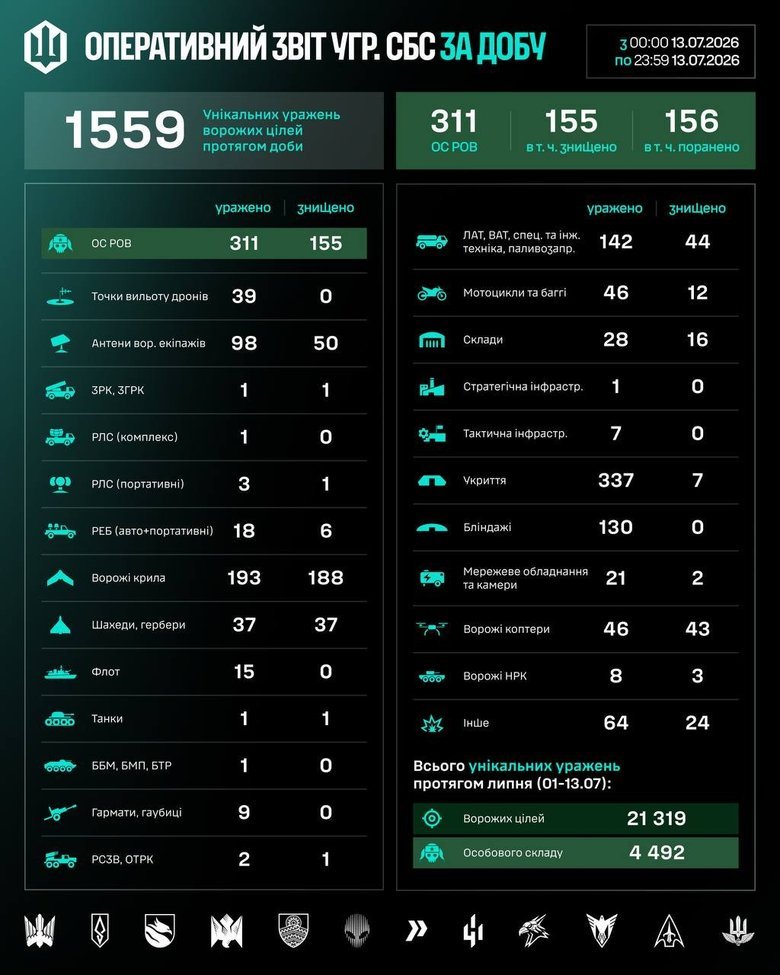
1. USF struck 15 Russian Federation vessels and over 1,500 targets in past 24 hours, - USF Commander Brovdi.
14.07.26 11:00
https://censor.net/en/n4013360
Over the past 24 hours, the Ukrainian military has struck 15 Russian vessels and over 1,500 other targets, and has killed or wounded 311 invaders.
According to Censor.NET, this was reported by Robert (Madyar) Brovdi, commander of the Unmanned Systems Forces.
More news on the Censor.NET Telegram channel
According to Madyar, Ukrainian drones struck 15 Russian vessels over the past 24 hours, though details of these strikes are not currently being disclosed.
What targets were destroyed by Ukrainian drones?
In addition to vessels, the following were targeted by the Unmanned Systems Forces:
• 39 launch sites for Russian drones;
• 9 guns and howitzers;
• 337 shelters;
• 130 dugouts;
• 46 copters;
• 8 ground-based robotic systems (UGVs);
• 18 electronic warfare systems;
• 3 radar stations;
• 8 crew-mounted antennas.
.
.
2. Operation “Crimean Switch”: Unmanned Systems Forces disable Kuban–Crimea energy bridge and destroy S-400, Pantsir and Tor systems. VIDEO
13.07.26 19:35
https://censor.net/en/v4013274
Ukraine’s Unmanned Systems Forces carried out the large-scale “Crimean Switch” operation, striking energy infrastructure and air defence systems belonging to the Russian occupation forces in Crimea and the temporarily occupied territories.
According to Censor.NET, on 12–13 July, Ukrainian drone operators struck 11 energy facilities, including nine electrical substations, a strategic electricity transfer node of the Kuban–Crimea energy bridge and a gas pumping station.
More news on the Censor.NET Telegram channel
In addition, five key elements of Russia’s air defence were struck.
Footage released shows the destruction of an S-400 Triumf air defense system launcher, a Tor-M2 surface-to-air missile system, a Pantsir-S1 surface-to-air missile and anti-aircraft artillery system, and two Nebo-U radar stations.
The operation involved units of the 414th Separate Unmanned Systems Brigade “Birds of Magyar,” the 413th Unmanned Systems Regiment “Raid,” the 1st Separate Unmanned Systems Centre, the Phoenix UAS Group and the 20th Separate K-2 Unmanned Systems Brigade.
According to the Unmanned Systems Forces, the strikes targeted facilities in temporarily occupied Crimea, as well as in the Donetsk, Luhansk and Zaporizhzhia regions.
VIDEO LINK:
https://videos.cnscdn.com/a/8/2/c/a82c7ce36c7700aa4f5e694487799971/original.mp4
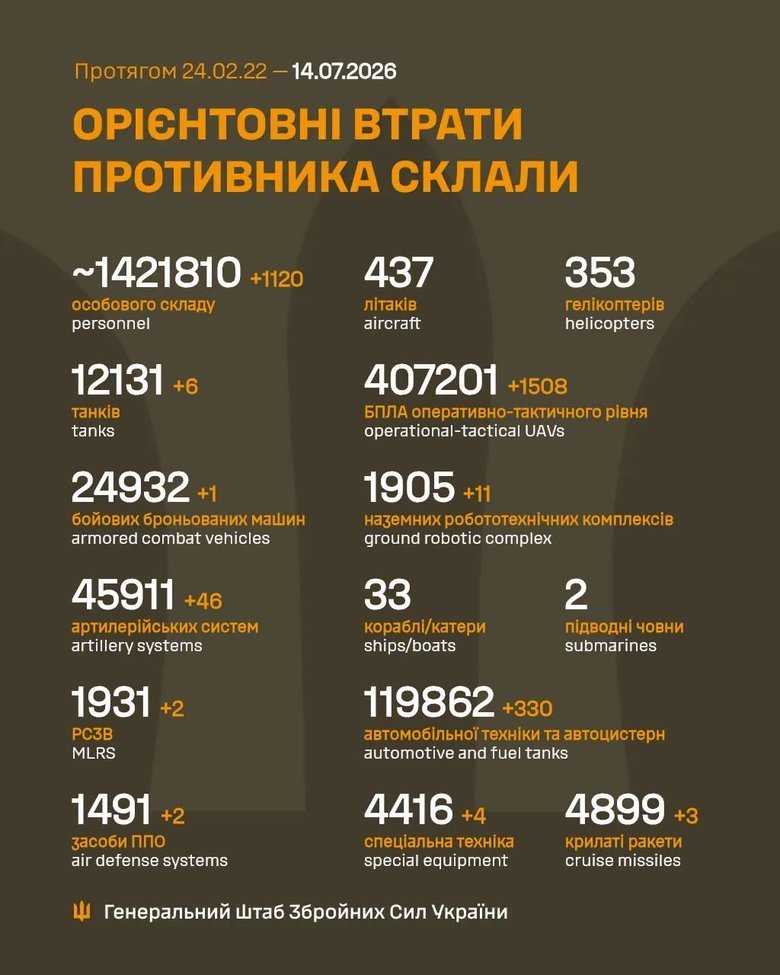
Russian Federation’s total combat losses since start of war are approximately: 1,421,810 personnel, 12,131 tanks, 45,911 artillery systems, and 24,932 armored vehicles.
https://censor.net/en/n4013329
14.07.26 08:43
• personnel – approximately 1,421,810 (+1,120) (killed and wounded)
• tanks – 12,131 (+6) units
• armored combat vehicles – 24,932 (+1) units
• artillery systems – 45,911 (+46) units
• multiple launch rocket systems – 1,931 (+2) units
• air defense systems – 1,491 (+2) units
• aircraft – 437 (+0) units
• helicopters – 353 (+0) units
• ground-based robotic systems – 1,905 (+11) units
• UAVs of operational and tactical level – 407,201 (+1,508) units
• cruise missiles – 4,899 (+3) units
• ships/boats – 33 (+0) units
• submarines – 2 (+0) units
• vehicles and tanker trucks – 119,862 (+330) units
• specialized equipment – 4,416 (+4) units
Disclaimer: Opinions posted on Free Republic are those of the individual posters and do not necessarily represent the opinion of Free Republic or its management. All materials posted herein are protected by copyright law and the exemption for fair use of copyrighted works.