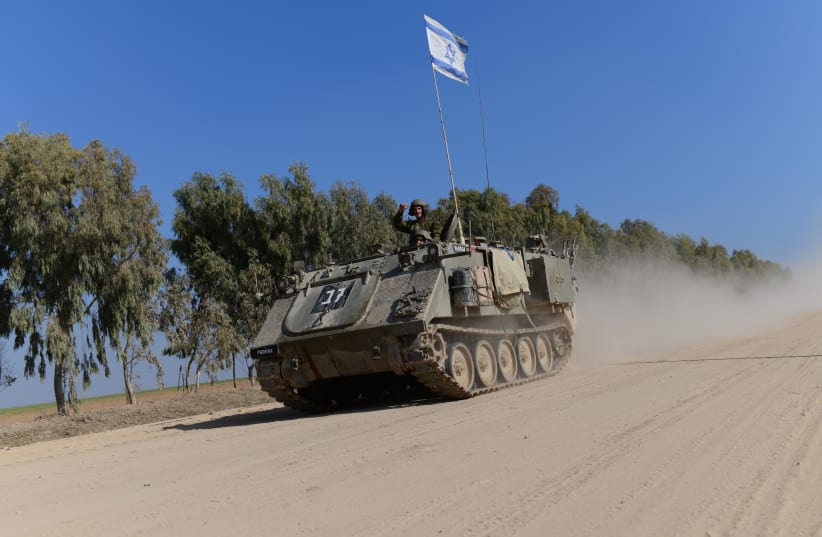
IDF armored forces at a staging area in southern Israel near the border with Gaza. January 01, 2024.
Posted on 05/29/2024 6:10:37 AM PDT by SJackson
IDF armored forces at a staging area in southern Israel near the border with Gaza. January 01, 2024.
A report posted on social media claimed to show an unmanned Israeli M113 armored personnel carrier moving around in an area near Rafah. A video and accompanying photos showed the M113, which is considered an obsolete and old armored vehicle platform vulnerable to anti-tank weapons and RPGS, moving slowly in semi-urban terrain.
Other comments on social media said that the M113, which is also known as a “Zelda” in Hebrew, claimed the vehicle was unmanned and that this new technology had been used since the war began. Discussion on the social media platform X, formerly known as Twitter, say these unmanned armored personnel carriers (APCs) have played a key role in the battle for the Philadelphi corridor in Rafah, the area that runs for seven miles along the border of Gaza and Egypt. The unmanned APCs have been used to move further west along the corridor, extending operations towards the sea. The IDF has been trying to find ways to repurpose the M113s for years. After 2014, it was decided to replace the aging system, which was first introduced in the 1960s. The vehicles are small, slow, and vulnerable to anti-armor weapons. However, they can be used in all types of auxiliary roles. For instance, they can be used in rear areas.
They can transport people. Israel has hundreds of active M113s and thousands in army depots that it can use, but the platforms are aging. Finding ways to make them relevant, rather than just let them collect dust, has been a challenge. One role for them was to put mortars on them so they could be used for firing 120 mm. mortars. Israel isn’t the only country trying to upgrade M113s. A report at Israel Defense earlier this year said Greece was turning to Israel to upgrade its own fleet of around 600 M113s. Devices that can be operated using remote control Back in January the website Globes noted that “there are devices that enable armored vehicles to be operated by remote control. One of them, manufactured by several companies including Elbit, is a system that is mounted on a heavy vehicle, like an APC, and with which you can be driven remotely. It’s a troop carrier without a driver, which has other things that a remotely piloted vehicle can be used for, especially in a terrorist-infested environment.” It is not clear if this is related to the latest reports on social media from Rafah.
Other countries have sought to turn their M113s into Remote Control Vehicles or Robotic Combat Vehicles. A report at the website Engineering.com noted in October 2023 “four defense contractors will each supply two working prototypes of remote control vehicles (RCVs, aka tank drones) to the US Army for three different types of tanks – one small and expendable version (RCV Light), a medium version (RCV-M) and a large version (RCV Heavy) – the latter an automated version of the M1 Abrams.”
Australia did the same thing, according to an April 2024 report at online Army Recognition. “Electro Optic Systems (EOS), a defense company based in Canberra, equipped the M113 APC with its R400 remote weapons system for the trials, which took place in the Puckapunyal Military Area. This initiative is part of a broader project by the army aimed at transforming the M113 APCs into autonomous or optionally manned combat vehicles, named M113 AS4.” The War Zone website also reported in 2022 that “a photo posted to Twitter by Ronkainen shows what is identified as a version of BAE Systems’ Robotic Technology Demonstrator based on an M113 hull that has been cut down. The lower profile is evident because the engine hatch hinge is now above the top line of the vehicle.” This “uncrewed” vehicle showed up at the US Army’s EDGE 22 technology demonstration at Dugway Proving Ground in Utah. The fact that the M113s have been reported spotted in the Rafah operation is also interesting, because the IDF’s new Eitan APCs, the super-modern wheeled replacement for the M113, has been active in Rafah as well with the Nahal brigade. The Eitan was developed to replace the M113 and it was first produced in 2020 and began to be delivered to soldiers in the fall of 2023, just before the war. The Eitan is a large-wheeled vehicle that looks futuristic and can carry 12 soldiers at speeds up to 90 kph, making it fast and maneuverable compared to older treaded APCs, like the IDF Namer, which is based on a heavy tank chassis. The reports of the use of unmanned M113s is part of a much larger story about new technology in the Gaza war. The IDF has been rolling out – and using for the first time – several new systems, from new smart gunsights to precision mortars. Many of these technologies were already under development or had been deployed in their initial stations. The war has accelerated the need and use of these systems to protect soldiers and provide more information to commanders and more precision fire to eliminate threats.
Hopefully not controled by artificial intelligence by Google.

An unmanned Armored Personnel Carrier. Is that an oxymoron?
Kind of, particularly with a pic showing a human driver. Note the article mentions a remote control M-1 Abrams.
Might be fun to load about 2,000-3,000 pounds of high explosive inside a remote control M113, and then drive it into an area where you suspect there are militants with RPGs...
And the purpose of all of those to drive Jews out of Israel a few kilometers at a time. That’s actual genocide.
Here’s hoping none of the illegals entering this country don’t have the knowledge to install this technology on vehicles. I’d speculate with the knowledge, the necessary parts are available here.

Yes. But you still need humans to operate them, at far less risk. And to occupy the objective in this case, but not always.
Yes, but for Israel likely too much risk of civilian casualties.
You can combine M113s to make a huge command center.
Of course, I never should have sold that car, but that is another issue.
A new entry for my book of oxymorons for the ignorant: “precision mortar”.
I actually worked on the GDC4S program back in 2003/2004 to upgrade M113 and 5-ton’s to be MTOC’s (Mobile Tactical Operations Center). Lots of new category 5E and fiber optic cabling in the M113’s, and to connect the various vehicles together.
Did all that up at Fort Hood, in Killeen, TX. Whatever the new name is “Fort Cavazos”?) now, anyway.
You had about the very first sequential turn signals. What an innovation that was!
But “Armored Personnel Carrier” is a descriptive name. They are modifying and upgrading the old obsolete APCs to radio controlled vehicles. To avoid confusion, I guess they are continuing the use of the old “APC” nomenclature.
The name Armored Personnel Carrier is descriptive in a generic sense, but the Israelis gave their version the name "Cheetah." In any event, under local names and whether in US, IDF, or other military service, the M113 has often been modified and used other than as a troop hauler.
Indeed, being tough and reliable, a lot of M113s are still in military inventories even if in reserve behind more modern armored vehicles like the Bradley or Striker. The M113 is just too good to scrap entirely.
I was out with my son the other day (he’s 33) and we saw a modern car with sequential tail turn signals. I told him the ‘67 Mercury Cougar was the first to have that (maybe it was ‘66?). He was impressed that a car from the mid-60s would have that innovation.
BiBi will enter Mop Up operations soon.
In that era, the rear turn signal took a device in the trunk that was the size of a small box of tissues and containing a printed circuit board with a clutch of resistors and capacitors. For the day, that was high tech.
Disclaimer: Opinions posted on Free Republic are those of the individual posters and do not necessarily represent the opinion of Free Republic or its management. All materials posted herein are protected by copyright law and the exemption for fair use of copyrighted works.