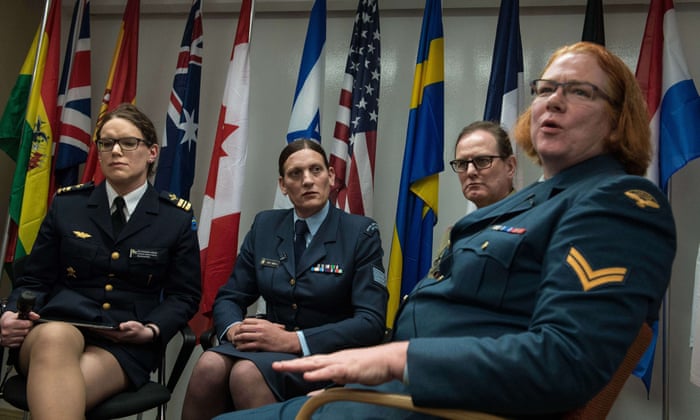
Absolutely! NATO commanders are ON IT!
Posted on 05/22/2023 2:50:25 PM PDT by marktwain
Executive Summary
THE SCALE OF Russian losses in 2022, combined with the Armed Forces of the Russian Federation confronting NATO systems they had not previously contended with, has caused a significant deviation in Russian operations from the country’s doctrine. This report seeks to outline how Russian forces have adapted their tactics in the Ukrainian conflict and the challenges this has created for the Ukrainian military that must be overcome. The report examines Russian military adaptation by combat function.
Russian infantry tactics have shifted from trying to deploy uniform Battalion Tactical Groups as combined arms units of action to a stratified division by function into line, assault, specialised and disposable troops. These are formed into task-organised groupings. Line infantry are largely used for ground holding and defensive operations. Disposable infantry are used for continuous skirmishing to either identify Ukrainian firing positions, which are then targeted by specialised infantry, or to find weak points in Ukrainian defences to be prioritised for assault. Casualties are very unevenly distributed across these functions. The foremost weakness across Russian infantry units is low morale, which leads to poor unit cohesion and inter-unit cooperation.
Russian engineering has proven to be one of the stronger branches of the Russian military. Russian engineers have been constructing complex obstacles and field fortifications across the front. This includes concrete reinforced trenches and command bunkers, wire-entanglements, hedgehogs, anti-tank ditches, and complex minefields. Russian mine laying is extensive and mixes anti-tank and victim-initiated anti-personnel mines, the latter frequently being laid with multiple initiation mechanisms to complicate breaching. These defences pose a major tactical challenge to Ukrainian offensive operations.
Russian armour is rarely used for attempts at breakthrough. Instead, armour is largely employed in a fire support function to deliver accurate fire against Ukrainian positions. Russia has started to employ thermal camouflage on its
(Excerpt) Read more at static.rusi.org ...
It does not claim either Russia or Ukraine will win this conflict.
are we prepared for fighting this force?
For Ukraine’s international partners, supporting Ukraine in liberating its territories is arguably
shifting from an emphasis on key systems, to the need for dedicated training and the assurance
that equipment provided to the Ukrainian military can be sustained. Tactics will be critical to the
effective disruption of Russian forces and their eventual defeat. “
Of course, an objective evaluation of Russian forces is a very strong weapon against Russian forces, as it allows a Russian foe to "know the enemy".
“In the attack, disposable infantry are the first to be employed. Disposable platoons are assigned to those avenues of approach to Ukrainian positions that are deemed to offer some cover and thus could prove viable. Although these have been described colloquially as ‘human wave attacks’,11 they no longer involve a dense concentration of infantry conducting an assault in a single mass.
Rather, a disposable fire team of two to five personnel is sent from a forming-up position in the Russian front line and advances to contact. There may be up to five fire teams pushed across an axis at any one time, but normally only one or two teams will be able to work forwards.12
The team will skirmish with Ukrainian defensive positions on contact, often until killed. Ukrainian troops noted that many continued to advance, even after being wounded. On more than one occasion Ukrainian soldiers report that disposable infantry have been shot from Russian positions when attempting to retreat.13
As teams are destroyed by defensive fire, Russian forces will commit successive teams forward by the same line of approach. Ukrainian forces must continuously defend their positions against consecutive waves, expending ammunition, exposing the locations of their defensive positions, and exhausting their personnel.
If these attacks were executed by capable assault troops motivated by factors other than coercion and narcotics, they would be roughly equivalent to historical assault tactics such as the ‘short attacks’ of the Chinese People’s Volunteer Army in the Korean War.14 The term ‘human wave attacks’ is certainly misleading for probes by successive small assault teams against enemy defences. However, the way that they are conducted is not conducive to successful assaults
nor to the maintenance of momentum. Rather, the continuous conduct of this activity, across all axes, is a form of reconnaissance that allows the Russian forces to do two things. First, they find points of weakness in the Ukrainian defences where these troops make surprising amounts of progress or face very limited fire. These are then prioritised for deliberate assault.
Alternatively, where the defence is strong, the revelation of Ukrainian firing positions allows specialised troops to begin targeting them.”
“are we prepared for fighting this force?”
Yes!!! Our Drag Queen Infantry are ready to shake some Booty at the Russian bastards. Hard to see how we can lose.
Artillery.
2022 12 million rounds. 20,000 to 60,000/day.
2023 7 million rounds. 12,000 to 38,000/day.
shifting from 152 mm to 120mm
Russia makes 2.5 million rounds per year.
Sabatoge their gas pipeline suggests rhat the answer is yes.
Do Russian troops say “I’m the 3rd Disposable Infantry Regiment”?
Have even 1,000 “Russian Army” soliders died in Ukraine? Chechens, prisoners, and mercs for sure.
Absolutely! NATO commanders are ON IT!
Seems our genius central planners didn’t count on enemy adaptation.
War is not static.
The Nazis had the best trained, most disciplined army in the world. A large portion of their armament was the absolute leading edge. In every battle their kill ratio far exceeded the Allies'.
What they failed to consider was the incredible adaptability of the Americans.
In large part, the Germans (NAZIs) lost for two reasons. They underestimated the political power of the Russians to accept 5-1 losses, for millions of personnel, and still fight; and they underestimated the enormous productive capability of the United States industrial machine.
Those two things, combined, are what defeated the Germans.
It was the fault of putting all your faith in one leader, who made enormous mistakes and would not accept the expertise of others.
What are you talking about? The ability of Ukraine to stop the Russian army was quite "unexpected". Everyone, except the Ukrainians, it appears, expected them to fold in no more than a couple of weeks.
You left out one important part. The use of massive artillery and rocket attacks on exposed Ukrainian positions.
Not that simple. The factors you mention did have a great deal of effect...but there was lots of bad military decisions by Hitler himself.Bombing the snot outta’ Hitler’s war production machine...and Hitler delaying invasion of Russia, to help hapless Italy finish off the Greeks, and then having 3 fronts: the west, the southern and the east did in the third Reich. The eastern front was going well for the Nazis, and they would have been in Moscow BEFORE the winter...but because the Nazis delayed they got caught ill prepared for Russian winter. The book, Rise and Fall of the third Reich, and the books about DDay will give more insight. Plus...Hitler was an idiotic war planner...
We are on the same page, as you likely noticed with my second post about German problems.
Stop reading at “Battalion Tactical Groups”, since that was a misbegotten idea that Shoigu tried to foist off on the RGF 10 years ago, and which they soundly ignored.
BTGs are only useful in small scale brush fire wars. Not in full scale high intensity wars which demand the traditional Army/Division/Regiment structure, and to which the RGF has been converting since 2014.
Disclaimer: Opinions posted on Free Republic are those of the individual posters and do not necessarily represent the opinion of Free Republic or its management. All materials posted herein are protected by copyright law and the exemption for fair use of copyrighted works.