Posted on 04/26/2023 9:16:18 AM PDT by navysealdad
Shares of First Republic Bank were in free fall in early trading on Wednesday, continuing an astonishing decline that poses a fresh challenge for the Biden administration and industry regulators.
After losing roughly half of their value on Tuesday, First Republic’s shares fell by an additional 40 percent Wednesday.
First Republic, which caters to a wealthy clientele, peaked at $147 per share in early February before the failure in mid-March of two midsize banks threatened to ignite a wider financial contagion. By late morning on Wednesday, its share price had dipped below $5.
(Excerpt) Read more at msn.com ...
Thank Brandonflation for this.
Somebody told me I should open an account at First Republic Bank. I was told but they are friendly personal banker is when you visit the branch, and they have fresh cookies and fresh coffee for you. Instead of going to a teller window you sit down at the Banker’s desk with them and chat about your business.
That’s what I was told anyway, that they are a very customer service oriented banking Institution.
But of course how that bank is managed is far more important than the customer experience when you go in the bank. I can buy my own cookies.
Didn’t the share price drop after they revealed a precipitous drop in deposits?
So it looks to me like this was caused by investors pulling out of smaller banks after the realization that some banks would be allowed to fail, while others would not. The government is picking winners and losers again, so why leave your money with a loser?
Now they have reached a point where they are trying to coerce the banking behemoths to further bail out this turd (they already got most of them to move billions of dollars in deposits to First Republic when their troubles with depositors fleeing began a few weeks ago).
Their argument to the JPMC, BofA, Wells Fargo, etc. is that it will be cheaper for you to buy bonds from this turkey at above market prices than to let it fail and then we will charge you billions in increased FDIC insurance assessments to cover the losses.
A very large part of First Republic’s business is serving ultra-high net-work (UHNW) individuals, covering everything from estate planning, to investing, to the establishment and management of trusts. In some respects, they’re a lot like the (failed) Silicon Valley Bank (SVB), where being a client is something of a status symbol to the Silicon Valley tech elite.
When I saw the staggering amount of uninsured deposits at SVB when they failed, I realized that these tech-titans were basically ignorant of FDIC coverage limits on deposits, and it never occurred to them that the failure of a bank could leave them very exposed. In other words, all their eggs were in 1 basket.
I expect the experience of these (former) SVB clients scared the poo out of the First Republic clients, as they realized they too were exposed. This would then have led to them moving deposits out of First Republic, and into other investments - even if that meant just moving the deposits to other insured banks - $250,000 at a time.
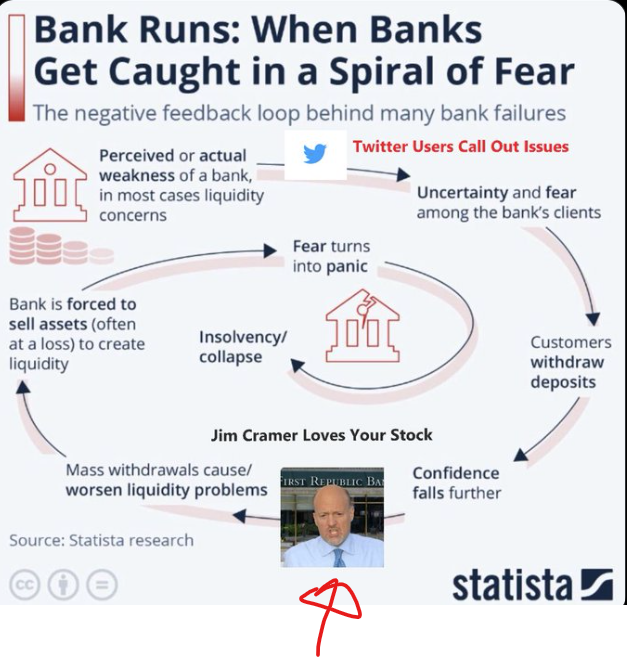
This is that contagion that is a bank run - fear. There might be nothing fundamentally wrong with First Republic as a bank. But no bank can withstand a run, where a significant portion of their depositors want their cash all at once.
If First Republic goes down, will there be another Federal back-stop, insuring un-insured deposits? Of course there will - just look at who the affected clients are: UHNW individuals - mostly coastal elites - that give mightily to the Democrats. You certainly don’t think the Biden administration would abandon them just days after his re-election bid kicked off, do you?
I first read this as “Shares of Free Republic sink...”
Was wondering “hunh?” then realized it was another bank solvency issue.
ONLY FOR HIGH ROLLERS, I WAS TOLD.
Disclaimer: Opinions posted on Free Republic are those of the individual posters and do not necessarily represent the opinion of Free Republic or its management. All materials posted herein are protected by copyright law and the exemption for fair use of copyrighted works.