Posted on 11/04/2022 1:27:39 PM PDT by FarCenter
...
While there are, of course, some anomalies, the layoff strategies that Big Tech has taken to date seem to careen between two extremes: cringe-worthy or Disney-villian-level. Many have resisted even using the term layoffs to avoid sending a signal to investors that their business is in trouble — a reality that anyone would be able to see simply by taking a quick glance at the stock market.
But the industry has always been ruthless when it comes to firing. While it’s easy to forget given the growth of the tech sector over the past two decades, the dot-com boom left tens of thousands without jobs. Even today’s stalwarts like Microsoft had to let thousands of workers go at certain points under the guise of business continuity. And it’s not uncommon for a company to fire workers soon before or right after big fundraising rounds or record sales quarters.
...
The last several months should be a lesson to tech workers to not believe the hype peddled by so-called luminaries who have somehow convinced themselves they’re making the world a better place by pushing largely unnecessary technology on customers and consumers alike.
It’s easy to be swayed when companies, particularly private startups, dangle lucrative compensation packages — chock full of stock options and topped off with a fancy new title — that promise to make employees rich if they stick around long enough.
It’s the Silicon Valley fairy tale. But it’s a fantasy that can be very easily shattered. Look at Stripe. To CEO Patrick Collison’s credit, his recent note announcing layoffs at the payment processing platform was much more considerate than Musk’s inbox Russian roulette. But that doesn’t change the fact that, for years, despite ample pressure, Collison resisted an IPO. Now with the public markets likely closed through 2023 due to economic uncertainty, it’s the employees who were eagerly awaiting their paydays — not Collison, with an $8 billion net worth — who are bound to suffer.
Part of the challenge is that most tech workers, especially younger ones, have only known boom times. Even during the economic recession in the late 2000s, the sector remained largely resilient and used the time to invest heavily in growth.
That’s not true now, as the sugar rush that propelled the growth of so many Silicon Valley startups and behemoths suddenly evaporates, leaving behind bloated businesses that have significantly higher head count than existing sales can support. And instead of growth at all costs, investors are in their “show me the money” phase, forcing companies to take drastic measures like layoffs in a bid to finally post profits after, in some cases, over a decade of operations.
My associates and I lived through a half dozen major layoffs over the decades.
I never heard anyone who was RIFfed complain they were being dealt dirty. We figured if we were laid off either we weren’t performing satisfactorily or were no longer necessary to operations.
The primary purpose of a corporation is to make money.
Twitter was created to make money.
If you are not making money you need to cut expenses. One of the highest expenses is payroll.
Everything else that is secondary flows out of profit.
Usually the latter in cutting expenses. Unfortunately, sometimes some good people get cut but that is the risk a company takes with RIFs.
Given the liabilities that companies can face when firing employees, especially those with access to company software, trade secrets, and other business-sensitive information, and those who may go “postal” after being fired, layoffs need to be done quickly and efficiently, and with appropriate company security present.
A little of both. Usually each department was given a number of positions to eliminate as part of corporate cost cutting goals, and line managers would decide which ‘dead wood’ they could afford to be rid of.
Although I have no doubt occasionally good people were let go.
Lesson: Always keep your resume up to date!
Ahhh
Enron.
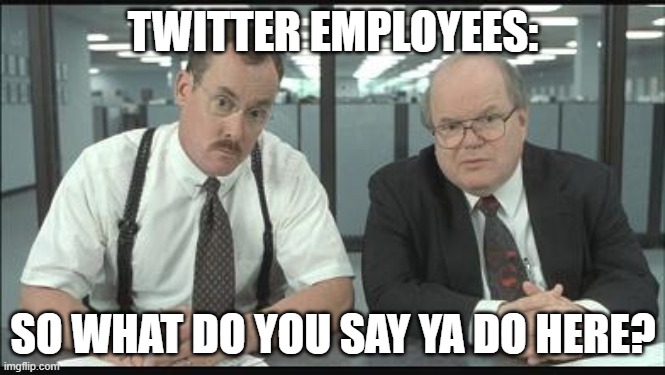
One of the funniest movies ever because it gets so much right!
Yes it did. Because Mike Judge spent several years in high tech in Silicon Valley in the 80s.
That’s because Big Tech doesn’t exist to make money for shareholders.
It exists to serve Deep State.
Watch the movie, Up In The Air, George Clooney plays a guy that is hired to fire people from companies. It is sometimes funny and brutal at the same time.
Let’s see. My experiences:
* “We can’t fire the development team in the UK because of labor laws, so we’re going to fire the US team, and give the UK team all your projects.”
* “Bally Gaming has bought the company, but only wanted the code and the patents, so good luck!”
* “Christmas of 2008 wasn’t as good as we’d hoped, and the company is doing a big layoff to appease Wall St.”
* “Your project has been canceled, you’ll be moved to a different group. (later) This project has been canceled, and the whole group is being laid off.”
That’s 20 years in hi-tech for you.
No, Grasshopper, not every solution needs an app.
...a guy that is hired to fire people from companies.Can you say "Mitt Romney"?
I’ve seen good people/co-workers get let go, some decisions so outlandishly stupid it makes me wonder still, years later why this person vs. that person.
A lot of times if you are good at your job and your manager isn’t, they see you as a threat and get rid of you because they can’t deal with being wrong all the damned time.
I got clipped in a RIF that was the last of 4 RIFs over a one year period (a total of about 10K people). I was one of two people who worked in the group I was in, had less seniority, and had recently got in an argument with another employee who was being a real douche to me. Long story short: my co-worker called me a few days after and spilled his guts to me that he did not realize how much I did. His statement was that he was nearly breaking down and crying on his way home each night from the stress of the extra workload.
There’s a million reasons good people or good solid workers get clipped.
The RIF above that I got clipped in was a few short days before the events of 9/11. It took me about 8 months to find gainful employment that wouldn’t cost me more to take on than I would net (less than half what I was making previously, and less than unemployment was paying me), plus major commute distances.
Disclaimer: Opinions posted on Free Republic are those of the individual posters and do not necessarily represent the opinion of Free Republic or its management. All materials posted herein are protected by copyright law and the exemption for fair use of copyrighted works.