Posted on 10/19/2022 8:35:51 AM PDT by UMCRevMom@aol.com
Biden is increasing the tax burden on trade workers to pay for other people’s nonsense degrees, and Milton Friedman wouldn’t stand for it. Author Kyle Reynolds profile Kyle Reynolds More Articles Share
Share Article on Facebook Share Article on Twitter
Share Article via Email
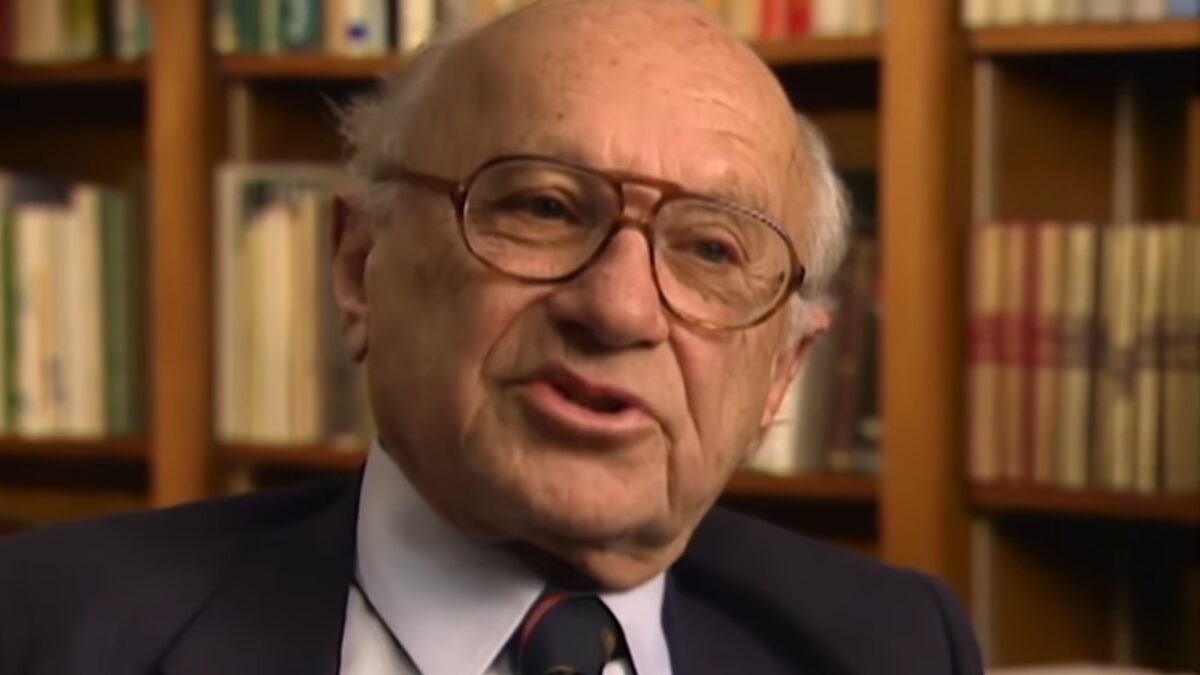
The application for President Biden’s student loan forgiveness plan recently became available to the public, reopening debate on the federal government’s role in the matter. The economist Milton Friedman offered a particularly innovative, yet politically infeasible, solution to the conundrum in his 1962 classic, “Capitalism and Freedom.”
Friedman advised the adoption of income share agreements. In such agreements, a borrower would take out loans from an institution, typically the federal government, that is willing to invest in his or her education. The borrower “in return would agree to pay to the government in each future year a specified percentage of his earnings in excess of a specified sum for each $1,000 that he received from the government.”
This presents a rather elegant solution to the longstanding concern. As Friedman noted, such an arrangement would ensure that the individuals who received the education “would in effect bear the whole cost. The amount invested could then be determined by individual choice.”
The efficacy and efficiency of this proposal stand in stark contrast to the recent incompetent and ineffective actions of the Biden administration’s proposal to forgive $10,000 to $20,000 of student loan debt per borrower. While the discussion of such a plan would not have been prevalent in the ’60s, we can extrapolate, with significant ease, Friedman’s views on the subject using his treatment of direct subsidization of professional education in his book as a guide.
Indeed, what is the forgiveness of student loans but the subsidization of those individuals’ education by the federal government? In Friedman’s words, such subsidization results in “an entirely arbitrary and almost surely perverse redistribution of income.” To use a contemporary political talking point to illustrate the concept: The government is increasing the tax burden on plumbers, electricians, and other trade workers to pay for other people’s gender studies, fine arts, or similarly less-than-lucrative degrees.
The economic ills resulting from such a policy are numerous and severe. The first consequence is a surplus in college-bound students, the causes of which are not difficult to surmise. Friedman rightly asserted that “[i]nvestment should be carried to the point at which the extra return repays the investment and yields the market rate of interest on it.” It is surely only common sense that you should not pursue an investment if it does not yield sufficient returns. However, “[i]f the investment is in a human being, the extra return takes the form of a higher payment for the individual’s services than he could otherwise command.”
So, Friedman argued, “[i]f the investment were subsidized, [the student] would have borne none of the costs. In consequence, if subsidies were given to all who wished to get the [education] … there would tend to be over-investment in human beings since individuals would have an incentive to get the [education] so long as it yielded any extra return over private cost.”
In following this logic, it may even be argued that the current educational subsidies and aid offered to the public produce a surplus of college-bound students. And this surplus, in turn, likely has contributed to the shortage of trade workers and skilled laborers.
If we wish to have the most efficient ordering of our limited economic resources and produce the ideal number of college-educated and non-college-educated citizens alike, then, as Friedman postulated, “[i]ndividuals should bear the costs of investment in themselves and receive the reward.” He argued that “the free choice of individuals” tends to “produce the optimum amount of investment.”
The second ill arising from so-called student debt forgiveness and subsidization is closely related to the rationale for individual choice. It is a person’s very choice that best distributes investment, not a third party’s centralized planning. So when the government mandates a “redistribution of income” through overinvestment in higher education, it constricts the capital available for more efficient private investment.
Such a “perverse” transfer of wealth also leads to an erosion of property rights. This erosion subsequently limits the attractiveness of certain investments, which, combined with the symptoms explored above, severely limits the amount of private economic investment compared to what the market alone would tolerate.
These factors, in tandem, invariably produce worse economic outcomes and decreased financial opportunities.
I worked and went to vo-tech school. Any college loser who tells me he got his student loan forgiven will get a punch in the nose from me.
Forbes.com
Canceling federal student loans will cost the federal government hundreds of billions of dollars— and the general public will eventually end up footing the bill.
According to an official estimate from the Congressional Budget Office, Biden’s student loan cancellation plan will cost $400 billion. However, the office notes that the estimate is “highly uncertain” based on the unknown of how many people would’ve repaid their debt had Biden not taken executive action and how much they still will repay.
Biden previously stated at a press conference that “there is plenty of deficit reduction to pay for the programs.”
But what exactly does “cost the government” mean? Canceled federal student loans would be immediately added to the federal deficit, which measures how much the U.S. spends minus how much it takes in.
Analysts agree that canceling federal student loans would increase the deficit. But what they’re split on is how significant that addition would be, and how the government could eventually recoup the costs.
Snip
Milton Friedman erred. There are more important things to life than economic efficiencies. The creation of the menace of China was born out of economic efficiency. People need a moral order to thrive in all other areas. Without it we got nothing. We can accomplish nothing that is any good.
The creation of the menace of China was born out of economic efficiencyThank you, Richard Nixon.
So it student loan debt ‘forgiveness’ an actual thing?
Are people getting their debts reduced?
I put off paying off my 2 daughters because I knew the duma$$es were going to do this.
I am totally against it, but if it happens I am not going to turn it down.
I worked my way through college so that I could take a smaller loan. Then when I completed my degree, I faithfully paid back my loan every month until I had it completely paid off.
These people who want loan forgiveness make me angry. Don’t take out a loan from anyone thinking that you shouldn’t have to pay it back. That’s stealing.
At age 53 I moved to FL and while standing in line to take the bar exam, surrounded by 25-26 year-old's who had just completed law school, I felt a bit intimidated by the idea that they had just 2 months earlier finished school, and some topics were fresher in their experience than I was in mine. Then, before the doors opened, the topic turned to student loan debt - and it quickly became a game of can-you-top-this? Starting at $50K it quickly surpassed $150K and I think the highest I heard was $180K just as the doors to the center opened. I remember thinking that I may have more years out of law school, but I had no debts as I stood there, and a lot of the candidates had the equivalent of a home mortgage on a modest home, with no physical collateral. The stress induced by that had to be a huge handicap. Well, not anymore if this initial effort by Biden mushrooms.
Biden: Me and my rat pack aren’t looking so good in the polls, so screw fiscal responsibility, we need to buy votes.
5.56mm
It’s an actual thing unless it gets stopped by the courts. Borrowers get between $10-20K adjustments depending on their income and whether they also got a Pell Grant at some point in the past.
One of Milton’s worst ideas.
I lived like a hobo going to college, U of Idaho, to prevent debt. My stuff fit in a backpack. I resent paying loans for what I call the “Starbucks” students.
The year after the Guaranteed Student Loan program went into effect my tuition double and continued to double every year after that.
The government was the one who made this mess in the first place!
As should those who took out loans and then paid them back, who went straight to work after high school, or who are simply paying for this with their taxes.
Remember the collective Nadlering of democrat pants when they said Trump “illegally” diverted pentagon money to build a border wall??? What did that end up costing compared to bailing out slackers in debt?
Nauseating.
Disclaimer: Opinions posted on Free Republic are those of the individual posters and do not necessarily represent the opinion of Free Republic or its management. All materials posted herein are protected by copyright law and the exemption for fair use of copyrighted works.