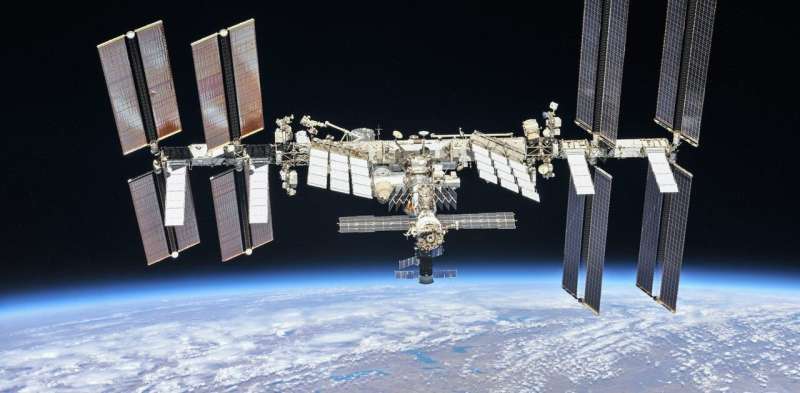
Could Russia crash the ISS?
Posted on 03/10/2022 9:26:09 AM PST by LibWhacker
Could Russia crash the ISS?
Nearly three decades of close collaboration in space between Russia and the western world seems to be coming to an end. With increasing tensions over Vladimir Putin's invasion of Ukraine, Russia has arguably threatened to crash the International Space Station and refuse to launch satellites for western countries. A few months ago, Russia blew up one of its own defunct satellites, creating space junk that threatened the safety of astronauts at the ISS.
So how is the war likely to impact on operations in space going forward, and what are the consequences?
Aggression in space could directly affect boots on the grounds. Imagery from space has become a regular feature in coverage of the invasion of Ukraine, showing long columns of armor moving inexorably towards Kyiv or Kharkiv.
While chilling in its content, it has offered a boost to the embattled Ukrainian resistance by helping it work out where the enemy is, where it is coming from and how it is configured. It is also a demonstration to the world of the level of force used by Russia, laid bare for all to see.
Satellite imagery used to be the preserve of advanced militaries and very few countries. Today, however, commercial companies are increasingly capturing such imagery, and their combined capability may surpass that of the Russian military. The advantage of this is that these companies can provide quasi-military support, potentially avoiding the tripwire of military involvement in Ukraine by western nations.
There are some who warn of a decline in US space power, particularly in the face of a highly ambitious Chinese space agenda and provocative Russian maneuvers in space. But any estimation of space power must include the commercial sector, in which western companies, and American firms in particular, have a vast lead.
SpaceX provides not only satellite imagery, but also communications. Its founder, Elon Musk, has come to the aid of Ukraine by providing it with terminals that allow access to the Starlink system, a megaconstellation of satellites that offers high-speed internet access. If Russia cuts off internet services and other forms of communication in Ukraine, Starlink could provide connectivity, giving Ukrainians secure to information and networking.
This is not wholly without risk, however. Musk has recently cautioned Ukrainian users that the Starlink terminals—effectively two-way satellite dishes—may allow them to be identified.
There have also been reports of Russia jamming the GPS signal from satellites in space to Ukraine. And it has been reported that Russia fully expects their own GLONASS satellite positioning system to be jammed as well.
If that happens, it will use an older, terrestrial system called Chayka, based on an older radio technology. While not as accurate as a satellite system, it should nevertheless be good enough for many of their purposes.
Direct dangers?
The conflict has also unfolded in other, unexpected ways in the space domain. In a series of tweets, the director general of Russia's space agency Roscosmos, Dmitry Rogozin, warned that ending cooperation over the ISS could lead to it falling out of orbit, possibly onto the United States or Europe (or China or India)—which has been interpreted as a threat.
He noted that Russias' Progress cargo ships which provides the thrust to correct the orbit of the ISS. Without them, the space station would fall into the Earth's atmosphere where most of it would burn up, yet some bits could survive and may hit people or buildings on Earth.
While this is extremely unlikely, not least due to the fact that there are Russian cosmonauts aboard currently, it was an alarming statement. In response, Musk said that his company would assist if Russia withdrew its support in a way that endangered the space station.
SpaceX's Dragon capsule is currently the only other spacecraft capable of docking with and supplying the ISS, and so could also provide the thrust if needed. Either way, it signals a much less cooperative future in space, with the ISS being decommissioned soon and Russia and China refusing to join the US-led Artemis program aiming to launch people to the Moon.
Russia has also halted its sales of rocket engines to the US (though the US had banned the import of these some years ago) and is refusing to launch a batch of 36 OneWeb satellites, which are designed to provide satellite internet broadband services worldwide, unless the UK government divests itself of its share of the OneWeb program, guaranteeing that they will not be used for military purposes. The UK has so far refused to negotiate. OneWeb already has 428 of its planned 648 strong constellation in orbit, and may start looking elsewhere for launch support in the future, as will many other companies.
Many countries also still rely on Russia and its Soyuz rockets for a number of launches for various applications, creating a difficult problem. But SpaceX and other companies, and indeed other countries, are increasingly able to plug the gap, so this is likely to be temporary.
If competition continues, it is not inconceivable that it could lead to conflict. While the use of kinetic weapons, which destroy satellites by running into them at high speeds and which Russia tested recently, seems unthinkable, we cannot be sure what Putin will do next.
The use of such weapons could create increased space junk which could destroy satellites and other probes in space, or even rain down on Earth. So it's important that the hostile threats in the space domain are not be allowed to escalate into anything further.
While Russia has a great deal of expertise in the space domain, its power there faces clear limits. Empty threats and tarnishing its reliability as a launch provider will only undermine its future prospects.
But more importantly, western commercial space assets have provided an important element of support for the besieged Ukrainians. This will enable important data and imagery to flow to where it is needed, to military units, decision-makers and to the population more broadly. Given the number and variety of satellites flying overhead, Russia will find it very difficult to respond.
Middle of the pack? Nah. Next to last?
Flinging everything at the wall hoping something sticks well enough to distract from US politicians getting their hands caught in the Ukrainian cookie jar. I am fast running out of popcorn.
Communications satellites become a big deal in the event of nuclear war—where communications become critical.
They are much easier to destroy than defend—which gives a big advantage to whoever strikes first.
This is a destabilizing (and rarely discussed) situation.
In other good news, threads about this war have gone from over a dozen on the first page to about 4 lately.
Next to last. If this thing drifted off into outer space tommorow, would anyobe really care other than Mrs. Jones 3rd grade class, wondering what happened to their space seed growing experiment?
I wonder if any SpaceForce guys hang out on FR?
I'm a big fan of space, but the war itself has to come first. We can always rebuild what we lose in space later.
Oh, wait... Biden's president. We won't even have cars when he's done with us!
“in the event of nuclear war—where communications become critical”
In the event of a nuclear war I think global communications will be the least of everyones’ worries.
Military communications is the key issue—if the military satellites are taken out, we are talking serious fog of war stuff.
World War IV will provide a nice distraction from all of their manufactured crises.
And help bring on The Great Reset and the New World Order.
“Next to last. If this thing drifted off into outer space tommorow, would anyobe really care other than Mrs. Jones 3rd grade class, wondering what happened to their space seed growing experiment?”
That was a rather ignorant comment since society relies on thousands of spacecraft for all kinds of services.
An ignorant comment is one where the dolt is talking about “thousands of spacecraft” when they are not being discussed.
P.S. The rules are you are supposed to not read the article before posting, not, not read the post you are responding to.
The ISS is in a low earth orbit and depends on the Russian vehicle to maintain it. With Russia threatening to pull out Musk is ready to take over. All aspects of space is being neutralized regarding Russian dependency. Musk has foreseen this and will fulfill this need.
Putin just kill his Russian space program. It is dependent on foreign investors. This will all go up in smoke.
Right, we were insane to let ourselves get into the position of depending on the Russians. Good old American capitalism and ingenuity comes to the rescue.
Obviously you did not read the article as it did discuss satellite. Either that, or your reading comprehension is that of a 2nd grader.
You said “THOUSANDS OF SPACECRAFT”. I was not referencing THOUSANDS OF SPACECRAFT. If you can’t even understand when you see the word “thing” it means ONE, SINGULAR, then you really need to shut the hell up and not lecture anyone about reading comprehension.
“If this thing drifted off”
Disclaimer: Opinions posted on Free Republic are those of the individual posters and do not necessarily represent the opinion of Free Republic or its management. All materials posted herein are protected by copyright law and the exemption for fair use of copyrighted works.