Source: P Photo/Charles Krupa
Posted on 03/14/2021 4:56:04 AM PDT by Kaslin
Source: P Photo/Charles Krupa
Americans like to believe our resources are as unlimited as the possibilities for our future.
That may be true. Ideas like “peak oil” – which seemed on the verge of winning acceptance just a decade ago – have petered out as science and engineering have pointed the way to discoveries of energy deposits so rich the nation has become a net energy exporter.
More than that though, America has made tremendous gains by learning to use the resources we already produce more efficiently. These gains are a winner for everyone, producers and consumers alike.
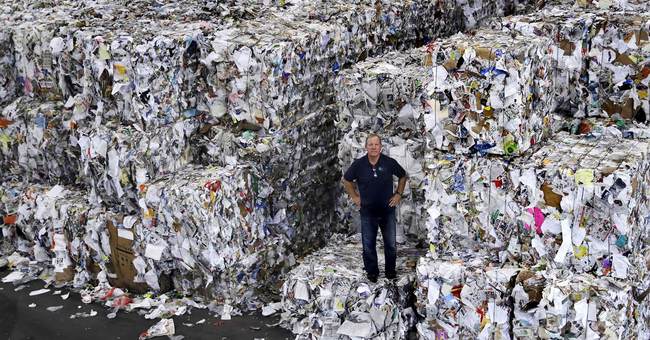
This is certainly true where recycling is concerned. Technology has progressed to a point where certain items such as plastics can be used again and again and again. The technology exists – and it's affordable. Unfortunately, in many cases it is still cheaper to use virgin materials to make new products than it is to use recycled materials, industry has not made the necessary transition.
When considering the costs, one not only has to consider how much is involved in producing something but also the expense of disposal. That is not an industry concern so much as it is a problem of the commons, that area in which no one person or group is specifically responsible because everyone is generally responsible.
Putting plastics in the ground forever after they’ve been used a single time is wasteful and inefficient. Recycling laws are supposed to cut down on that waste but, because companies – many of whom talk the talk but don’t walk the walk when it comes to being environmentally friendly – aren’t making the conversation to recycled materials in their production stream because of fluctuations in the price and inconsistency in the supply.
There is a solution. The introduction of minimum recycled content (MRC) standards is the kind of light-touch regulation that’s environmentally friendly and will create jobs as new industry develops without imposing confiscatory costs on consumers or producers.
Simply put, adding an MRC requirement ensures the demand for recyclable materials remains economically viable by maintaining a balance with our abundant supply and demand of recyclables – at a manageable cost while building resilience in recycling end markets.
In a March 2019 Gallup Poll, 65 percent of respondents said they agreed with the statement “protection of the environment should be given priority” over other concerns including cost. America is waking up to the need to do things differently. And no wonder. After rising for decades, U.S. recycling rates have plateaued, the U.S. Environmental Protection Agency says, because Americans are creating more trash. In 1990, the total generation of municipal solid waste was 208.3 million tons. By 2018, that amount had risen to 292.4 million tons, 23.7 million tons higher than the year before. This requires action.
To increase the demand for recycled materials in the manufacturing supply chain, California has already enacted legislation requiring minimum recycled content for plastic beverage containers. New Jersey is considering similar legislation with MRC standards for plastic beverage and rigid plastic containers.
The MRC approach is a step toward circularity, a concept many people believe is part of the economy of the future in developed parts of the world. In a circular economy, waste materials become inputs rather than outputs that government and industry can embrace as a revenue source while protecting the environment. Additionally, the adoption of recycled materials as a stable source of predictable revenue may give city and county governments the ability to avoid economically and socially damaging tax increases that send residents and businesses away.
The Manhattan Institute, a New York-based think tank that deals with urban issues from a free-market perspective, argues that rethinking municipal recycling will help local governments save money. Now, through the MRC approach, they can be transformed into an effort in which price signals assure taxpayer-diverted recyclables are beneficially reused again and again is the right step forward.
According to the Harris Poll, four in five Americans (80 percent) agree governments at all levels should prioritize the use of recyclable products/materials when making purchasing decisions. Recycling is demand-driven; thus, increasing the use of recycled content in manufacturing is critical to the success of recycling programs.
Recycling and composting also help reduce carbon footprints. Utilizing nearly 94 million tons of compostable materials in 2019 meant the equivalent of 42 million cars taken off the road. On average, recycling one ton of materials saves three tons of carbon emissions. The MRC approach saves energy and reduces greenhouse gas emissions as manufacturers and packaging producers will have to use recycled materials to make new products.
The wife and I recycle and compost. Less than one small bag of trash per week. I don’t even pay for trash pick up, which is the reason I’m so into it. Next time you take a flight, look down. No, there’s no more room for dumps.
Wealth, real wealth, and not just a stash of precious things in a vault somewhere, comes from the development of ever more efficient ways of converting apparently useless or only marginally useful things into something else of much greater value. The greatest currency of all is energy, and it is spent in converting the forms of a number of substances into things of greater value.
Of course, along the way, a lot of junk is produced as well, but in an energy-efficient world, these pieces of “junk” are converted to higher and better use.
The widespread availability of energy in some form is also the widespread distribution of wealth, and in the magic of the principle of capitalism, permitting the person who achieves a high ratio of conversion of energy to useful products and service to enjoy the fruits of ingenuity and labor, has spread this wealth to untold millions of fellow citizens.
“ No, there’s no more room for dumps.”
Realy? Every acre of land in the US is currently being used for other productive purposes? And you can see that from 30,000 feet?
Please tell me that was sarcasm.
Definitely sarcasm. But you had ask because, like me, you’ve had people try to peddle that BS to you before too.
Indeed.
Sarcasm wouldn’t work were it not for the absurdity our society and many of it people.
Good job there.
Great post. And the greatest source of lies, damn lies, and statistics is politics. People think politics is a war of ideas, but really it's a war of interests. Like all wars, the first casualty is the truth. Politics makes for a terrible hobby.
The extreme energy efficiency of a free market should decide what is worth recycling.
Less than one small bag of trash per week. I don’t even pay for trash pick up
........................................................
What do you do with that one bag?
Disclaimer: Opinions posted on Free Republic are those of the individual posters and do not necessarily represent the opinion of Free Republic or its management. All materials posted herein are protected by copyright law and the exemption for fair use of copyrighted works.